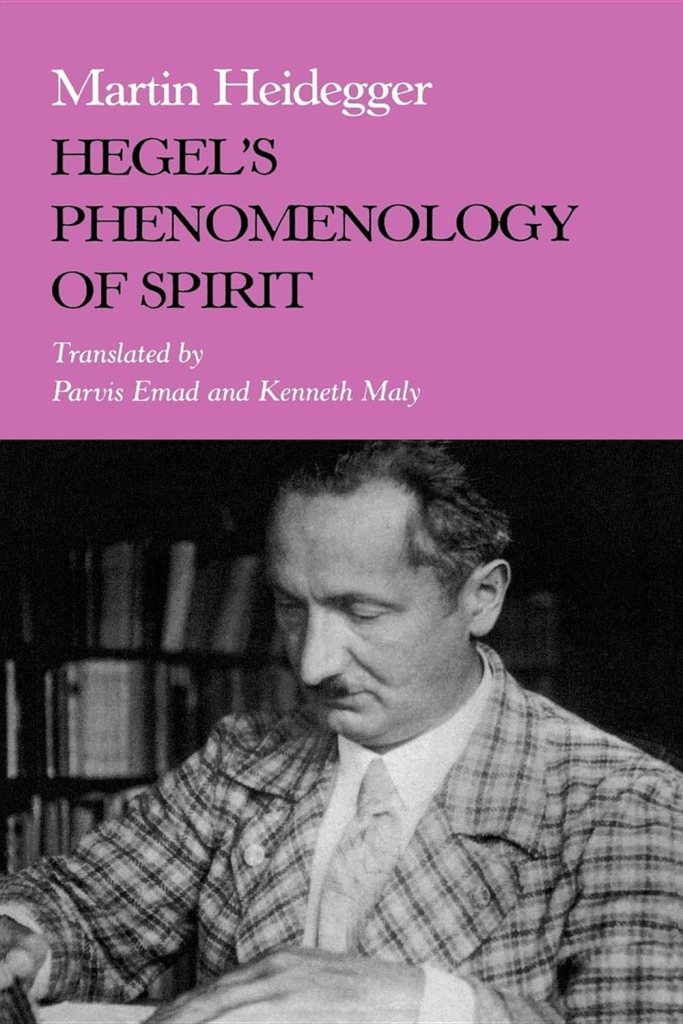
In Martin Heidegger’s 1930-1931 lecture course on Hegel’s Phenomenology of Spirit, we encounter not merely a reading of Hegel, but an intense and fundamental engagement with the very movement of thinking that animates Hegel’s dialectic. Heidegger, whose own philosophical project aimed to dismantle and reconstruct the history of ontology through the lens of temporality, delivers a radical interpretation that situates Hegel’s work within the essential problematic of Being and Time, the ontological difference, and the unfolding of spirit’s experience of itself. The lecture course illuminates Hegel’s phenomenology not as a static doctrine but as an ever-dynamic movement of spirit’s self-revelation.
Heidegger bypasses Hegel’s preface and introduction, focusing instead on the sections of “Consciousness” and “Self-Consciousness.” This choice is pivotal, for it is within these sections that Hegel grapples with the structures of knowledge as they rise through various shapes, each dissolving and transforming through a dialectical process. In Heidegger’s reading, these sections are not isolated analyses but manifestations of spirit’s self-movement—a movement that embodies the historical destiny of Western metaphysics.
Central to Heidegger’s interpretation is the concept of temporality. For Heidegger, the phenomenological method, as developed by Hegel, is deeply enmeshed with the unfolding of time. The very dialectical structure of Hegel’s Phenomenology manifests the temporal horizon through which consciousness comes to grasp itself as spirit. Heidegger identifies in Hegel’s dialectic a primordial movement where each stage of consciousness’s experience is a mode of becoming, an act of appearing and disappearing, a negation and a retrieval. This temporality is not an external process but intrinsic to the very nature of thinking itself. Spirit, as it rises through its experiences, is bound to time, and yet, in its ultimate realization, aims to transcend it. Heidegger thus finds in Hegel a profound but unfulfilled insight into the temporality of being.
Heidegger’s lecture course underscores ontological difference—the distinction between beings (entities) and Being (the ground or essence of entities). In Hegel’s system, consciousness, as it ascends through the shapes of sense-certainty, perception, and understanding, confronts the limits of finite knowing. The objectivity of the known is constantly subverted by the subjectivity of knowing, until consciousness discovers its own inherent activity in the object. Heidegger discerns in this movement the foundational problem of Western metaphysics: the conflation of Being with beings. Hegel’s dialectic ultimately aims to resolve this conflation by demonstrating that consciousness, in knowing itself, knows the totality of Being. Yet for Heidegger, Hegel’s resolution still binds Being to the conceptual structure of representation, thereby covering over the fundamental mystery of Being as such.
This Heideggerian critique does not diminish the profundity of Hegel’s achievement; rather, it situates Hegel’s Phenomenology as a necessary but ultimately incomplete step in the history of ontology. The dialectic, for Heidegger, is not merely a logical method but a historical process in which Being reveals itself through the self-transcending movement of spirit. Each stage of the dialectic—whether it be the immediacy of sense-certainty, the mediation of perception, or the synthesis of understanding—represents an epoch in the history of Being. The dialectical negations are, in Heidegger’s view, attempts by Being to overcome its concealment, to bring itself into unconcealment (truth). Thus, the Phenomenology is not just a book; it is the very event of Being’s historical self-revelation.
Furthermore, Heidegger explores the significance of being and time in Hegel’s thought. Hegel’s goal of achieving absolute knowledge—where subject and object are fully reconciled—is, for Heidegger, an expression of spirit’s drive to overcome the finitude of temporal existence. Absolute knowledge, in Hegel’s system, represents the culmination of history, the point where the self-consciousness of spirit abolishes time by comprehending all temporal moments as moments of itself. However, Heidegger contends that this obliteration of time undermines the authentic temporality of existence. Being, for Heidegger, cannot be subsumed within the timeless conceptual totality of absolute spirit; it must be approached through a more originary grasp of time as the horizon of all understanding.
The work-character of Hegel’s Phenomenology is another crucial theme in Heidegger’s interpretation. For Heidegger, a philosophical work is not simply a product of an author’s intellectual labor; it is an ergon, a living work of thinking that must be experienced and enacted by each reader. The Phenomenology is thus a “work of thinking” in which the reader participates in the movement of spirit’s self-unfolding. Heidegger emphasizes that this participation is not a passive reception but an active engagement, where the reader is drawn into the dialectical movement and must undergo the same experiences that consciousness undergoes. The Phenomenology is not merely about spirit; it is spirit in action.
In light of these themes, Heidegger’s lecture course on Hegel’s Phenomenology of Spirit becomes an essential moment in Heidegger’s own project of “dismantling the history of ontology.” By reinterpreting Hegel, Heidegger seeks to recover the question of Being that has been obscured by metaphysical systems. Hegel’s dialectic, while a profound exploration of spirit’s self-revelation, ultimately falls short of confronting the abyssal nature of Being itself. Heidegger’s encounter with Hegel is thus both a critique and a homage—a recognition of Hegel’s unparalleled insight into the movement of thought and a call to go beyond Hegel toward a more primordial questioning of Being.
This lecture course invites readers to reconsider not only Hegel’s philosophy but the entire trajectory of Western thought. In Heidegger’s hands, the Phenomenology of Spirit reveals itself as a necessary preparation for the more radical task of thinking that Heidegger himself undertakes. This analysis focusing on the exchanges of temporality, dialectic, and ontological difference in Hegel’s work open the path to a renewed engagement with the fundamental questions of existence. Heidegger’s reading, is therefore an existential challenge, a call to participate in the ongoing movement of spirit, to confront the finitude of time, and to open ourselves to the mystery of Being.
In Hegel’s Phenomenology of Spirit by Martin Heidegger, we find a dialogue that transcends the boundaries of interpretation, where the voices of two of the greatest philosophers collide, illuminating the depths of spirit’s experience and the horizon of Being. This lecture course, dense with thought and rich with existential urgency, stands as a testament to the unending task of philosophy: to think, to question, and to engage with the truth of Being as it reveals itself through time.
 Simon Gros
Leave a comment