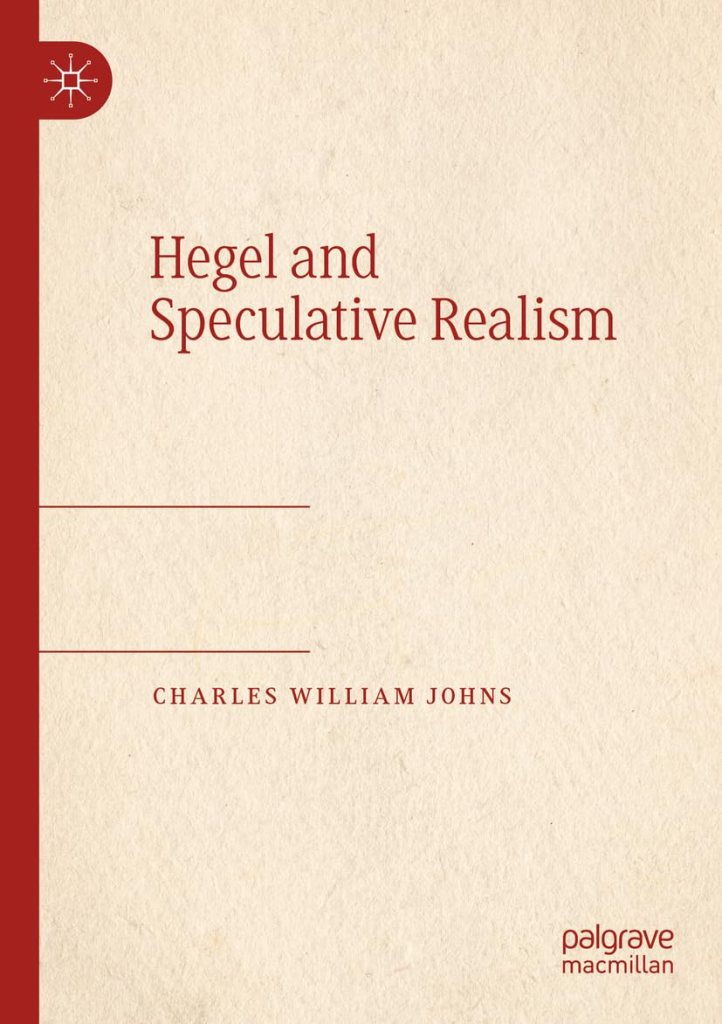
In Hegel and Speculative Realism, Charles William Johns undertakes an ambitious philosophical endeavor that traverses the vast conceptual landscapes of speculative realism and Hegelian philosophy, probing the limits of metaphysical thought in contemporary discourse. The book pursues two central objectives: first, to interrogate speculative realism’s conceptualizations of the “real”—a reality withdrawn, contingent, and infused with radical extinction—in juxtaposition with Hegel’s absolute idealism. Second, Johns challenges the reader to reconsider Hegel’s dialectical system as a dynamic framework capable of encompassing not only the necessities of logical progression but also the contingent potentialities of existence.
Speculative realism, emerging from the philosophical crucible of the 2007 Goldsmiths conference, represents a rupture with correlationist paradigms that limit reality to what can be conceived within the confines of human thought. Johns critically examines the four principal thinkers of this movement—Quentin Meillassoux, Graham Harman, Ray Brassier, and Iain Hamilton Grant—each of whom articulates a distinctive vision of a reality that transcends anthropocentric constraints. Whether it is Meillassoux’s “hyper-chaos,” Harman’s “withdrawn objects,” Brassier’s “nihilistic extinction,” or Grant’s “dynamism of nature,” these speculative realists seek to articulate modes of being that exist outside the confines of human cognition. Yet, Johns provocatively asks: Does Hegel’s philosophy, with its relentless commitment to the Absolute, offer a parallel or even complementary pathway to understanding these same speculative insights?
Johns begins by exploring speculative realism’s core concepts. The notion of the “withdrawn object” in Harman’s object-oriented ontology suggests an essence of things that can never be fully accessed through relationality or human experience. For Johns, this resonates with Hegel’s notion of the “in-itself” as that which exists beyond immediate perception. Similarly, Meillassoux’s “absolute contingency” destabilizes the principle of sufficient reason, asserting that everything that exists could just as easily not exist. Here, Johns finds echoes of Hegel’s dialectic, which incorporates contingency as an essential moment in the unfolding of the Absolute. By situating these speculative theses alongside Hegel’s logic, Johns demonstrates that Hegel’s system is not a closed, deterministic totality but a dynamic, self-revising process open to the unanticipated.
In perhaps his boldest move, Johns reinterprets Hegel’s dialectical relationship between Nature and Idea as a theory of “singularity,” suggesting that Hegelian thought does not preclude the existence of multiple paths of becoming. The dialectic, with its synthesis, sublation, and unfolding, is for Johns a historically contingent trajectory—one that may not be the sole route to the Absolute. In this reading, speculative philosophy must be open to exploring not only “what exists” but “what could exist,” as well as what it means to “inexist”—a concept that challenges traditional ontologies by embracing potentialities that lie outside actuality. This view reframes Hegel’s triad of Being, Non-Being, and Becoming as a matrix of infinite virtualities and possibilities, each a speculative node within a larger metaphysical web.
Johns also uncovers Hegel’s neglected engagements with astronomy, actuality, and non-being, arguing that Hegel’s thought is far more expansive than its conventional interpretations allow. Hegel’s musings on the celestial, the concrete, and the limits of presence reveal a thinker deeply attuned to the speculative dimensions of reality. In Johns’s hands, Hegel’s speculative idealism is reinvigorated as a philosophy that does not merely map the necessary contours of thought but ventures into the speculative voids of the possible and the non-existent.
The book’s analysis extends to the political and ethical implications of these metaphysical inquiries. If speculative realism reveals a world in which human thought is decentered, what are the consequences for our understanding of agency, freedom, and responsibility? Johns suggests that Hegel’s concept of Geist (Spirit) offers a means of reconciling the speculative with the ethical. Spirit, for Hegel, is not merely the self-realization of human rationality but a cosmic process in which thought and being mutually constitute one another. This vision of Spirit as both logical and spatio-temporal opens up new avenues for thinking about collective action, historical progress, and the limits of human knowledge in a universe indifferent to our presence.
In a particularly innovative section, Johns explores the intersections between speculative realism and contemporary science, particularly cosmology and astronomy. The vast, unfathomable scales of the cosmos, with its black holes, dark matter, and quantum uncertainties, mirror the speculative realists’ insistence on the withdrawal and contingency of the real. Yet Hegel’s dialectic, Johns argues, provides a philosophical apparatus for integrating these scientific discoveries into a coherent, albeit open-ended, metaphysical framework. The universe, in its speculative vastness, becomes a stage for the dialectical play of being and nothingness, actuality and potentiality, finitude and infinity.
Johns offers a synthesis that is itself dialectical: speculative realism and Hegelian philosophy, far from being antagonistic, are two expressions of a deeper speculative impulse—an impulse to think beyond the confines of what is immediately given, to risk thought in the pursuit of the unknown. In this way, Hegel and Speculative Realism is not just a comparative study but a philosophical intervention, inviting readers to engage with the most pressing metaphysical questions of our time. Johns’s erudition, precision, and speculative daring make this book an essential contribution to contemporary philosophy, offering a vision of thought that is as expansive as the reality it seeks to comprehend.
 Simon Gros
Leave a comment