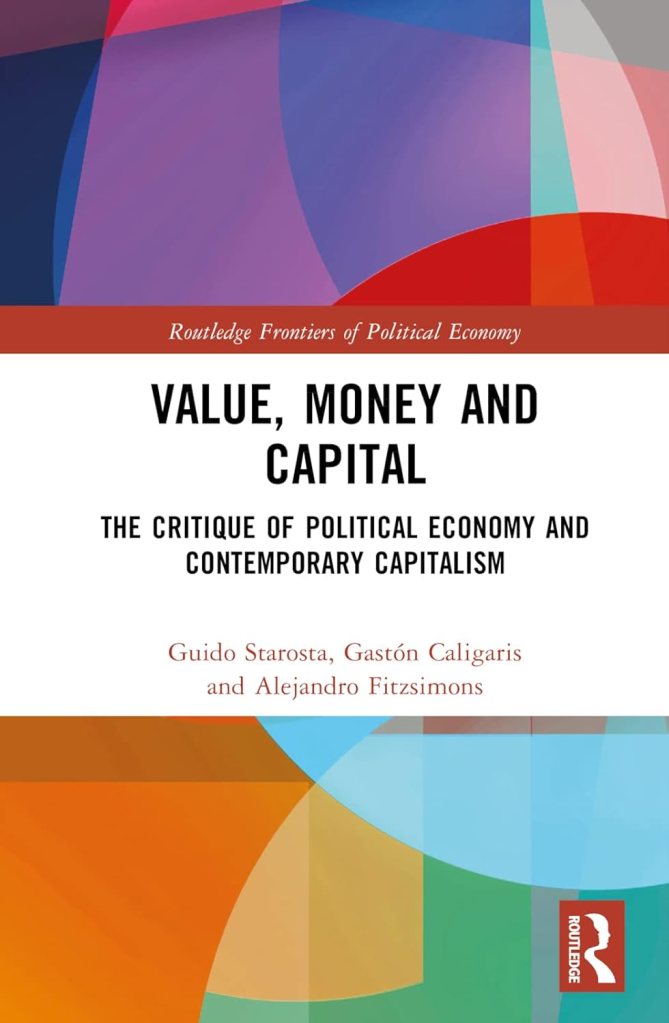
In Value, Money and Capital: The Critique of Political Economy and Contemporary Capitalism, Guido Starosta, Gastón Caligaris, and Alejandro Fitzsimons re-examine the core tenets in Marx’s theory, offering a critical intervention into the field of political economy and the study of contemporary capitalism. The book serves as both a painstaking theoretical reconstruction and a contemporary application of Marx’s dialectical critique, synthesizing insights from global debates, particularly those emerging from the rich, though less internationally disseminated, Latin American Marxist tradition. The authors’ engagement with the foundational categories of value, money, and capital is notable for its depth, precision, and its critical stance towards the more reductionist or circulationist readings that have characterized sections of 20th and 21st-century Marxist scholarship.
Through a systematic dialectical approach influenced by Juan Iñigo Carrera, the authors make a detailed interrogation of Marx’s value theory and critique both the circulationist value-form theories and production-centered interpretations that have dominated recent debates. They insist on an immanent understanding of the law of value as constituting the very social fabric of capitalist production, where privately-undertaken labor, mediated by exchange, manifests itself as abstract social labor. This perspective transcends traditional dichotomies between production and circulation, providing a nuanced understanding of how labor, in its concrete and abstract dimensions, assumes a historically-specific social form in the capitalist mode of production.
The book’s analysis of money takes these insights further by addressing the long-standing controversy over the commodity nature of money. Starosta, Caligaris, and Fitzsimons dissect the debates between theorists like Lapavitsas and Ingham, situating their arguments within Marx’s own methodological framework. They reject reductionist explanations that attribute the genesis of money to the purposive actions of commodity owners, arguing instead that money’s emergence is grounded in the systematic development of value-forms. This approach underscores that while credit and non-commodity forms of money play significant roles in contemporary capitalism, they cannot transcend the fundamental laws of value without destabilizing the system itself. The authors’ reflections on credit-fueled expansions and the crisis tendencies of capitalism offer provocative insights into the periodic upheavals that define the contemporary world economy.
In their exploration of skilled labor and the value of labor-power, the authors address some of the most under-theorized aspects of Marx’s work. They challenge the “received wisdom” that attributes changes in the value of labor-power primarily to class struggle, positing instead a structural tendency for capitalist production to require increasingly educated and healthy labor-power. This structural analysis situates the reproduction of labor-power within the broader dynamics of industrial development and technological change, offering a robust critique of more voluntaristic or economistic interpretations. Their treatment of skilled labor similarly transcends superficial debates, grounding the increased productivity of complex labor in the time and effort invested in acquiring and honing specialized skills.
The discussion of extraordinary surplus-value and innovation exemplifies the book’s commitment to theoretical rigor. The authors engage deeply with the controversy over whether technological innovations generate new value or merely redistribute existing value among capitals. Through the exegesis of Marx’s texts and a critical dialogue with contemporary theorists like Reuten, Carrera, and Mandel, they argue that surplus profits derived from innovation result from the transfer of value within and across sectors, rather than from an intensification of labor’s productive power. This analysis clarifies fundamental misconceptions in the literature and reinforces the authors’ broader critique of the fetishistic forms of capitalist social relations.
The second half of the book extends these theoretical insights to the analysis of contemporary capitalism. Chapters on cognitive labor, global value chains, ground-rent, and the specificity of Latin American development demonstrate the continuing relevance of Marx’s critique of political economy for understanding today’s world. The authors challenge theories of cognitive capitalism that assert the obsolescence of the law of value, arguing instead that intellectual labor and digital commodities remain fully integrated into the value-form. Their analysis of global value chains reveals the uneven and combined dynamics of capitalist accumulation, where value is extracted and redistributed across complex networks of production.
In their discussion of ground-rent, Starosta, Caligaris, and Fitzsimons revisit debates that have largely faded from Anglophone Marxism but remain vital in Latin American scholarship. They highlight the significance of primary commodities and landownership in shaping patterns of accumulation in resource-rich countries. Their critique of dependency theory, particularly the work of Dussel and Marini, offers a fresh perspective on the flow of surplus-value and the structural constraints on development in Latin America. The authors contend that the export of rent-bearing commodities generates a continuous inflow of social wealth, appropriated primarily by local landowners, while the broader dynamics of global capital accumulation limit the potential for autonomous development.
The book concludes with a methodologically sophisticated reflection on the unity of production and circulation in the global capitalist system. The authors reject dualistic approaches that separate theory from empirical analysis, insisting instead on a dialectical method that grasps the immanent connections between abstract categories and concrete phenomena. This perspective enables them to address the real contradictions of contemporary capitalism, from the cognitive dimensions of labor to the geopolitical dynamics of uneven development, without falling into reductionism or empiricism.
Value, Money and Capital is an essential contribution to contemporary Marxist theory. Its combination of rigorous theoretical analysis, critical engagement with current debates, and application to pressing issues in global capitalism marks it as a landmark work in the critique of political economy. For scholars of Marxism, political economy, development studies, and economic sociology, this book offers both a profound re-reading of Marx’s value theory and a powerful framework for understanding the complexities of 21st-century capitalism. The authors’ insistence on the continuing relevance of Marx’s method, even as they extend it beyond his own texts, ensures that this book will remain a touchstone for critical research and debate in the years to come.
 Simon Gros
Leave a comment