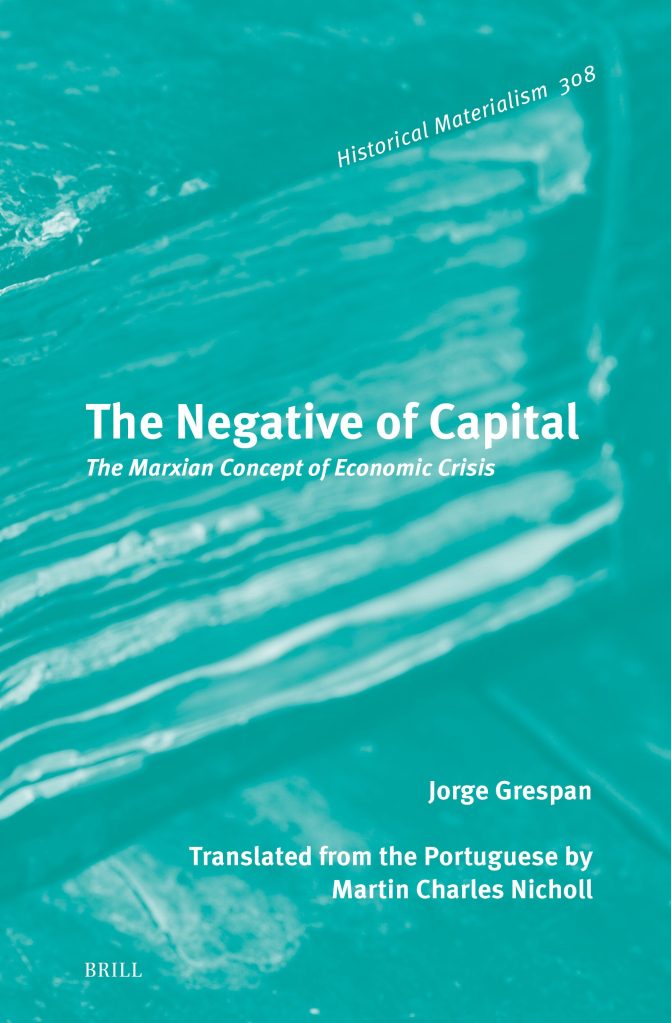
In The Negative of Capital: The Marxian Concept of Economic Crisis, Jorge Grespan undertakes an extraordinary examination of the concept of crisis as developed in Karl Marx’s Capital and its preparatory manuscripts. Rather than treating crises as isolated, incidental phenomena, Grespan reorients the discussion by positing crisis as the very negative of the concept of capital itself. In doing so, he revitalizes longstanding debates surrounding the nature, causation, and inevitability of economic crises, offering a reconstruction of Marx’s dialectical method to illuminate the internal logic by which capital not only reproduces itself but also inexorably generates its own negation.
Grespan’s thesis is developed through a layered analysis of the dialectical categories that underpin Marx’s critique of political economy. Central to his argument is the assertion that crises manifest as capital’s inability to self-measure—a form of mismeasurement intrinsic to capital’s structure. The notion of ‘self-measurement’ is derived from capital’s need to continuously subordinate labor and extract surplus value in a process of quantifiable, calculable valorization. Yet, as Marx demonstrates, this very process is fraught with contradictions that render self-measurement precarious, inevitably leading to periodic devaluation. Grespan traces how, at each stage of Marx’s exposition—whether in the sphere of commodity production, circulation, or reproduction—the concept of capital unfolds alongside a corresponding conception of crisis. In other words, the negative or self-destructive aspect of capital develops in tandem with its positive or valorizing side.
By parsing Marx’s categories, Grespan shows that crises are not mere accidents or contingent disturbances. They are, rather, “relatively necessary”—a term that captures the dialectical intercourse between possibility and inevitability within the dynamics of capitalist production. This relative necessity emerges from the contradictions inherent in capital’s drive for expansion, contradictions that cannot be resolved without undermining capital itself. For instance, the drive to maximize surplus value through technological innovation and productivity gains ultimately leads to a fall in the rate of profit, an outcome that manifests as crisis. Yet, this tendency is not absolute; counter-tendencies may temporarily stave off collapse, rendering crises postponable but never entirely avoidable.
In Grespan’s reading, the fragmented presentation of crisis across Marx’s writings is not a sign of theoretical incompleteness but a reflection of the systematic nature of Marx’s critique. The concept of crisis cannot be relegated to a single chapter or volume because it is embedded in every determination of capital’s movement. As capital progresses through various stages of development—from the simple exchange of commodities to the complex processes of production and global circulation—the crisis potential inherent in each stage also deepens and diversifies. Thus, the crisis associated with the world of simple commodity producers (the discrepancy between sales and purchases) is fundamentally different in form and content from the crisis that emerges at the level of total social capital, characterized by the over-accumulation and over-valorization of capital.
Moreover, Grespan’s analysis insists on the historical and social specificity of crises. Unlike bourgeois economists who view crises as anomalies or failures of external factors, Grespan affirms Marx’s insight that crises are the “objective form of critique”—a self-criticism enacted by the system’s own contradictions. Capital’s fetishistic nature, wherein social relations appear as relations between things, obscures the structural causes of crises and renders them mystifying to economic agents. Grespan’s rigorous reconstruction of Marx’s dialectical method serves to demystify these crises, revealing them as necessary expressions of capital’s self-negating logic.
The book’s conceptual density is matched by its methodological precision. Grespan demonstrates a deep engagement with Marx’s preparatory manuscripts, including the Grundrisse and the 1861–67 notebooks. His reliance on dialectical categories such as ‘measurelessness’, ‘relative necessity’, and the ‘tendential fall in the rate of profit’ allows him to reconstruct Marx’s unfinished theory of crisis with a level of detail and systematic coherence that few others have achieved. Through this reconstruction, Grespan challenges simplistic interpretations of Marxian crisis theory that reduce crises to single causes such as under-consumption, disproportionality, or falling profit rates. Instead, he argues that all these factors are present in Marx’s analysis, but they are synthesized within a broader conceptual framework that views crisis as an expression of capital’s fundamental contradiction.
Grespan also addresses the contentious issue of whether crises are merely possible or absolutely inevitable. By invoking the category of ‘relative necessity’, he navigates between the extremes of determinism and contingency. Crises are neither purely accidental nor strictly predetermined; they arise from the contradictory nature of capital, whose self-reproduction is always conditional and mediated by opposing tendencies. This nuanced approach provides a powerful antidote to both fatalistic collapse theories and excessively voluntarist interpretations of capitalist resilience.
In the postface to the English edition, Grespan extends his analysis to the 2008 global financial crisis, contesting the notion that this crisis was purely a “financial” phenomenon. Instead, he argues that the crisis confirmed the systemic contradictions outlined by Marx, particularly those related to interest-bearing capital and the fetishistic nature of financial instruments. The financialization of capital, far from being an anomaly, represents an advanced form of capital’s self-negation, wherein the illusion of autonomous financial growth conceals the underlying contradictions in the sphere of productive capital.
The Negative of Capital is not merely an academic contribution to Marxian scholarship; it is a work of profound theoretical and political significance. By revealing the systematic nature of crisis in Marx’s critique of capital, Grespan opens up new avenues for revolutionary praxis. Understanding crisis as the necessary negative of capital equips readers with the conceptual tools to comprehend the limits and potentialities of capitalism, and to envision forms of social organization beyond it. For anyone seeking a deeper understanding of the Marxian concept of crisis, Grespan’s work is an indispensable resource—a masterful synthesis of theoretical rigor, historical insight, and dialectical reasoning.
 Simon Gros
Leave a comment