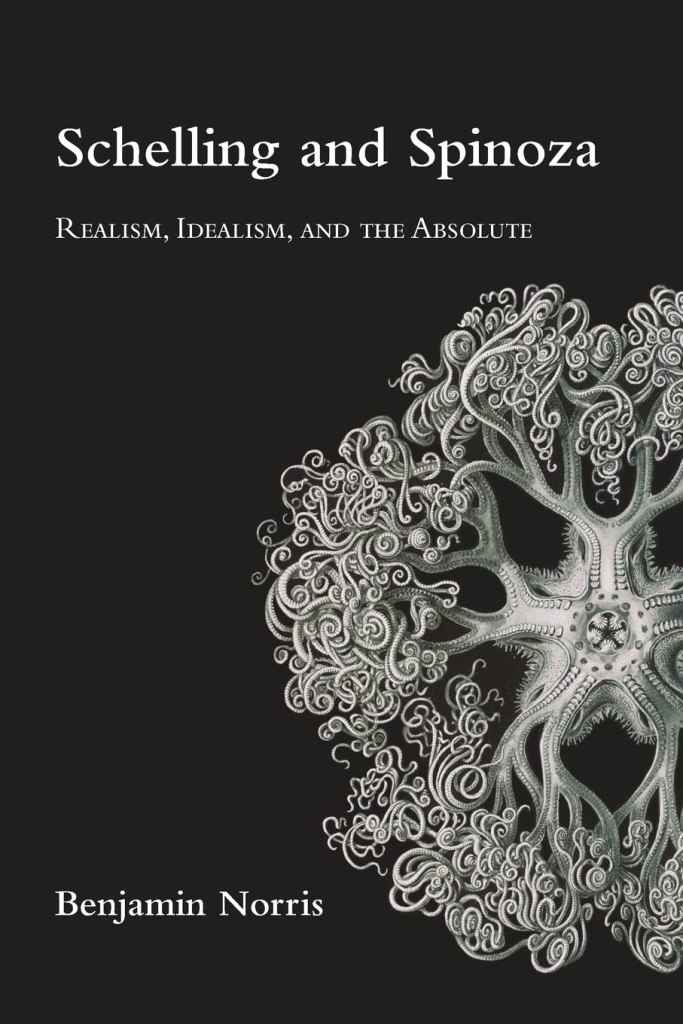
Schelling and Spinoza: Realism, Idealism, and the Absolute by Benjamin Norris is a rigorous philosophical excavation of the intersection between Friedrich Wilhelm Joseph Schelling’s transcendental and speculative idealism and Baruch Spinoza’s rationalist metaphysics. This work reconstructs Schelling’s engagement with Spinoza’s substance monism to illuminate the persistent philosophical tensions between realism and idealism that animate Schelling’s thought. Norris probes Schelling’s dialectical movement from early embrace to later critique of Spinoza’s system, drawing out the implications of the Absolute as a synthesis of thought and existence, realism and idealism. Through a philosophical genealogy spanning Schelling’s youthful inquiries to his mature works, Norris elucidates how the hyphen in “ideal-realism” operates as a conceptual fulcrum that both binds and differentiates the real and the ideal within a dynamic, living Absolute.
Norris’s exploration hinges on Schelling’s early recognition of Spinoza’s systematic rigor—his commitment to the Principle of Sufficient Reason and the unity of thought and extension—as the purest form of dogmatic realism. Yet, for Schelling, Spinoza’s monism, while sublime in its rational consistency, remains lifeless. Spinoza’s ontological duality between thought and existence, Norris argues, undercuts the dynamic vitality Schelling attributes to the Absolute. The heart of Norris’s analysis shows that Schelling’s critique of Spinoza is not a rejection of monism per se, but a transformation of monism into a more complex identity of identity and non-identity—a fractured, living unity that can sustain both nature and freedom.
By tracing Schelling’s attempts to reconcile and transcend the oppositions of Spinoza’s system, Norris provides a philosophical archaeology of the concept of the Absolute as a living process. This Absolute, for Schelling, is not the static substance of Spinoza’s Deus sive Natura, but a self-differentiating unity that accommodates becoming, conflict, and the emergence of finite particulars. Schelling’s dynamic Absolute entails a Wechseldurchdringung—a mutual interpenetration—of realism and idealism, where neither can stand independently, yet each retains its distinctiveness. This mutual saturation of the real and the ideal forms the metaphysical bedrock of Schelling’s philosophy of nature and freedom, making his project an ideal-realism that transcends Spinozist determinism.
Norris situates this dynamic within the broader philosophical landscape of post-Kantian idealism and the pantheism controversy ignited by Jacobi. The specter of nihilism, which Jacobi saw as the inevitable consequence of Spinozism and transcendental idealism, becomes a backdrop against which Schelling’s philosophical journey unfolds. Schelling’s refusal to accept the lifeless determinism of Spinoza’s system and his rejection of Jacobi’s fideism represent a third path: a speculative metaphysics that grounds reason within a living, organic reality. This middle ground, Norris contends, reveals Schelling’s lasting relevance for contemporary debates in metaphysics, particularly in the ongoing tension between realism and antirealism, immanence and transcendence.
In the current philosophical context, Norris’s Schelling and Spinoza challenges the rigid binaries that dominate discussions of metaphysical realism and idealism. By revisiting Schelling’s nuanced critique of Spinoza, Norris illuminates how a return to Schelling requires grappling with the implications of the Absolute as a site of both identity and fracture—a synthesis that is never complete, always alive. The book underscores that any contemporary metaphysics of immanence must engage with the Schellingean realization that unity is never simple and identity is always dynamic. Schelling’s insistence on the hyphen in “ideal-realism” thus serves as a philosophical injunction to resist the simplifications of monistic or dualistic ontologies, compelling a vision of reality that is as terrifying as it is sublime.
Norris’s study is a monumental contribution to Schelling scholarship and to the broader discourse on German Idealism and its contemporary ramifications. By reanimating the dialogue between Schelling and Spinoza, Norris not only clarifies Schelling’s philosophical development but also opens pathways for a renewed speculative realism that is neither trapped in the solipsism of idealism nor confined to the inert determinism of classical realism. Schelling and Spinoza invites readers to reconsider the Absolute as a horizon of thought and existence—a living, dynamic totality where philosophy and reality meet, clash, and become.
 Simon Gros
Leave a comment