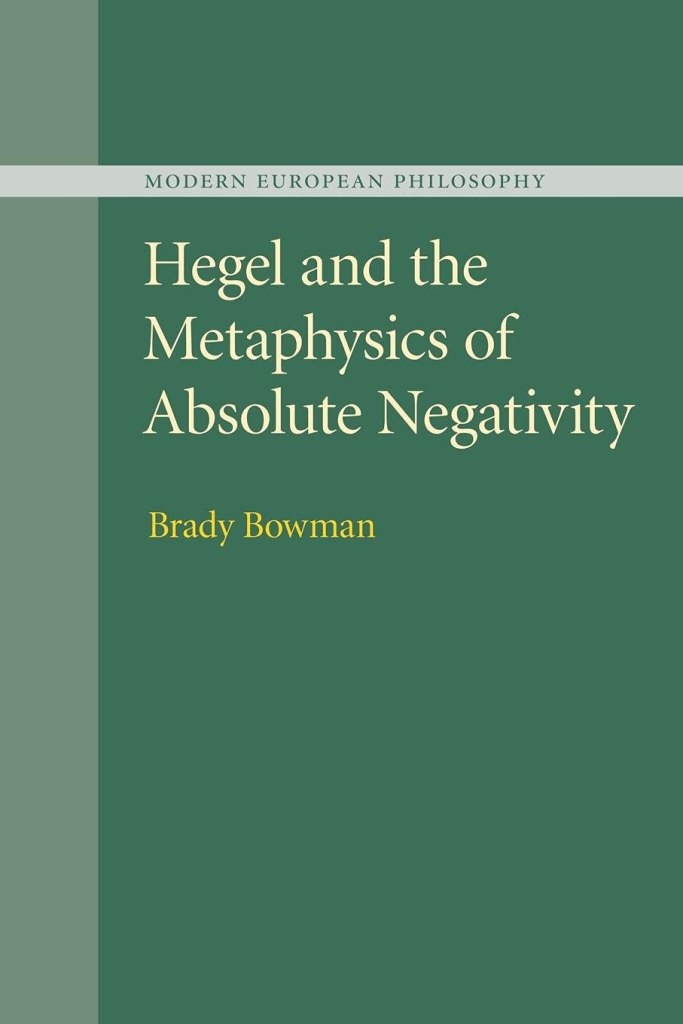
Brady Bowman’s Hegel and the Metaphysics of Absolute Negativity delivers a rigorous examination of the very essence of Hegelian philosophy, offering a study of Hegel’s doctrine of absolute negativity and the Concept (der Begriff) as the pivotal elements that animate his dialectical system. These doctrines are not only Hegel’s most original contributions but also the systematic heart of his entire metaphysical project. Bowman’s work goes deeply into the interrelation between these ideas and demonstrates how they underpin Hegel’s critique of classical logic and ontology, his innovative understanding of finite cognition, and his speculative account of consciousness’s integration within nature.
Bowman’s analysis shows the proposition that absolute negativity—the dynamic process of self-determination through negation—and the Concept are two facets of a singular philosophical reality, distinguished as process and structure. This synthesis constitutes the foundation for Hegel’s dialectical logic, which both critiques and transcends traditional logic by revealing its inherent limitations when confronted with the unconditional or absolute. Bowman’s engagement with Hegel’s texts underscores how Hegel’s speculative logic emerges as a necessary transformation of pre-critical rationalism, challenging Kant’s rigid distinction between appearances and things-in-themselves and Jacobi’s fideistic leap away from rationality.
Bowman situates Hegel’s system within the broader historical trajectory of German Idealism, dissecting Hegel’s complex relationship with Kant’s transcendental idealism and Jacobi’s critique of rationalism. Kant’s demonstration of the antinomies arising from finite categories when applied to the unconditioned, and Jacobi’s critique of deterministic rationalism, serve as critical junctures where Hegel identifies the need for a “completely altered view of logic”—a speculative logic that does not merely negate finite cognition but sublates it within a higher, self-determining Concept. Bowman argues convincingly that this altered logic allows Hegel to articulate a metaphysical framework in which thought and reality, mind and nature, are fundamentally isomorphic.
The book explores how Hegel’s concept of finite cognition—the sphere of understanding constrained by the categories of traditional logic—becomes a critical object within his speculative philosophy. Bowman illustrates how Hegel traces the genesis and scope of finite cognition, revealing its dialectical necessity while simultaneously delineating its inherent limitations. Hegel’s dialectic of negativity shows that finite determinations inevitably lead to contradictions that can only be resolved through a higher synthesis, ultimately pointing to the speculative Idea, wherein difference and identity, determinacy and infinity, achieve reconciliation.
Bowman provides an exhaustive analysis of how absolute negativity operates within Hegel’s philosophy of nature and consciousness. He explores Hegel’s attempts to integrate natural science, mathematics, and logic into his broader metaphysical framework. In contrast to Kant’s delineation of metaphysics and the finite constraints of natural science, Hegel’s speculative approach seeks to demonstrate the conceptual necessity behind nature’s determinate structures and the emergence of finite mind within it. Through detailed exegesis of key Hegelian texts, Bowman reveals how Hegel’s logic of absolute negativity allows for a dynamic understanding of nature that transcends mechanistic determinism and reflects the self-determining activity of the Concept.
Additionally, Bowman revisits the philosophical debates that shaped Hegel’s formative period—the pantheism controversy, the philosophical disputes with Fichte and Schelling, and the broader crisis of rationalism—to illuminate the historical significance of Hegel’s project. His analysis underscores how Hegel’s metaphysical system is an ambitious in that it seeks to reconcile the deterministic implications of Spinozist substance monism with the freedom and self-consciousness central to Kantian and post-Kantian philosophy. In Bowman’s interpretation, Hegel’s speculative metaphysics emerges not as a retreat from reason, but as its deepest articulation—a logic that can accommodate the dynamic, self-negating structure of reality itself.
By grounding his arguments in a robust metaphysical reading of Hegel, Bowman challenges contemporary non-metaphysical interpretations that reduce Hegel’s thought to a form of epistemology or linguistic analysis. He makes a compelling case for viewing Hegel as a thinker who revitalizes the metaphysical ambitions of philosophy, offering a systematic account of reality wherein mind, nature, and thought are bound by the dynamic movement of absolute negativity. This work is essential for anyone seeking a deeper understanding of Hegel’s dialectical method, his place within the history of German Idealism, and the enduring relevance of his metaphysical vision.
Hegel and the Metaphysics of Absolute Negativity is a masterful engagement with Hegel’s philosophy, offering a penetrating analysis of his core doctrines while situating them within their historical and philosophical context. Bowman’s exposition of Hegel’s speculative logic and his critical engagement with the limitations of finite cognition reveal a vision of reality that is at once dynamic, self-determining, and profoundly rational—a metaphysics that embraces negativity as the very principle of life and thought. This book will be indispensable for students of Hegel, German Idealism, and the history of metaphysics more broadly.
 Simon Gros
Leave a comment