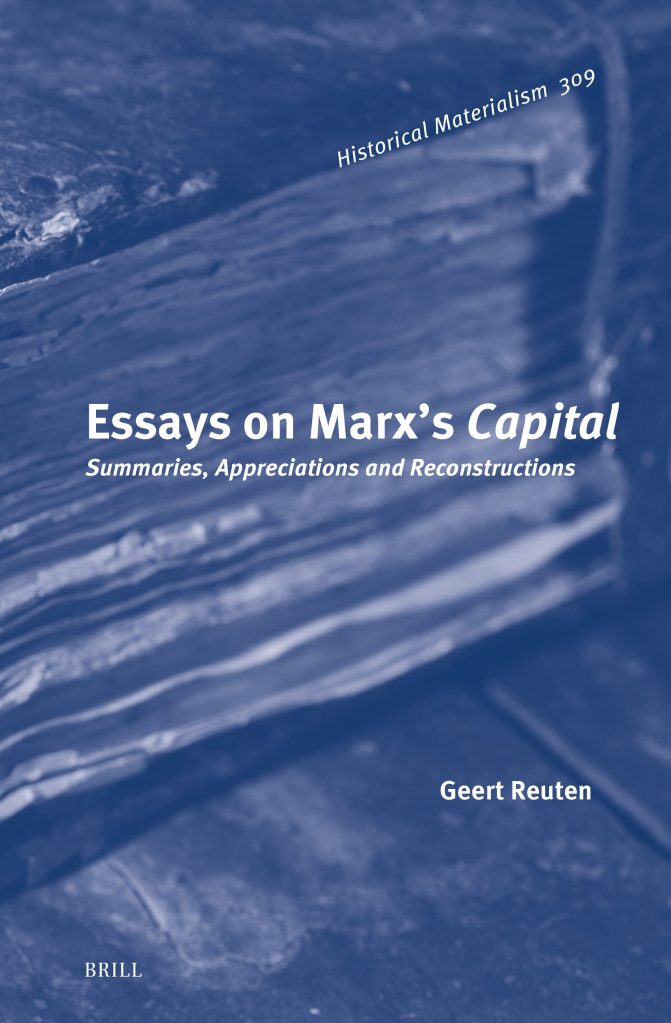
Geert Reuten’s Essays on Marx’s Capital: Summaries, Appreciations and Reconstructions is an erudite, detailed exploration of Karl Marx’s magnum opus Capital. This collection of 21 essays, written between 1991 and 2019, illuminates the intricacies of Marx’s systematic-dialectical method and the monetary value-form analysis that undergirds his critique of political economy. Reuten’s work does not merely engage in interpretation but ventures into a rigorous dialogue with the structure, logic, and presuppositions of Capital, offering summaries, appreciative insights, and when necessitated by inconsistencies or textual ambiguities, reconstructions of Marx’s arguments.
The essays are organized systematically to follow the architecture of Marx’s three volumes of Capital, thereby mirroring the progression of Marx’s exposition itself. Part A sets the stage by addressing the general outlines of Capital and methodological issues that permeate Marx’s entire project. Here, Reuten considers the evolution of interpretations of Marx’s work, the nuances of Marx’s conceptualization of value, and the systematic-dialectical approach that informs Marx’s critique. This section is crucial for grasping the theoretical scaffolding that supports the subsequent explorations of individual volumes. The essays here, such as “Marx’s Conceptualisation of Value in Capital” (2019) and “The Interconnection of Systematic Dialectics and Historical Materialism” (2000), provide a penetrating analysis of Marx’s value theory, moving beyond simplistic labor-time interpretations to a more nuanced understanding of value as a historically specific social form expressed in monetary terms.
Reuten underscores that Marx’s theory of value is not static but dynamic, evolving through the layered conceptual progress of Capital. In this context, he examines the dialectical method—distinguishing between historical dialectics and systematic dialectics—and highlights the significance of Marx’s approach to critique. Rather than external criticism, Marx’s method of critique evaluates capitalism from within, exposing its contradictions by tracing the implications of its own standards and norms. Reuten’s engagement with this method is both appreciative and reconstructive, acknowledging the brilliance of Marx’s insights while suggesting ways to resolve the ambiguities and methodological tensions that arise, particularly in the posthumously published volumes edited by Engels.
Part B shifts focus to the first volume of Capital, where Marx lays the foundation of his critique by examining the production of surplus value. Reuten’s essays delve deeply into Marx’s conceptual innovations and methodological choices, offering detailed summaries and critical reflections on key chapters and parts. For instance, in “The Difficult Labour of a Theory of Social Value” (1993), Reuten dissects Marx’s exposition of value in the opening chapters, elucidating how Marx’s systematic-dialectical presentation generates layers of abstraction that build toward a more concrete understanding of capitalist production. The essay highlights the tension between Marx’s abstract-labor theory of value and his reliance on metaphors inherited from Hegelian philosophy and classical political economy, ultimately proposing a reconstructive approach to resolve these tensions.
Reuten also engages with Marx’s treatment of money in Capital Volume I, particularly in “Money as Constituent of Value” (2005). Here, Reuten examines how Marx’s analysis of the value form culminates in the concept of money as the “extroversive form” of value. This essay underscores the inseparability of value and its monetary expression, a theme that recurs throughout the collection. Reuten’s reading of Marx’s German terminology reveals nuances often obscured in English translations, such as the distinction between “introversive” and “extroversive” dimensions of value.
In Part C, which focuses on Capital Volume II, Reuten explores the circulation of capital. Essays like “The Status of Marx’s Reproduction Schemes” (1998) and “Some Notes on Marx’s Macroeconomics Avant La Lettre” (2023) highlight the methodological and theoretical challenges posed by Marx’s unfinished manuscripts. Reuten critically assesses the logic of Marx’s reproduction schemas, questioning whether they align with a systematic-dialectical methodology or adopt a more conventional modeling approach. This scrutiny leads to a broader reflection on the macroeconomic dimensions of Marx’s theory, which, while underdeveloped in Capital, provide fertile ground for contemporary Marxian economics.
The culmination of Reuten’s project is found in Part D, dedicated to Capital Volume III. This volume, which Marx left in manuscript form, deals with the distribution of surplus value and the formation of profit, interest, and rent. Reuten’s essays in this section grapple with the notorious “transformation problem,” the tendency of the rate of profit to fall, and the cyclical dynamics of capitalist accumulation. In “Marx’s Rate of Profit Transformation” (2009) and “The Productive Powers of Labour and the Redundant Transformation to Prices of Production” (2017), Reuten offers a critical reconstruction of Marx’s arguments, addressing methodological, theoretical, and philological challenges. He argues that Marx’s earlier conceptualizations of value and surplus value become incompatible with the transformation procedures outlined in Volume III, necessitating a careful reconstruction that remains faithful to Marx’s systematic-dialectical method.
One of the most compelling themes in Reuten’s essays is the dynamic nature of capitalist development and its inherent contradictions. Essays like “Destructive Creativity” (1998) and “The Rate of Profit Cycle and the Opposition between Managerial and Finance Capital” (2002) explore how technological change, financialization, and the stratification of capital shape the cyclical dynamics of accumulation. Reuten’s analysis of these themes demonstrates the enduring relevance of Marx’s critique in understanding contemporary capitalism’s crises and transformations.
Throughout Essays on Marx’s Capital, Reuten’s commitment to clarity, precision, and methodological rigor is evident. His work exemplifies the best tradition of Marxian scholarship, one that respects the historical integrity of Marx’s texts while pushing forward the theoretical boundaries of the paradigm. The book is not merely a collection of essays but a systematic engagement with the totality of Capital, offering both a summation of Marx’s achievements and a path forward for critical social theory. For scholars, students, and anyone engaged with the critique of political economy, this collection is an indispensable resource, reflecting a lifetime of study and reflection on Marx’s revolutionary work.
 Simon Gros
Leave a comment