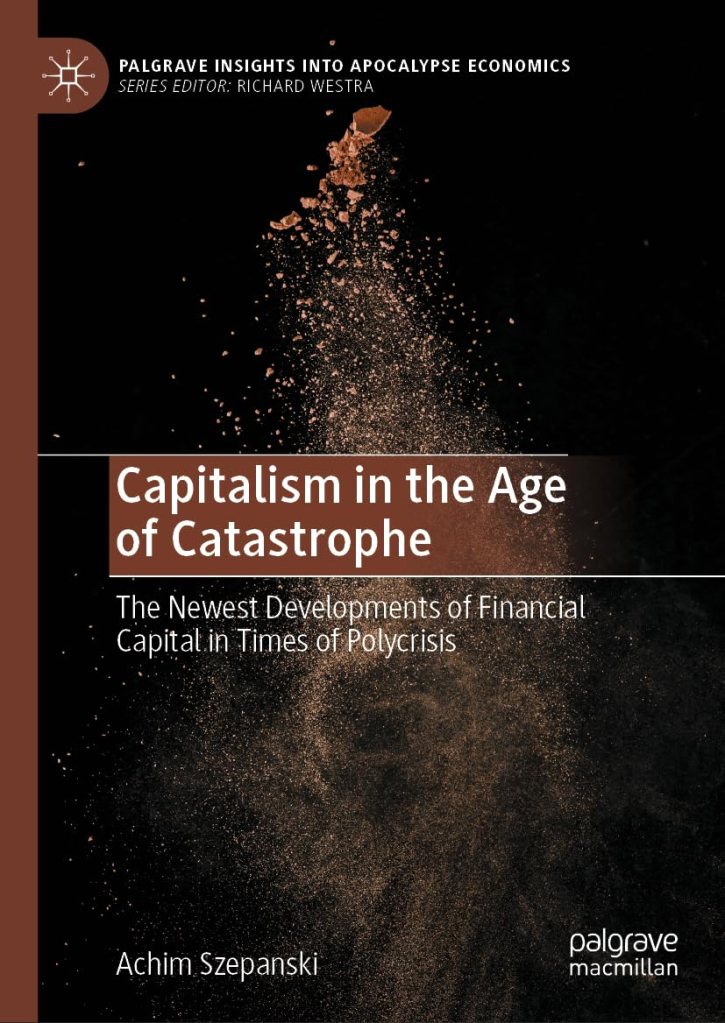
Achim Szepanski’s Capitalism in the Age of Catastrophe: The Newest Developments of Financial Capital in Times of Polycrisis is a searing philosophical interrogation of the late-capitalist world system as it collides with an era of unprecedented crises. Rooted in an intricate synthesis of Marxist economic analysis and the radical critiques of Georges Bataille and Jean Baudrillard, this book elucidates the spiraling trajectories of financial capitalism as it manifests a systemic, self-cannibalizing excess. Szepanski’s work traverses the grim landscapes of contemporary hyper-financialization, ecological devastation, geopolitical volatility, and the collapse of historical teleology, proposing that we live within a “polycrisis” defined by interlocking catastrophes that are intrinsic to capitalist logic itself.
Central to Szepanski’s analysis is the concept of the “over,” a philosophical and economic lens that reveals the nature of capitalist excess—over-accumulation, over-speculation, and over-pollution—as not merely anomalies or externalities, but as inherent outcomes of capital’s drive for perpetual self-expansion. This notion of the “over” is examined through the lens of Bataille’s General Economy, wherein excess is a surplus that cannot be absorbed productively and must be either squandered or catastrophically consumed. For Bataille, every system of restricted, utilitarian economy—where profit and rational accumulation reign supreme—produces an inevitable excess that finds expression in waste, destruction, and ruin. Szepanski transposes this insight onto the contemporary era of speculative finance, wherein capital’s hypertrophic growth leads not to stability but to a metastasizing chaos that threatens both social cohesion and planetary ecology.
Szepanski draws from Baudrillard’s critique of late-capitalist simulation and hyperreality to argue that financial capital, in its ecstatic pursuit of speculative returns, has severed ties with the “real” economy of goods and services. The speculative economy’s acceleration into ever-more abstract derivatives and repurchase agreements has engendered a surreal, self-referential system where value is untethered from material reality. This “ecstasy of capital” is a form of self-referential delirium, a feedback loop wherein speculative capital generates profit from the multiplication of pure signs of value, detached from the labor processes that once underpinned classical surplus value. Capital no longer accumulates merely through production but through the ecstatic intensification of circulatory speed and informational flows, where even the act of speculation becomes the object of further speculation.
The book’s exploration of hyper-inflation, stagflation, and the dominance of central banks in advanced economies underscores how these crises are symptoms of a deeper malaise—the inability of capitalism to reconcile the contradictions of its own expansionary drive. Szepanski examines the role of financial instruments like index funds and asset management firms, which facilitate wealth extraction on a planetary scale for an increasingly concentrated elite. The repurchase agreement, a linchpin of contemporary liquidity provision, emerges as a paradigmatic figure of capitalist temporality, wherein value is perpetually borrowed from the future to sustain a fragile present. These mechanisms, rather than stabilizing the system, only exacerbate its volatility, setting the stage for more frequent and severe crises.
Ecological collapse, Szepanski argues, is not merely a byproduct of capitalism but an essential feature of its “over” logic. The over-pollution of the environment and the unchecked extraction of natural resources reflect a system that perceives the Earth’s finitude as a limit to be transgressed. Here, Szepanski channels Baudrillard’s notion of “hyperreality” to describe a world where ecological signs—climate data, carbon metrics, environmental warnings—are commodified and rendered banal through their endless circulation in media networks. The climate crisis, then, becomes both a hyperreal spectacle and a concrete catastrophe, wherein the mediation of ecological collapse obscures its lived reality. The result is a state of “frenetic standstill” (Virilio), where the acceleration of informational and financial flows paralyzes meaningful action.
Geopolitical precarity is another vector through which Szepanski analyzes the catastrophic logic of financial capital. The contemporary world order, marked by escalating tensions between the United States and China, the war in Ukraine, and the fallout from the COVID-19 pandemic, reveals a system that has lost its ability to stabilize itself through traditional means. The concept of “polycrisis” captures the simultaneity and interconnectedness of these disruptions, where financial, ecological, and political crises feed into one another, producing a self-reinforcing cycle of instability. The specter of “disaster capitalism,” wherein crises are systematically exploited for profit, becomes a defining feature of this era. Yet, Szepanski warns that even this logic of exploitation reaches its limits in the face of existential threats like climate collapse, which could render capitalist accumulation itself unsustainable.
Szepanski’s rigor is matched by his theoretical ambition. Drawing on Marx’s notion of “dead labor” and the vampiric nature of capital, he depicts a system that survives by consuming the future—a form of “auto-cannibalism” where the very conditions of life are sacrificed for short-term returns. This analysis is enriched by references to Bataille’s ideas of excessive expenditure and Baudrillard’s notion of the “spiraling cadaver of humanism,” suggesting that capitalist modernity is haunted by a latent death drive, a nihilistic impulse to inflate itself to the point of collapse.
Capitalism in the Age of Catastrophe is a reflection on the end of history’s horizons. Szepanski confronts the paradox of a system that accelerates toward infinite growth while foreclosing the possibility of a different future. The “over” of capital’s excess is also the “over” of historical possibility, where the utopian dreams of modernity are subsumed by a dystopian reality of endless crisis. Yet, even as he charts this bleak terrain, Szepanski’s work remains an incisive call to understand the mechanisms of our predicament—an intellectual act of resistance against the nihilism of speculative capital. This book is indispensable for political economists, critical theorists, and anyone seeking to grasp the philosophical and economic contours of our catastrophic age.
 Simon Gros
Leave a comment