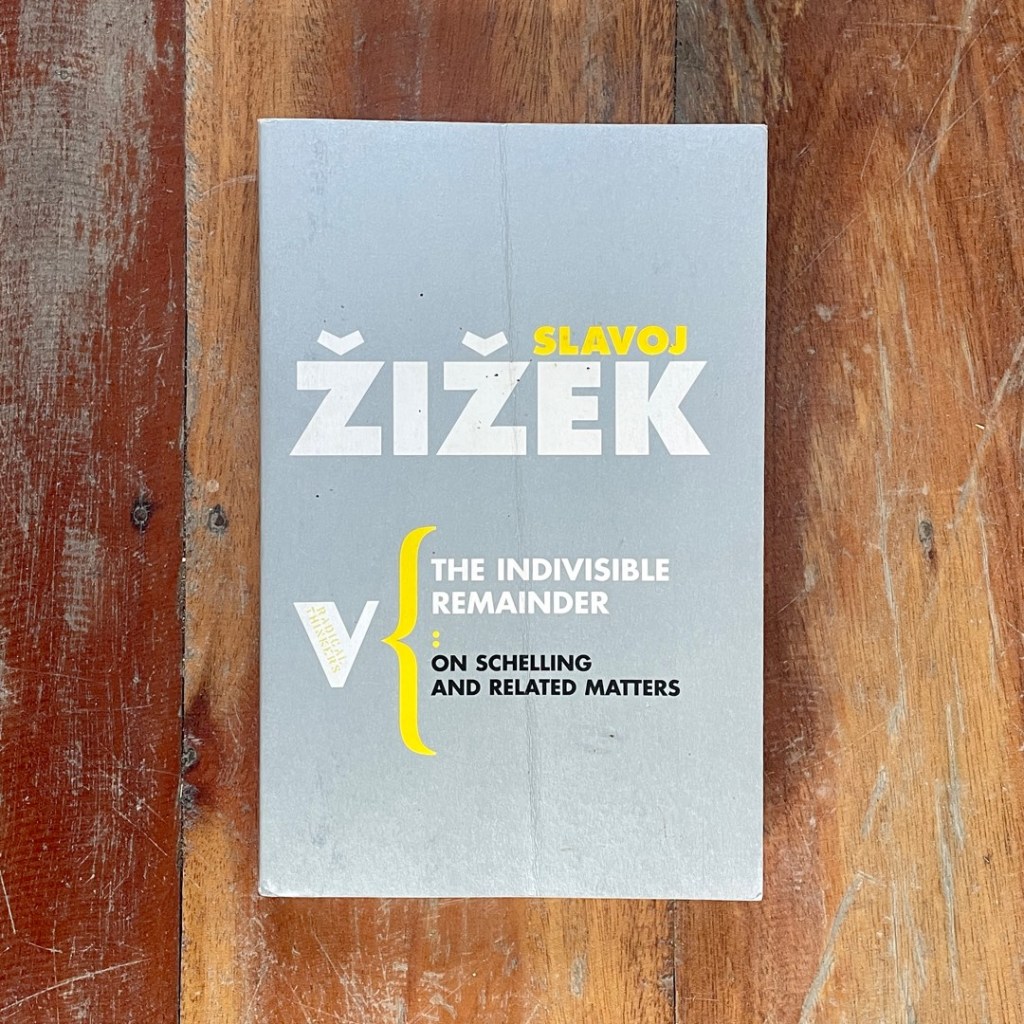
In Slavoj Žižek’s The Indivisible Remainder: On Schelling and Related Matters, the reader is immediately drawn into a staggeringly complex, exhaustively intricate, and conceptually vertiginous philosophical essay that seeks to re-locate Schelling—so often overshadowed by the towering figures of Kant and Hegel—at the very center of a tradition stretching from the ancient materialists, through Marx, all the way to Freud and Lacan. The book offers nothing less than a total re-reading of Schelling’s darkest and most elusive works, especially his drafts of the Ages of the World, where the German idealist obsessively wrestled with the attempt to articulate the “beginning of the world,” the primordial leap that brings forth the universe of logos out of a monstrous pre-symbolic Real, a vortex of drives and pulsations that defies conceptual mediation. Žižek’s text, dense with theoretical acrobatics and packed with politicized examples drawn from popular culture and contemporary ideology, endeavors to reinvent how we approach not merely Schelling’s legacy, but also the overlapping genealogies of modern philosophical thought and the ongoing crises that pervade our globalized, late-capitalist condition.
From the outset, Žižek situates Schelling alongside those truly materialist thinkers—Lucretius, Marx, Lacan—for whom the “unfinished” character of their thought stands as both a methodological principle and a metaphysical necessity. These thinkers share a certain kernel of dissatisfaction, a repeated confrontation with their chosen problem that never finds a neat, ultimate resolution. In Schelling’s repetitive return to the question of how existence might have emerged from a non-symbolizable Real, how the fragile universe of meaning could have burst forth from primeval darkness and chaos, we are confronted with a problem that resonates strongly with Marx’s critique of speculative idealism and Lacan’s notion of a non-sublatable drive. For Schelling, finite existence, contingency, temporality, and the irreducible remainder that resists total idealization are not peripheral anomalies, but crucial motifs that anticipate whole swathes of modern thought. Marx’s exposure of the grounding illusions of ideology and commodity fetishism, Freud’s concept of a fundamental lie at the core of subjectivity—these announcements are all already delicately inscribed in the Schellingian scenario, where the Absolute itself is implicated in a drama of contraction and expansion, darkness and light, necessity and freedom.
The Indivisible Remainder brilliantly unfolds Schelling’s view of how the finite world arises against the background of a “divine madness,” a proto-genetic matrix of contradictions that must be perpetually repressed if symbolic order is to be instituted. For Žižek, the ultimate achievement of Schellings Ages of the World drafts lies in their very failure: again and again, Schelling tries to account for the passage from the pre-symbolic to the symbolic and consistently falls short of providing a definitive narrative. Yet it is precisely this failure that illuminates Schelling’s place as a kind of “vanishing mediator,” who stands at a transitional moment between idealist metaphysics and a thoroughly modern consciousness of radical contingency. By plunging back into Schelling’s darkest texts, Žižek establishes a philosophical resonance chamber where materialist dialectics reverberate unexpectedly within theological imagery, where the mystical and the rational cross paths, and where the Real’s impenetrable kernel shows up as the crucial stumbling block around which reason revolves.
In a feat of interpretative dexterity, Žižek then stages a confrontation between Schelling and Hegel. He mines the tension between their approaches to negativity, freedom, and the fundamental antagonisms at the heart of being. Whereas Hegel sublates contradiction into a higher conceptual unity, Schelling foregrounds an insurmountable remainder. The “indivisible remainder” is precisely that element—be it a surplus-enjoyment, a libidinal kernel, a non-symbolizable x—that resists the neat closure of idealistic mediation. Žižek thus shows that if Hegel’s dialectical thought prioritizes the Symbolic’s self-movement, Schelling dares to envision the ontological catastrophe that precedes symbolic structuration. In other words, Schelling’s obscure primordial conflict, the intra-divine discord, and the paradoxical “pre-history of God” highlight the ways in which the Symbolic Order emerges not from a stable Ground, but from a violent break, a monstrous contraction without which no expansion into meaning and order would be possible.
After reconstructing the intricate architecture of Schelling’s thought and aligning it with Marx’s and Lacan’s unfinished projects, Žižek unexpectedly shifts to “related matters”—the thematic fields where Schellingian insights cast new light. Here lies one of the book’s signature moves: philosophy is not safeguarded in a dusty academic corner, but is tested and re-applied in the most varied domains, including the sphere of modern technology, the computerized texture of contemporary life, the transformations in sexual experience under late-capitalist conditions, the rise of cynicism as our default ideological stance, and even the perplexing crises of quantum physics. By injecting Schelling’s metaphysical tensions into these far-flung contexts, Žižek’s book insists that the fundamental questions of finitude, freedom, and the vexed origin of symbolic order are not only abstract puzzles for philosophers, but concrete problems that resonate in the everyday world we inhabit. The very coordinates of our late-capitalist universe—our subjectivity, our sexual relations, our political ideologies—are plagued by the same paradoxical remainder that Schelling identified at the core of the Absolute. Far from being a mere historical curiosity, Schelling emerges as a decisive interlocutor for understanding today’s world of digital mediation, ideological cynicism, and the disintegration of stable communal frameworks.
Žižek’s style, as always, bristles with provocative allusions and symptomatic details. He populates his argument with references to popular culture: from the temporal loops of Groundhog Day, to the cynical inertia of Forrest Gump, to the manic speed of Hollywood blockbusters. He extracts from these everyday cultural products the hidden metaphysical scandals and ideological strategies that echo Schelling’s insistence on the impossibility of a seamless passage from the inhuman Real to the realm of reason and logos. Through such examples, the philosophical core—Schelling’s investigations into the essence of human freedom, the pre-human horror hidden in the divine Ground, the everlasting struggle to narrate the birth of the symbolic universe—is brought closer to home, made tangible and urgent. The Indivisible Remainder thereby exemplifies how the highest philosophical speculation can be powerfully linked to the most banal daily experience, revealing the repressed, constitutive violence that sustains our symbolic coordinates.
In exploring Schelling, Žižek also reinterprets Freud’s legendary encounter in a Slovene cave, where Freud supposedly stumbled upon the anti-Semitic mayor Karl Lueger, a figure whose name in German conjures up the notion of a lie. From this anecdote, Žižek draws a psychoanalytic lesson: deep in the subterranean recesses of the Real, we do not find a positive, authentic Truth waiting to be uncovered, but rather a fundamental deception, a constitutive lie—Schelling’s Grund is never simply a firm foundation, but a pulsation of impossibility. And just as Freud’s unconscious conceals not a pristine inner truth but a contradictory formation of desires and fantasies, Schelling insists that the Absolute has no pure, unsullied origin, but only a perpetual struggle to ground itself through an impossible jump, a traumatic event that must be retroactively concealed. This shared insight once again locates Schelling at the conjunction of philosophy and psychoanalysis, making it clear why Lacan’s attempts to conceptualize the Real, the Symbolic, and the Imaginary can be fruitfully illuminated by Schelling’s pre-Hegelian engagement with the transcendental contours of negativity.
Brimming with theoretical finesse, The Indivisible Remainder resists any neat summarization. It draws the reader through layer upon layer of conceptual complexity, challenging them to confront the irreconcilable tensions at the heart of subjectivity, ideology, nature, politics, sexuality, and even scientific cognition. The book refuses a linear, triumphalist narrative and instead thrives on the productive failures of philosophical systems, on the cracks and inconsistencies that betray an underlying truth. By reading Schelling, Žižek indirectly diagnoses our own predicament: we live in an era when traditional forms of authority and belief have disintegrated, where cynicism and irony reign supreme, yet where the underlying coordinates of our symbolic universe remain tainted by an obscure leftover, a piece of the Real that resists integration and keeps the machinery running in its strange, uncanny way. The Indivisible Remainder thus stands as a paradigmatic Žižekian intervention—erudite yet irreverent, anchored in philosophical depth but oriented toward the most contemporary anxieties, demanding that we look anew at a neglected figure and thereby re-center the horizon of our thinking.
By the time the reader completes The Indivisible Remainder, they will have traveled through a panorama in which Enlightenment rationality, Christian theosophy, German Idealist philosophy, Marxist critique, Freudian psychoanalysis, and Lacanian theory all pass through the Schellingian prism, revealing unsuspected continuities and tensions. They will recognize how late-capitalism’s “universe of goods” and computerized management of everyday life is haunted by the same paradoxes Schelling articulated at the dawn of modernity. They will sense that the crisis of modern subjectivity—its failures of sexuality, its ideological cynicism, its anxieties around scientific truth and the order of knowledge—points back to a primordial rupture, a Schellingian “indivisible remainder” that no symbolic edifice can fully digest.
In the end, The Indivisible Remainder is a powerful testament to the vitality of re-reading the philosophical canon from unexpected angles. By bringing Schelling’s failed attempts at cosmic narration into dialogue with Marx, Lacan, popular cinema, quantum physics, and our digitalized modernity, Žižek offers a brilliant and disconcerting meditation on the origins and ends of philosophical speculation. The result is a work that transcends mere historical scholarship, bursting forth as a bold theoretical challenge that demands the reader abandon received wisdom and enter into the chaotic, pre-symbolic heart of existence, where reason itself trembles on the brink of madness, and where only by facing the irreducible kernel of negativity can we hope to understand our all-too-human striving for meaning.
 Simon Gros
Leave a comment