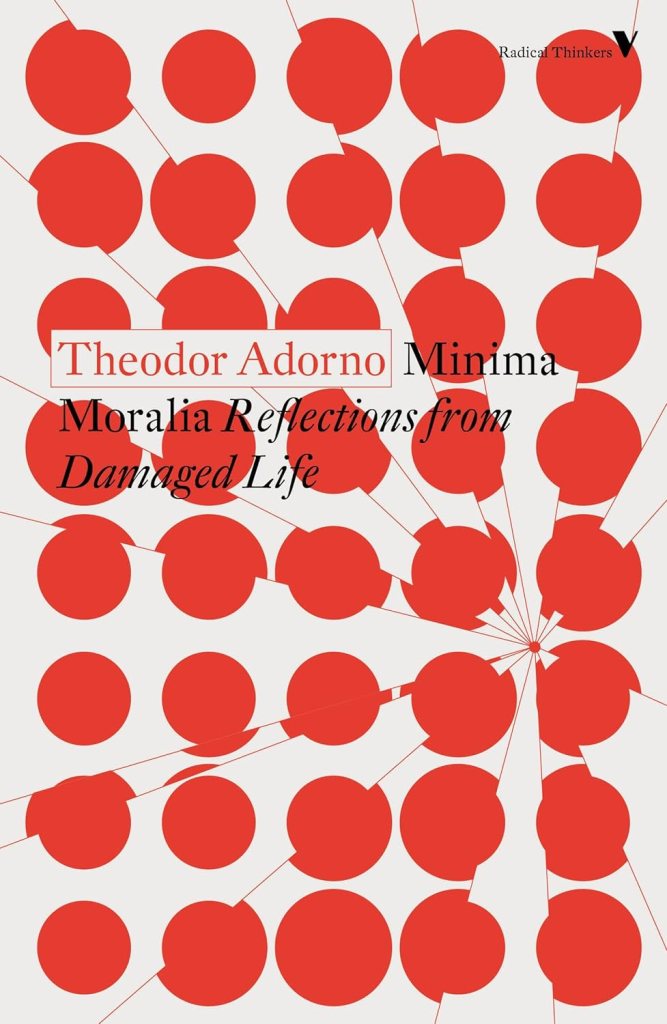
Minima Moralia: Reflections from Damaged Life is a work that both demands and resists easy classification, emerging as a monumental philosophical opus crafted in the wake of catastrophe and sustained by an unremitting critical energy. Written by Theodor W. Adorno, one of the most mercilessly lucid and unflinchingly honest thinkers of the twentieth century, it stands as a collection of 153 aphorisms and short essays that do not so much constitute a linear argument as crystallize into a mosaic of insights whose cumulative effect is as unsettling as it is revelatory. Completed in 1949 and published in 1951, the book’s genesis lay in the darkest hours of World War II, during Adorno’s period of exile in America. It was originally presented as a tribute to his friend and collaborator, Max Horkheimer, yet it has since transcended the boundaries of personal dedication and historical moment to become a universal testament to the persistent challenges of attaining a humane existence under the conditions of what Adorno calls “damaged life.”
The fractured historical backdrop against which Minima Moralia was conceived is essential for understanding its persistent urgency and enduring importance. Adorno, driven into exile by fascism, was acutely aware that neither his intellectual acuity nor his privileged upbringing exempted him from the devastation that ravaged Europe and left no life intact. His philosophical approach—steeped in the critical tradition of Marx, Nietzsche, and Freud, yet uncompromisingly skeptical of any comfort that might be gleaned from borrowed ideals—manifests as a sorrowful science. Here, philosophy becomes the painstaking excavation of the shattered remains of experience in an age when the concepts of a “good life” and “honest existence” seem like mocking illusions. The aphorisms and reflections of Minima Moralia are pointed and relentless; they record the internal wounds of a thinker who survived not because he overcame horror, but because survival was historically and brutally forced upon him. Thus, the work’s subtitle, Reflections from Damaged Life, does not name a theme so much as acknowledge a fundamental impossibility: that, under late capitalism, fascist terror, mass deception, and the commodification of culture, a truly undamaged life—an existence worthy of human beings—is no longer possible.
The genre of Minima Moralia itself is revealing. It openly resists the systematic architectonics that philosophy traditionally employs. Instead, each brief section isolates a facet of everyday life, be it a gesture, a social custom, a political scandal, a linguistic quirk, or a cultural commodity, and probes it mercilessly until it yields a truth about the domination, alienation, and suffering that structure human relations. The book’s form, dense and aphoristic, is not a stylistic flourish but a precise philosophical strategy. Adorno conceives the aphorism not as a decorative miniature but as a splinter of negation, a fragment that condemns the whole by revealing its hidden logic. Each segment stands on its own, yet they all belong to a fractured totality. They are philosophical x-rays, capturing both the ravaged interior of the self and the systemic forces that have inflicted that damage. This is why Minima Moralia can be considered as nothing less than a dialectical masterpiece: it embodies the tension between the particular and the general, the intimate and the institutional, the subjective pang and the global catastrophe. Adorno’s method, in calling attention to the unreconciled antagonisms and untruths at every level of existence, reminds us that critical thought must itself remain incomplete, unpacified, and unsystematic if it is to maintain fidelity to the truth of a broken world.
No dimension of modern life escapes Adorno’s scrutiny. He fixates on commodification and the devolution of culture into mass-produced entertainment for passive consumption. The latent violence at the heart of social norms, the toxic cheerfulness of what calls itself “normality,” and the systematic undermining of intellectual integrity by the demands of the capitalist division of labor all come under the lens of his unforgiving analysis. Art, once endowed with the capacity to transcend material constraints or at least protest them, has been mutilated by profit motives and the standardization of taste. Relationships, once capable of harboring the promise of authenticity and moral growth, now suffocate beneath the weight of commodity exchange, empty sociability, and silent complicity with the status quo. Even private spheres, sanctuaries in which individuality might have flourished, are exposed as no more than appendages to the overarching process of material production. The titles, the etiquette, the polite gestures that mask domination—Adorno brings them all before a philosophical tribunal where no reassuring verdict is delivered. Instead, we learn that the very spontaneity which might have shielded life against the encroachments of reason turned into means of adaptation and ends in itself, perpetuating the conditions that reason was supposed to overcome.
The nature of critical thinking itself is at stake in Minima Moralia. Adorno’s text stands firmly against any facile optimism or empty humanism that would promise a quick moral or political resolution. He warns us that to speak of the “good life,” as philosophers once did, is now to indulge in illusion at best, and complicity at worst. In the wake of Nazi terror and the survival of its victims, concepts like morality and happiness have not merely been eroded—they have been hollowed out, leaving behind only the echo of their former resonance. Yet Adorno does not abandon the possibility of redemption altogether. On the contrary, his pessimism is a desperate form of loyalty to a hope that cannot be articulated in the degraded language of the present. Genuine emancipation still flickers as a utopian glimmer, but it can be approached only through negative dialectics: the relentless critique of what is, the exposure of the untruth of the “whole,” and the refusal to be comforted by false certainties. Thus, while Adorno offers no recipe for social reform, he does outline a path for intellectual honesty. The reader who meets Minima Moralia with a willingness to confront the complicity of thought and reality will find not relief, but a transformed and more exacting sense of what critical reflection entails.
It is significant that the text itself has never lost its relevance. In a world ever more saturated by media, surveillance, and the infiltration of commodity logic into the most intimate corners of existence, Adorno’s reflections have acquired a new urgency. What The Times Literary Supplement once described as a “classic of twentieth-century thought” continues to resonate in scholarly debates across philosophy, aesthetics, cultural studies, sociology, and psychology. Intellectuals, theorists, and artists persist in turning to Minima Moralia, as if to a well of bitter water, for the lucidity that can emerge only when one is not afraid to name the horrors by their true names, to acknowledge that “life does not live,” as Adorno’s epigram from Kürnberger states. Even today, the importance of critical consciousness and unflinching negativity stands out as a necessary antidote to the widespread rationalizations of injustice and conformity.
Minima Moralia does not present a direct political program. Its power lies instead in its capacity to disabuse the reader of the illusions and deceptions that have grown so deeply into modern life that they are rarely recognized as such. Far from encouraging quietism, Adorno’s shattered images of everyday existence serve as an alarm, a reminder that we cannot reform social reality without first seeing it as it is. Precisely by refusing to offer comfort, the text calls forth the kind of intellectual resistance and reflective self-awareness that might one day help to break the vicious cycle of domination. The work’s aphorisms illuminate the untruth of standard narratives and demand that the reader engage in a painful labor of recognizing what has been lost, falsified, or degraded. This is the bleak redemption offered: that by confronting the damaged life directly, without pretense, we keep alive a mode of thinking that, as a last redoubt, preserves the memory of a world in which human flourishing could once have meant something true and might still mean something tomorrow.
Adorno’s writing, combining a literary sensibility with an uncompromising philosophical rigor, insists that the task of thought today is to look without blinking at what culture and society have become. He acknowledges that we have inherited both the Greek and Hebrew sources of Western philosophy, and from them the idea of a “good life.” But in mid-twentieth-century modernity, after the horrors of fascism, genocide, and the relentless objectification of humanity, that ideal has evaporated. The good life is no longer possible, and to pretend otherwise is to allow injustice to perpetuate itself. Yet as “the splinter in your eye is the best magnifying glass,” each aphorism wounds in order to clarify perception. Each fragment of negation might, in its negation of the present unfreedom, hint at freedom. This is the paradoxical movement in Adorno’s approach: he turns philosophy inside out, no longer identifying truth with the confident totalities of the past, but with the relentless exposure of their untruth. There is still a teaching in Minima Moralia, a kind of ascetic wisdom that renounces cheap transcendence. It offers “the melancholy science” that now must substitute for any joyful symphony of meaning.
In this sense, Minima Moralia is also an homage to the dialectic, a fervent insistence that history must be read backwards, that what society prescribes as order conceals the ceaseless reproduction of domination. Ideas, like culture itself, must be interrogated without mercy. What Adorno calls the “untrue whole” is no simplistic target: it encompasses every structure of complicity, every ideological veil, every form of instrumental rationality that claims to be the final word. In laying bare these patterns, Minima Moralia fulfills a negative redemptive function. It shows that in a world of triumphant unreason, genuine reason survives only in resistance, in critique, in the steadfast refusal to project a false harmony onto a broken reality.
Over the decades, critics like Peter E. Gordon have underscored the sense of unhealed wound that pervades the text, and Susan Sontag’s praise that “a volume of Adorno is equivalent to a whole shelf of books on literature” captures not only Adorno’s depth but the sheer range of insights that ripple out from his reflections. Although the text is compact—just 153 aphorisms—its intellectual territory is immense. It compels one to recognize the exchanges between the most intimate personal experiences and the largest historical cataclysms, showing that even the smallest changes in everyday behaviour are bound up with the worst horrors of the twentieth century. It unites philosophical complexity with literary elegance and precision, making it a torturous yet indispensable companion to anyone seeking truth.
Minima Moralia ultimately occupies a singular place in the canon of critical theory: a spiritual autobiography of an intellectual who survived annihilation only to pronounce that cultural reconstruction is as impossible as returning to a childhood paradise, and a stern indictment of a civilization that has forfeited any claim to innocence. It is a work that must be read and reread, each encounter yielding fresh layers of meaning and forcibly reminding us that thinking itself, without illusions, might be the last gesture of solidarity we can extend toward a humanity whose own image has been shattered. In this shattered image, and only there, perhaps, glimmers the negative projection of a utopia—remote, unreachable, yet indispensable—that kindles the stubborn hope Adorno will not altogether deny. Minima Moralia is thus more than a book; it is an unending, deeply philosophical invitation to carry thought to the brink of despair, and in doing so, perhaps, to rediscover the faint, tenacious possibility that in reflection’s very extremity something like reconciliation might one day be conceivable.
 Simon Gros
Leave a comment