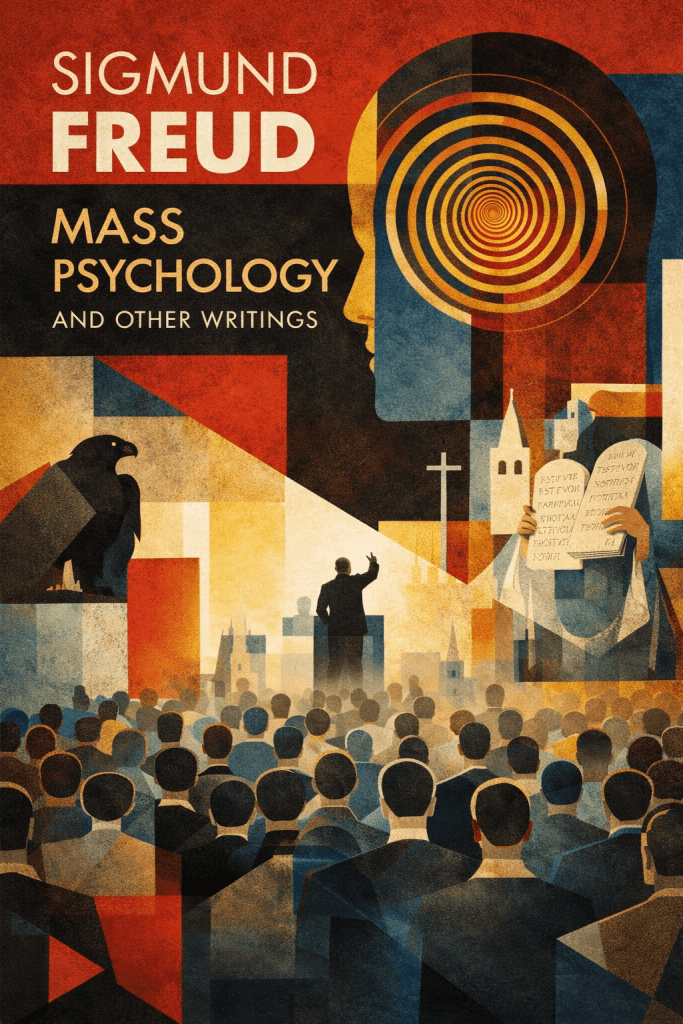
This Penguin Modern Classics volume of Freud’s writings on mass psychology, translated by J. A. Underwood and framed by an introduction from Jacqueline Rose, gathers Freud’s most sustained attempts to render collective life intelligible from within the conceptual resources of psychoanalysis. Its central problem-space concerns the permeability between individual mental life and social formation: how a psyche that appears solitary in introspection is, in its very constitution, “peopled” by others, and how the psychic mechanisms that stabilize a person’s self-relation can be reconfigured—sometimes rapidly, sometimes across centuries—into the binding forces of churches, armies, peoples, and traditions. The book’s specific distinction is in the way it treats mass phenomena, religious belief, and historical memory as sites where psychoanalytic categories are both tested and transformed, yielding a study of social cohesion that remains methodologically explicit, conceptually risky, and internally tensioned.
The book’s editorial architecture immediately conditions how it should be read as a system. The contents page presents an apparently simple series—an early essay on compulsive ritual, the major treatise on mass psychology, a brief piece titled “A Religious Experience,” the extended polemic and analysis of religion as illusion, the late composite work on Moses and monotheism with multiple forewords and internal subdivisions, and finally a short intervention on anti-Semitism.
Yet the introduction insists that the commonplace separation between “individual” psychoanalysis and “social” psychology becomes unstable under scrutiny, and it does so by taking Freud’s own opening move in Mass Psychology and Analysis of the ‘I’ as a programmatic statement: the opposition between individual and mass psychology loses sharpness once one attends to the fact that “the other” is constitutive of mental life. That claim is not presented as a rhetorical flourish; it functions as a guiding rule for reading the selection as a whole. The introduction’s insistence that our psychic life is a palimpsest of models, objects, helpers, and foes, and that the psyche is itself a “social space,” establishes a hermeneutic stance in which the book’s several genres—clinical analogy, social theory, cultural critique, and speculative reconstruction—are treated as variations on a single explanatory ambition: to show how the relational grammar of desire, identification, and authority persists across the boundaries that ordinary discourse draws between private symptom and public institution.
This interpretative stance is reinforced by the bibliographical and legal paratexts on the copyright page, which specify original publication contexts and dates across more than three decades: the earliest item, “Compulsive Actions and Religious Exercises,” appears as a pre-war journal essay; the mass-psychology treatise appears in the early interwar period as a standalone publication; “A Religious Experience” appears as a short piece in Imago; The Future of an Illusion appears as an interwar book; Moses the Man and Monotheistic Religion appears in 1938 as a late work published in Amsterdam; and “A Comment on anti-Semitism” appears in a Paris journal in late 1938, with an editorial bracket in the text itself noting that it was presented as Freud’s first publication since exile from Vienna.
The book thereby stages, within its own material composition, an encounter between psychoanalysis and European history that is neither purely external context nor merely anecdotal background. Rose’s introduction makes this historical pressure explicit by situating these writings under the shadow of the catastrophes of the twentieth century, remarking that—apart from one short exception—the texts were written after the First World War, while the Moses work was composed as the Second World War approached, and by tracing in Vienna’s political and anti-Semitic developments a mass politics that Freud could not treat as an abstract object.
Even when a reader remains methodologically internal to Freud’s own texts, the editorial decision to gather these particular writings, and to lead them with an introduction that narrates their historical horizon, makes it difficult to treat “mass psychology” as a merely theoretical domain. The authorial text, translator’s mediation, editorial framing, and institutional publication contexts form a layered object whose meaning depends on how one navigates those layers.
Underwood’s translator’s preface is crucial for understanding how the English text constructs Freud’s conceptual discipline. The preface refuses the fantasy of the translator’s invisibility, and the refusal is presented as an ethical and methodological necessity in the case of an author who repeatedly thematizes language. Underwood characterizes his task as manufacturing a “transparent illusion of equivalence,” thereby acknowledging a paradox that will resonate with Freud’s own account of religious and cultural illusion: an illusion can be methodically produced, it can be regulated by constraints, and it can function as a necessary medium without thereby dissolving into mere arbitrariness.
Underwood’s polemic against Strachey’s practice in the Standard Edition—especially the invention of technical neologisms such as “cathexis,” built from Freud’s ordinary word Besetzung—is not merely a translator’s complaint about style. It sets a philosophical orientation toward Freud’s conceptuality: Freud’s terms, on this view, should be allowed to remain close to ordinary language even when they carry technical force, because Freud’s own theoretical strategy depends upon precisely that oscillation between the ordinary and the metapsychological.
Underwood’s preference for translating Besetzung without importing a pseudo-Greek apparatus, and his complaint that Strachey “put a lot in,” implies that the English reader should be permitted to experience Freud’s movement from everyday speech into technical determination as an internal movement of the text, rather than as an effect imposed by a translator’s systematic jargon.
The preface also explains the book’s internal annotation policy: original notes are translated; additional contributions by the translator appear in square brackets, as do English translations of German titles in Freud’s notes. This is an explicit statement about editorial layering within the body of the text, and it matters. Freud’s writings here repeatedly analyze how an authority can be installed within the subject as an internalized ideal or law. Underwood’s square-bracket practice installs a visible mark of mediation, thereby preventing the reader from confusing translator authority with authorial voice. The book’s apparatus becomes an object lesson in how “voices” can be distinguished without pretending that mediation is absent.
The result is a reading environment in which stratification is not an inconvenience; it is part of the work’s own theme, a formal analogue to Freud’s claim that psychic life contains differentiated agencies and that social formations embed and redistribute authority.
If one reads the volume as an integrated system, the first striking feature is that the earliest essay on compulsive action serves to function as more than an antiquarian prologue. It introduces, in miniature, a method that will later be enlarged into social theory: argument by analogy grounded in clinical observation, guided by a discipline of inference that neither collapses difference nor treats resemblance as superficial.
Freud begins from a similarity that had been noticed before—the resemblance between compulsive actions in nervous persons and the routines by which believers testify to piety—and he insists that the resemblance has depth rather than mere appearance. The term “ceremonial,” attached to compulsive actions, becomes for him a clue: it signals that the neurotic’s private ritual is already structurally social, already oriented toward a law-like form, already marked by scruple, repetition, and the management of anxiety through symbolic act.
The significance of this early move is that it treats “religious practice” and “neurotic symptom” as two configurations of a single formal problem: how an agent relates to a demand that is experienced as binding, opaque in origin, and nevertheless felt as necessary. The essay thereby installs one of the volume’s persistent tensions: the interpretive gain achieved by reducing religious practice to a mechanism recognizable in pathology coexists with the risk of explaining away religion’s distinct social function.
Freud’s own text sustains this tension by presenting the analogy as a venture grounded in understanding “how neurotic ceremonial comes about,” and by treating the analogy as a way to infer “mental processes of religious life,” rather than as an identity claim. In the book’s overall system, this early essay supplies a formal template for later arguments: ritual repetition, anxiety management, and the binding power of symbolic actions will recur, but they will be refunctioned within a broader account of mass formation, tradition, and historical latency.
The mass-psychology treatise then performs a decisive expansion and re-specification of the problem. Its very title in Underwood’s translation—Mass Psychology and Analysis of the ‘I’—already signals a methodological wager: that “the mass” and “the ‘I’” can be analyzed in a single conceptual field, and that the ‘I’ itself contains strata whose analysis is inseparable from social relation.
Freud’s opening thesis, echoed by Rose, states that the antithesis between individual and social psychology loses sharpness; and the treatise proceeds by operationalizing that claim. The “other” is no longer merely the object of desire or the model for identification; it becomes the structural medium through which an individual’s relation to itself is organized.
The treatise is famously intertextual: it engages Le Bon’s portrayal of the mass mind, considers other appreciations of collective mental life, and moves through themes of suggestion, libido, church and army, identification, hypnosis, herd instinct, primal horde, and the internal level of the ego—rendered here as an internal differentiation between ‘I’ and ‘I’-ideal.
Yet to read this as a sequence of topics would miss the systematic transformation enacted across the treatise. The text’s movement is more aptly described as a progressive shifts of explanatory burden: it begins in the orbit of descriptive social psychology, where the mass is associated with suggestibility, contagion, and diminished intellectual responsibility; it then transfers explanatory responsibility to psychoanalytic mechanisms, chiefly libidinal ties and identification; it finally internalizes these mechanisms within the structure of the ‘I’ itself, culminating in the claim that the “miracle” of mass formation involves an exchange or surrender of the ‘I’-ideal for a mass-ideal embodied in the leader.
The conceptual pivot here is Freud’s reconstruction of “suggestion.” Rather than treating suggestion as an irreducible social force, he treats it as a name for a phenomenon whose mechanism requires explanation, and he proposes that libido—the energy of love broadly construed, including inhibited aim and transformed attachment—supplies that mechanism.
This proposal does not simply add a new causal factor; it re-describes the mass relation as a set of affective investments. The mass is bound by ties that are, in Freud’s sense, erotic, even when their surface content is political, military, or religious. The philosophical audacity consists in the expansion of “love” beyond the interpersonal and sexual domain into a general theory of social cohesion: a group holds together because each member stands in a libidinal relation to the leader and, through that relation, to one another.
Freud’s analysis of two “artificial masses,” church and army, is structurally decisive because it renders explicit the dual form of attachment: horizontal ties among members are mediated by a vertical tie to an ideal figure, whether Christ or commander.
In these artificial masses Freud finds a model of the mass fantasy: the leader loves all equally. This fantasy is not treated merely as a belief; it is treated as a psychic condition of cohesion, a premise that stabilizes identification and curbs internal rivalry by guaranteeing an equal relation to the ideal object. The mass thereby becomes intelligible as a libidinal economy: the distribution of love, and the assurance of equal access to the loved figure, regulates aggression within the group and relocates aggression toward outsiders.
This relocation reveals another of the volume’s persistent tensions: social cohesion and social violence arise from the same libidinal mechanism. Freud’s analysis does not require a separate “dark” principle to explain cruelty; cruelty can emerge as the consequence of the same attachments that produce solidarity.
When the ideal object is installed as the mediator of love, those who fall outside the mediated field can become targets of hostility. The text’s conceptual discipline here is striking: hostility is not added as an afterthought; it follows from the structure of identification itself. To identify with a group is to accept a criterion of belonging, and criteria of belonging invite exclusion. The “mass” thereby appears as a psychic formation with an intrinsic boundary function.
The problem becomes sharper once Freud links mass formation to the primitive social hypothesis of the “primal horde.” In doing so, he imports into the mass treatise a mythic-anthropological construction that is already associated, within Freud’s corpus, with the origin of law, guilt, and the symbolic. In this volume, the invocation of the primal horde is not simply speculative flourish, it functions as a way of grounding the leader relation in a more primordial schema of paternal authority and brotherhood.
The leader becomes the successor of the primal father; the group becomes a fraternity constituted under the sign of a shared submission and a shared renunciation. Here the mass-psychology treatise begins to anticipate the Moses work’s fixation on murder, guilt, latency, and tradition, even before those motifs arrive in their explicitly historical form.
The treatise’s later movement—especially in the section “A level within the ego”—is where the book’s system sharpens. Freud asserts that each individual is a component of many masses, tied in many directions through identification, and that each has built an ‘I’-ideal from a variety of models: race, class, religious community, nationality, and more.
This multiplicity is not meant as sociological description alone, it becomes a claim about psychic structure. The ‘I’ is internally differentiated; it contains an ideal that can judge, command, and produce guilt, and it can be temporarily neutralized or merged with the ‘I’ itself, producing triumphal affect analogous to mania. Freud thereby brings into mass theory the psychopathology of mood and the metapsychology of internal agency.
The mass “miracle” becomes a special case of a more general mechanism: the surrender of the ‘I’-ideal to an external embodiment, which then regulates the subject’s self-relation. Once this internal architecture is in view, hypnosis and being in love become privileged analogies: both involve a restriction of the subject’s critical agency and a concentration of libidinal investment in an object that replaces the ‘I’-ideal.
Freud’s insistence on the dual type of attachment—identification and the placing of the object in the position of the ‘I’-ideal—provides the treatise with a conceptual closure that is also an opening into the rest of the volume. For if the ‘I’-ideal is the internalized locus of authority, then religious illusion, tradition, and historical memory can be analyzed as formations that stabilize themselves by occupying, shaping, or exploiting that locus.
Seen from this perspective, the volume’s placement of “A Religious Experience” after the mass treatise is not incidental. The piece’s brevity functions as a methodological hinge. Whereas the mass treatise unfolds a systematic apparatus, “A Religious Experience” presents a focused encounter with a phenomenon that can be read in several registers at once: as testimony, as symptom, as cultural form, as experiential claim. Its selection suggests an editorial intention to hold open the space between lived experience and theoretical explanation.
In the mass treatise, religious formation is treated primarily as a model of artificial mass; in “A Religious Experience,” the concept of religion is pulled back toward the intimate event of subjective meaning. The system thereby resists a simple reduction of the religious to group mechanics. At the same time, the very title invites the reader to ask what counts as “religious” in a psychoanalytic framework: whether the designation refers to content (God, sacred object), form (overwhelming affect, conversion-like structure), or function (binding, reassurance, protection against anxiety). The volume does not resolve this question here; instead it sets it as a problem that The Future of an Illusion will attempt to stabilize in a more explicitly theoretical way.
The Future of an Illusion is, within this volume, the text where Freud’s Enlightenment impulse becomes most overt and most burdened. The opening establishes a methodological caution: to ask about the fate of a culture and its future changes is to venture beyond what most individuals can overview, and ignorance of past and present weakens judgement. This caution is not mere modesty; it is a way of situating cultural prognosis within epistemic limits.
Freud thereby frames his analysis into religion as both necessary and precarious. He is not simply “attacking religion”; he is attempting to understand, within a theory of culture, why certain representations and institutions persist despite their dubious truth status, and how culture might transform without them. The concept of “illusion” becomes the organizing category. Its philosophical role is delicate.
An illusion, for Freud, is not defined simply by falsity; it is characterized by its relation to wish, its genesis in desire and need. This permits a conceptual distinction between error and illusion: an error may arise from ignorance or miscalculation, whereas an illusion is bound to the affective economy of the subject and the culture.
The distinction carries methodological consequences: illusions are resistant to refutation because they are sustained by libidinal investment. One thereby sees the mass-psychology treatise re-enter the religious analysis from another side. In the mass treatise, the leader’s equal love is a mass fantasy that binds; in The Future of an Illusion, religious doctrine becomes a cultural product whose binding force derives from its capacity to satisfy wishes for protection, meaning, and moral order.
Freud’s analysis of religion in The Future of an Illusion is structurally ambivalent, and the book’s system depends on preserving that ambivalence. On the one hand, religion is treated as a kind of collective childishness: a dependence on a paternal figure projected into the cosmos, offering consolation against nature’s indifference and the dangers of life. On the other hand, religion is acknowledged as a cultural instrument that performs work: it binds communities, curbs aggression, provides a framework for renunciation of drives, and supplies motivations for ethical conduct.
The tension is internal to Freud’s method. His psychoanalytic explanation of religion’s genesis threatens to undermine religion’s normative authority by tracing it to infantile need; yet his sociological realism recognizes that cultures have relied upon precisely those authorities to stabilize themselves. The text’s argument-like movement can be read as a repeated attempt to bring these aspects into a single conceptual picture: religion as a psychic mechanism of consolation and as a cultural technology of governance.
The concept of “renunciation of drives” becomes pivotal here, and it echoes the mass treatise’s account of the ‘I’-ideal as the sum of restrictions the ‘I’ should observe. In both contexts, Freud’s underlying claim is that civilization requires restriction, that restriction produces discontent and resistance, and that cultural forms must manage that resistance. Religion manages it by offering compensations and by sanctifying prohibitions; psychoanalytic enlightenment would manage it by understanding, education, and an acceptance of reality less saturated by wish.
The book’s internal tension becomes especially visible in Freud’s treatment of reason. He presents reason as slow, weak in persuasion, and lacking the immediate consolations of illusion. This does not read as a triumphant rationalism; it reads as a sober diagnosis of the psychic conditions under which rationality operates.
Reason competes with libidinally charged representations. Even when reason’s claims are compelling, they lack the affective binding power that illusions possess. Here the volume’s translator’s preface quietly resonates again: the “transparent illusion of equivalence” is offered as a disciplined necessity, and Freud’s “illusion” is offered as a cultural necessity that one might hope to outgrow. Both cases involve an illusion that is not simply a deception; it is a medium structured by constraints, serving a function in the economy of understanding or culture. The book’s system thereby invites a subtle thought: the critique of illusion is itself conducted through forms that rely upon regulated fictions. The critique does not collapse, yet it acquires a reflexive tension that prevents it from becoming a simple moral denunciation.
If one returns, at this point, to the early essay on compulsive ceremonial, one can see how The Future of an Illusion both inherits and transforms it. The early essay locates religious-like practice in the structure of obsessional symptom, emphasizing repetition, scruple, and the management of anxiety. The Future of an Illusion generalizes the mechanism, treating religion as a cultural formation of wish-fulfilment and as a means of managing fear and helplessness. The formal resemblance remains, yet the explanatory register shifts.
Obsessional ceremonial is explained through individual psychopathology; religious doctrine is explained through collective need and cultural transmission. The shift introduces a methodological problem that Freud does not conceal: the passage from individual to culture is neither a mere scaling up nor a direct deduction. It requires mediating concepts—tradition, education, authority, institutional enforcement. Freud’s analysis thus becomes less purely clinical and more sociological, even as it remains psychoanalytic in its core causal vocabulary. The volume’s integrated character depends on this widening: the same categories—wish, drive, renunciation, identification—are repeatedly redeployed under altered conditions, and each redeployment places pressure on their meaning.
That pressure reaches its highest intensity in Moses the Man and Monotheistic Religion, whose internal composition is itself explicitly layered. The table of contents, as encoded in the volume’s internal navigation, distinguishes parts, forewords, and datings: “Moses an Egyptian,” “If Moses was an Egyptian…,” and “Moses, His People, and Monotheistic Religion,” with a “Part One Foreword I (before March 1938)” and a “Foreword II (in June 1938),” followed by “Part Two Summary and Restatement” subdivided into thematic units: the people of Israel, the great man, progress in spirituality, renunciation of drives, truth content of religion, recurrence of the repressed, historical truth, historical development.
This compositional stratification is significant because it externalizes the work’s own self-relation. Freud does not present his Moses thesis as a seamless narrative. He frames it repeatedly, offers forewords that situate the argument’s status and difficulty, and provides a summary and restatement that reorganizes the preceding material into a conceptual schema. The work thereby stages its own effort to stabilize itself under the pressure of evidential uncertainty, political danger, and theoretical ambition.
The Moses work’s governing wager can be stated in a way that remains internal to the text’s own categories: that the formation of a people bound by monotheistic religion can be understood through the same psychoanalytic mechanisms that Freud uses to understand symptom formation, repression, and the return of the repressed, provided that one introduces the mediating notion of tradition and a “latency period.”
The work’s famous thesis that Moses was an Egyptian is less important, in the book’s system, as a historical claim than as a lever for reconfiguring the concept of religious origin. By displacing Moses from Israelite origin, Freud opens a space in which monotheism appears as a transmission, an adoption, and an imposed law, rather than as an organic emanation of a people’s spontaneous spirit. This displacement intensifies the problem of authority. Monotheism becomes bound to the figure of a “great man,” and the people’s relation to that figure becomes a problem of identification, obedience, and guilt.
Here the mass-psychology treatise returns in transformed guise. The leader of the mass, who embodies the mass ideal, reappears as Moses, whose authority founds a tradition that outlasts him. Yet the Moses work goes beyond the mass treatise by making the leader relation historical in a strict sense: it asks how a leader’s authority can persist after death, how it can become law, how it can be internalized as a religious demand, and how it can generate hostility and endurance across generations.
The work’s conceptual core is organized around repression and recurrence. Freud argues for a structure in which an event—most dramatically, a murder—can be repressed, remain latent, and return in altered form as religious tradition, doctrine, and ritual. The analogy with individual psychopathology is explicit in the foreword’s thematic headings, including “The analogy” and “Application.” This explicitness is methodologically revealing. Freud treats his historical reconstruction as analogous to clinical reconstruction: both infer from present formations back to hidden events that explain them.
Yet the analogy is not treated as self-evident; Freud registers “difficulties,” and the structure of the work itself embodies those difficulties by repeatedly framing, restating, and qualifying. The philosophical problem thus becomes twofold. First, there is the epistemological problem of historical truth: what warrants attach to reconstructions that cannot be directly verified? Second, there is the ontological problem of tradition: how can something repressed become transmissible? In individual psychology, repression concerns an individual’s memory and affects; in cultural psychology, the carriers of repression are multiple subjects across time. Freud’s solution, internal to the text, is to treat tradition as a medium through which traces can be carried without conscious knowledge, and to treat the latency period as a structural analogue of the temporal gaps observed in symptom formation. Tradition becomes, in effect, a social unconscious, or at least a medium in which unconscious traces can be conserved and reactivated.
This move generates one of the volume’s most productive internal frictions. In the mass-psychology treatise, the mass is often characterized by immediacy: the rapid formation of transitory crowds, the sudden disappearance of individual development “without trace,” the replacement of critical agency by suggestion. Yet Freud also notes, in the treatise, the existence of steady, long-lasting mass formations—race, class, religious community, nationality—whose continuity is less visible but more pervasive. The Moses work takes this second dimension and radicalizes it: a people is treated as a mass formation sustained by long temporal arcs, and the decisive psychic work occurs across generations rather than in moments of crowd contagion.
The concept of the mass thus expands from spatial aggregation to temporal continuity. The leader relation expands from charismatic immediacy to the afterlife of authority in law and tradition. The ‘I’-ideal expands from a psychic agency within an individual to a socially stabilized ideal embedded in a religious system. The volume thereby effects a systematic transformation of its own categories: the same mechanism of identification that explains a soldier’s devotion to a commander is refunctioned to explain a people’s devotion to an invisible God, mediated through the figure of Moses and the tradition that attributes divine law to his mediation.
The Moses work’s subdivision “Progress in spirituality” and “Renunciation of drives” connects it back to The Future of an Illusion in a way that complicates that earlier text’s rationalist horizon. In The Future of an Illusion, Freud hopes for a future in which humanity can abandon religious illusion and ground its ethical life in reason, even while acknowledging the psychic difficulty of such a transition. In the Moses work, the emergence of monotheism is treated as a form of “progress,” linked to an abstraction away from sensory representation and toward an invisible, demanding deity.
This progress is inseparable from intensified renunciation: the demands of the religion produce restrictions and ethical formations. Yet the Moses work’s concept of “truth content of religion” complicates the simple dichotomy between illusion and reality. Freud introduces, within the work, a distinction between different senses of truth—explicitly thematized as “historical truth” and as forms of truth that can persist in tradition even when historical evidence is uncertain. The volume thereby installs a dialectical tension between critique and recognition. Religion is treated as illusion in the sense of wish-fulfilment, yet religion is also treated as a bearer of truths about psychic history, guilt, authority, and renunciation. The truth is not located primarily in doctrinal propositions about the world; it is located in what the religion encodes about human psychological development and social formation. This does not vindicate religion as doctrine; it repositions religion as symptom and archive.
The philosophical discipline of this repositioning depends upon Freud’s repeated insistence on recurrence of the repressed. “Recurrence” is the category that binds together individual symptom, mass cohesion, and historical tradition. In the early essay, the repressed returns as compulsive act; in the mass treatise, archaic structures return as leader devotion and herd-like formation; in the Moses work, an archaic event returns as monotheistic tradition and as the persistence of guilt and law. The motif recurs with altered valence: initially it is a clinical mechanism; later it becomes a social mechanism; finally it becomes an historical mechanism.
With each transformation, the category acquires new responsibilities. It must explain not merely why an individual repeats, but how a group stabilizes itself, and how a people carries a memory it does not consciously possess. This inflation of responsibility creates pressure on the category: recurrence must now account for institutional mediation, textual transmission, and collective identity. Freud’s own text responds by thickening the mediating concepts: latency, tradition, the great man, the people, and the internalization of law.
At this point, the brief final text, “A Comment on anti-Semitism,” assumes a function that exceeds its length. The piece is bracketed with an editorial note identifying its first publication and emphasizing its status as Freud’s first publication since exile. In its content Freud reports having studied press and literature statements occasioned by recent Jewish persecutions and having encountered an “extraordinary” article whose excerpts he selects.
The importance of this gesture lies in its restraint and its method. Freud does not offer a sweeping treatise here; he performs an act of selection and citation, guided by a critical judgement about what is “extraordinary.” The method aligns with psychoanalysis’s attention to symptomatic utterances: a text encountered in the public sphere becomes an object whose formulations reveal something about the psychic economy of anti-Semitism.
Within the volume’s system, this short piece functions as a concrete instantiation of the mass-psychology thesis that collective hatred cannot be understood solely as rational calculation or political strategy; it must be approached as a phenomenon with affective and identificatory roots. The Moses work had already placed anti-Semitism within a long historical and religious horizon, linking it to monotheism, tradition, and the burdens of ethical demand. The “Comment” brings the problem into the present tense of persecution and exile, thereby closing the volume with an alignment between theoretical analysis and lived historical threat.
Rose’s introduction, placed before the translator’s preface and the texts, is itself a layer that participates in this systematic closure. It begins by confronting the assumption that psychoanalysis deals only with individual bourgeois subjects, and it mobilizes Freud’s own opening to deny that assumption. It then situates the writings historically, emphasizing that the catastrophe of European war and the rise of anti-Semitism shadow Freud’s writing life. It thereby supplies a frame in which the volume’s theoretical claims are read under historical pressure.
This frame is not merely contextual; it shapes the reader’s sense of what Freud is doing when he speaks of church, army, leader, and people. The introduction also explicitly cites Freud’s phrase about the antithesis between individual and social psychology losing sharpness, and it elaborates the idea of the mind as a palimpsest of figures. The philosophical effect is to prime the reader to attend to internal traces, to treat “the other” as constitutive, and to read mass formation as a reorganization of internal relations rather than as an external force acting on a self-sufficient individual.
When one gathers these layers—the translator’s declared resistance to imported jargon, the visible marking of bracketed additions, the introduction’s insistence on social constitution, and the selection’s temporal arc from 1907 to 1938—one can see that the book’s unity is not simply thematic. It is architectonic.
The texts collectively perform a migration of psychoanalytic categories across domains while forcing those categories to transform under new burdens. Libido, identification, the ‘I’-ideal, illusion, renunciation of drives, repression, latency, tradition: each concept appears, is deployed, and is redeployed with altered function. The redeployments are not always seamless.
The book deliberately leaves visible the points at which Freud’s method strains: the transition from clinical observation to social theory; the reliance on Le Bon and others as descriptive prompts; the invocation of primal-horde hypotheses; the speculative historical reconstruction in Moses; the oscillation between critique of religion as illusion and recognition of religion as bearer of a certain truth content. These strains are not failures that the volume attempts to conceal; they are the very sites where Freud’s ambition shows itself as ambition rather than settled doctrine.
A particularly instructive internal friction concerns the status of evidence. Freud repeatedly insists on psychoanalysis as a science grounded in clinical material, yet the volume’s social and historical writings necessarily operate with indirect evidence: descriptions of crowds, institutional structures, textual traditions, and historical conjectures.
Freud compensates by making method explicit. In the mass treatise, he uses comparative reading of social-psychological authors and then seeks a psychoanalytic mechanism that can explain the observed features. In The Future of an Illusion, he begins with epistemic caution and then treats religion as a cultural formation whose genesis can be inferred from human helplessness and wish. In Moses, he offers forewords that lay out premises, analogies, and difficulties, and he provides a summary and restatement that reorganizes the argument into conceptual units, including an explicit focus on “historical truth.”
The work thereby functions as a laboratory of inferential strategies: analogy, reconstruction, conceptual unification, and explicit recognition of difficulty. The volume’s neutral tone is not a mere stylistic choice; it is the form in which Freud conducts these strategies, keeping evaluative heat subordinate to explanatory discipline.
Another key point concerns the concept of authority. In the mass treatise, authority is embodied in the leader and internalized as the mass ideal; in The Future of an Illusion, authority is projected into a paternal God who guarantees moral order; in Moses, authority is traced to a great man whose law becomes tradition; in the early essay, authority appears as a compulsion experienced as binding without transparent origin. Across these texts, authority repeatedly appears as something that operates through love.
The leader is loved, the God is loved and feared, the law is loved as ideal, the compulsion is obeyed as if it were sacred. Freud’s insistence on libidinal ties thus forces a philosophical complication: authority cannot be adequately understood as external coercion alone. It is sustained by affective investment, and that investment is capable of producing both cohesion and cruelty.
The concept of the ‘I’-ideal condenses this complication. It is the internal authority that judges the ‘I’ and can produce guilt and inferiority; it is also the agency that can be surrendered to a leader or merged with the ‘I’ in triumph. The internal architecture of authority thereby becomes the hinge between private conscience and public devotion. The volume as a whole reads as a prolonged attempt to render that hinge intelligible.
A further problem concerns the relation between enlightenment and symptom. Freud’s critique of religion in The Future of an Illusion is oriented toward a hoped-for maturity in which culture can do without religious wish-fulfilments. Yet the mass treatise and the Moses work repeatedly show how deeply psychic life relies upon formations that resemble illusion: the mass needs the fantasy of equal love by the leader; tradition carries traces without conscious knowledge; the ‘I’ itself is structured by ideals that may be stricter than reality warrants.
The volume thus places pressure on any simple narrative of disenchantment. Even where Freud advocates the replacement of religious illusion by rational insight, his own analysis suggests that human sociality relies on idealizations, identifications, and internal authorities that have an illusory structure in the sense that they exceed empirical reality and are sustained by wish and investment. The book does not dissolve into scepticism; it constructs a more demanding problem: how rationality can operate within, and in relation to, a psychic economy that continually generates ideal formations. In this respect, the translator’s insistence on avoiding artificially technical neologisms has philosophical import: it allows the reader to feel how Freud’s concepts hover near ordinary ideals and loves, rather than being quarantined in a specialist metalanguage. The proximity intensifies the question of whether the mechanisms Freud describes are exceptional pathologies or general conditions of human culture.
The editorial notes—distributed as “Notes” sections after the introduction and after each major division—also play a systemic role. They exhibit the book’s commitment to philological and contextual clarification, yet, by Underwood’s own policy statement, they also mark translator intervention. The notes thereby instantiate the volume’s own theme of mediation: a text can be bound to an apparatus that clarifies, cites, and sometimes supplements; yet the apparatus must remain distinguishable from the authorial voice. The reader is asked to practice a form of interpretive hygiene: to recognize that meaning emerges from an interaction between text and apparatus without collapsing them. This competence becomes especially important in Moses, where forewords and restatements already produce internal layers, and where the question of “historical truth” is itself an object of analysis. The volume trains the reader to perceive layers, and that training is part of the book’s philosophical work.
In the end, the volume’s internal architecture stabilizes its central tensions only partially, and it does so in a way that appears deliberate. The tension between individual and mass psychology is stabilized by the claim that the ‘I’ is internally structured by relations to others and by ideals, making social formation a reorganization of internal agencies rather than an external add-on. The tension between religion as illusion and religion as cultural binder is stabilized by distinguishing religion’s truth as wish-fulfilment from its truth content as an encoding of psychic history and ethical renunciation. The tension between evidence and reconstruction is stabilized by the explicitness of method and by the layered composition of Moses, which repeatedly frames its own difficulty.
Yet other tensions remain unresolved in a strong sense. The aspiration to cultural maturity persists alongside the diagnosis of reason’s limited persuasive power. The attempt to explain mass cohesion through love persists alongside the recognition that love-based identifications can generate aggression. The use of analogy persists alongside the recognition that the passage from individual symptom to cultural tradition requires mediations that are never fully captured by a single mechanism. The book thereby remains a demanding reading that requires patience for unresolved contradictions that are held in view rather than dissolved.
 Simon Gros
Leave a comment