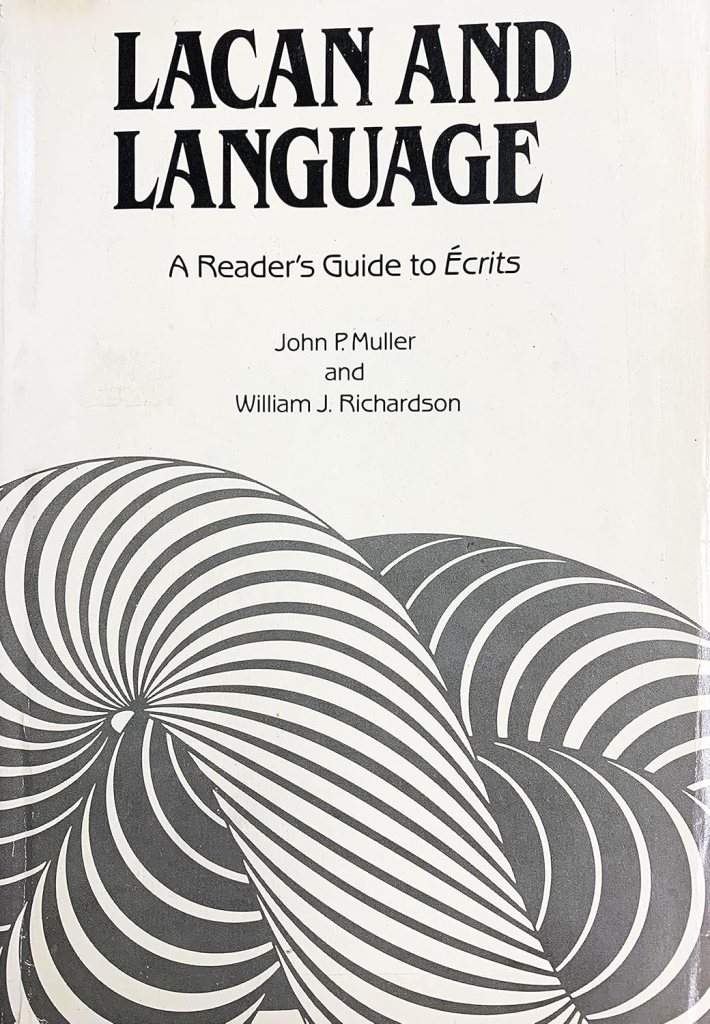
This book stands as an extraordinarily rigorous and lucidly subtle instrument designed to guide any serious reader through the labyrinthine terrain that constitutes Jacques Lacan’s Écrits. Its authors, John P. Muller and William J. Richardson, address themselves to a daunting intellectual challenge: to bring into focus a complex variety of thought in which Jacques Lacan’s prose, notoriously resistant to linear explanation, is fully recognized as being both forbiddingly difficult and infinitely rewarding. The work does not retreat into facile simplifications; on the contrary, it employs with exceptional thoroughness the very tools needed to disclose the true contours of Lacan’s fundamental insight that psychoanalysis is at heart a talking cure, a form of dialogue in which words and their resonances carry the subject, both analyst and analysand, beyond the mere banality of conscious egoic discourse and into a domain where language itself reveals the deeper truths of being.
In so doing, it affirms that Lacan’s persistent stylistic difficulties, rather than representing mere obscurantism, form a deliberate strategy crafted to invite the reader into a living experience of the very processes he names as central to the unconscious and its structural character. The authors set out to show that behind every impenetrable sentence, every rhetorical flourish, every seeming paradox, lies a conceptual key that can unlock the inner architecture of meaning—a meaning that ultimately converges on a fundamental recognition: the unconscious is structured like a language, and the psychoanalytic encounter, if properly understood, unfolds as a narrative in which the subject’s desire, fears, and fragmented selves find articulation, metamorphosis, and at last some measure of intelligibility through verbal exchange.
The book’s approach is carefully attuned to the historical and theoretical context from which Lacan’s thought emerged. It reveals that, far from being a mere enigma, Lacan’s style is a precise demonstration of the unconscious processes Freud discovered and that Lacan reinterpreted by placing signifier and signified at the heart of psychic life. Muller’s and Richardson’s exposition is deeply philosophical and sets the stage for understanding Lacan’s entire undertaking as a return to Freud, one that frees psychoanalysis from simplistic biologism, reductive adaptationism, or the sentimental overemphasis on affective warmth. Instead, we are led to see psychoanalysis as a reordering of the subject’s entire being through speech.
Speech is not simply an external tool, a convenient medium of exchange: it is what literally allows the subject to emerge, to realize that selfhood is not an immediate given but something produced within the symbolic network that language weaves. Therefore, the guiding motif of this reading guide is to demonstrate that through Lacan’s writings, a crucial rethinking of Freudian concepts is achieved: where Freud opened the world of dreams, slips of the tongue, and jokes to psychoanalytic interpretation, Lacan formalized these phenomena within the linguistic dimension, making it possible to clarify them with a subtlety and delicacy equal to their complexity. The reader gradually discovers that the entire Freudian discovery takes on an entirely different coloration once placed under the lens of language. The unconscious emerges not as a repository of repressed images or energies alone, but as a dynamic exchange of signifiers, a chain of meanings that insist rather than exist, that remain elusive except through acts of speech that constantly redefine and reorder them.
This guide’s great merit lies in the painstaking clarity with which it attempts to present Lacan’s ideas without sacrificing their irreducible complexity. Far from flattening Lacan’s doctrines into a neat summary, it instructs the patient, serious reader in navigating them, illuminating the inflection of key terms, and clarifying their interrelational bonds. It shows how, for Lacan, the primary enigma was always the relationship between language and the unconscious.
In his famous dictum that the unconscious is structured like a language, he does not simply mean that unconscious representations resemble words, but that the very logic of unconscious processes follows the laws of signification, that the unconscious must be read rather than simply excavated. This reading itself necessitates an understanding of metaphor and metonymy, of how desire slides along associative chains of signifiers, and of how the subject is born into a discourse that predates and shapes him. It is precisely this sort of conceptual elaboration that the authors supply: they contextualize Lacan’s references, making sense of his reliance on structural linguistics, showing how he invests Saussure’s concepts of the signifier and signified with a new psychoanalytic valence, and how he draws on Jakobson’s analysis of metaphor and metonymy to model the mechanisms of condensation and displacement in dreams. The guide likewise clarifies Lacan’s recourse to Lévi-Strauss, illuminating how structures of kinship and myth resonate with the symbolic order that Lacan designates as the true field of psychoanalysis.
What emerges is an appreciation of how everything in Lacan’s system—from the mirror stage that establishes the ego as an alienated image, to the Oedipus complex as structured by the paternal metaphor, to the intricate relationships among the Imaginary, Symbolic, and Real—derives its proper sense only when we hold firmly to the linguistic analogy. The book shows that the mirror stage, far from being a quaint developmental anecdote, is the inaugural moment in which the human organism is captured by an image that gives it unity at the price of alienation, an alienation that will haunt all subsequent identifications. Just as the subject is born into a pre-existing language and finds itself shaped by words and codes it never chose, so too it confronts the mirror image as a form that organizes its experience of the body and reality. The authors make us see that Lacan’s early work on the mirror stage and aggressivity is not some separate concern but is deeply integrated into his mature linguistic turn. The ego is revealed as a construction whose illusions are sustained by the Imaginary dimension, and only by piercing through these illusions with the analytic word can the subject reach a level of authenticity closer to the truth of desire.
The guide likewise underscores the central theme that the analytic cure depends on speech addressed to another who listens in a particular way. The analyst does not guide the patient by offering scientific certainties or moral guidelines, but by adopting a stance that allows the subject’s unconscious to speak. The authors highlight that Lacan returned psychoanalysis to its roots in free association and made listening to the signifiers uttered by the patient the central methodological principle. Instead of forcing interpretations, the analyst allows the patient’s own speech to reveal the hidden nodes of meaning, the repressed signifiers that carry the weight of unconscious desire. Thus, we learn that every symptom is like a rebus, requiring deciphering, and once the symptom’s meaning is fully integrated into the patient’s history as a signifying formation, its raison d’être vanishes. The guide excels in showing how Lacan takes Freud’s initial linguistic insights—Freud’s realization that dreams are like rebuses, that slips and jokes follow linguistic rules—and turns them into a principle of universal scope: that all of psychoanalysis is a hermeneutics of language, a relentless effort to restore lost or censored words, to articulate what has never been fully spoken.
In its efforts to assist readers in grasping Lacan’s theorization of the unconscious as a linguistic structure, the book is careful to preserve the daunting complexity and not reduce it to mere slogans. It reveals that comprehending Lacan involves understanding that the unconscious is always another text, that the subject’s truth is not contained wholly in his conscious script. The unconscious resides in those gaps, distortions, ambiguities, and strange echoes that inhabit every human utterance. We are guided to recognize that psychoanalysis, in Lacan’s vision, is neither an explanatory science of hidden drives nor a technique of adaptation, but rather a mode of interpretation that allows the subject to re-historicize his life. By granting speech the power to reorder his past, the subject can come to situate himself differently with respect to his desires and to the symbolic constraints that shape his destiny.
Moreover, the authors display profound insight into how this linguistic perspective influences the notion of analytic training and practice. In a milieu dominated by attempts to standardize technique or to reduce psychoanalysis to a form of re-education, they show that Lacan demands a more radical understanding of what analytic formation entails. One must become a “past master” in the art of reading the unconscious text of the patient’s discourse. This involves, as they stress with utmost clarity, a training that requires familiarity not only with psychological theory but with fields as diverse as linguistics, rhetoric, anthropology, the study of myths, literature, and even the techniques of poetics and logic. The complexity of Lacan’s enterprise calls for an unusually broad cultural and intellectual horizon in the analyst, since understanding the unconscious as language means that the analyst must be well versed in the myriad ways in which meaning, metaphor, narrative, and structure take shape in culture. This extends beyond the patient’s individual psyche into the history of civilization itself, for the unconscious is defined not by individual biography alone but by its embedding in a symbolic order shared among subjects.
As a consequence, the book as a whole constitutes a singular bridge between Lacan’s most tortuous formulations and the disciplined reader’s sincere desire for comprehension. It avoids the worst temptations of vulgarization. Instead, it offers a methodology of reading that exemplifies how one might approach Lacan: patiently working through difficulties, consulting the references, unfolding the implications of particular Lacanian statements, and situating them in relation to Freud’s original discoveries. In this way, the guide stands as a model of the hermeneutic practice it champions, a shining example of the very analytical stance that invites the reader to participate actively in the construction of meaning. It shows that Lacan’s texts, once navigated with proper guidance, yield their treasures to those who neither flee the complexity nor imagine it can be stripped down to a few catchphrases. The authors emphasize that the subtlety of Lacan’s position ensures that every step gained in understanding involves entering deeper into the network of signifiers that structure human subjectivity.
This book allows us to see that far from being an unapproachable oracular figure, Lacan emerges as a thinker who possessed an original understanding of human subjectivity and who found a unique way to communicate it—namely, through texts that demand that the reader undergo a certain transformative experience. Because Lacan’s style is itself a demonstration of the unconscious at work, to read him seriously is to participate in one’s own analytic journey.
By offering a rigorously reasoned framework for approaching this journey, the authors make possible a truer encounter with Lacan’s achievement. The result is that the patient, persevering reader, guided by their commentary, gradually comes to inhabit Lacan’s conceptual world not as a passive consumer of information but as a reflective subject, attuned to the rhythms and resonances of language. Through this engagement, one comes closer to understanding why Lacan insisted that psychoanalysis does not simply help people adapt to their environment, but sets them on the path to discovering their desire. It is here, the guide shows, that the whole enterprise of analyzing language in psychoanalysis finds its meaning: to foster in the subject a renewed capacity for genuine speech, that is, speech that does not lie, a speech by which the subject can at last claim responsibility for what he says and who he is.
 Simon Gros
Leave a comment