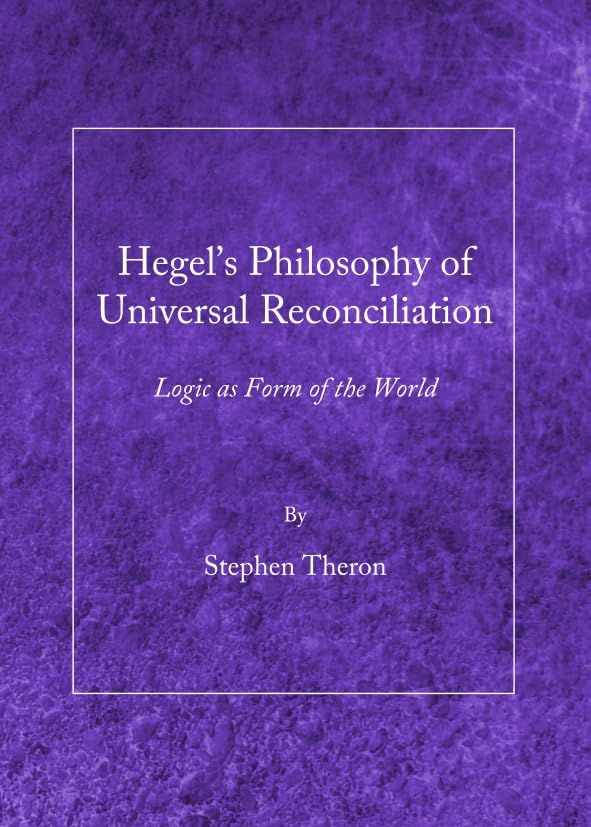
Hegel’s Philosophy of Universal Reconciliation: Logic as Form of the World by Stephen Theron represents a culmination of a presentation of Hegel’s theology and metaphysics, positioned as the final entry in a series dedicated to Hegel as theologian. This series, inaugurated with New Hegelian Essays (2012) and developed through From Narrative to Necessity (2012) and Reason’s Developing Self-Revelation (2013), charts the journey of Hegel’s thought as it transcends “picture-thinking” and realizes its apex in the concept of the Idea, or humanity’s accomplished future.
Theron’s subtitle, Logic as Form of the World, draws upon Frege’s penetrating question, “What is the world without the reason?” This rhetorical inquiry anchors the essence of the book’s argument: for Hegel, logic is not merely a formal system but the very structure of reality, a self-articulating, dynamic process through which Mind realizes itself in the world. The reconciliation of God and humanity, a core theme in Hegel’s theological philosophy, is revisited and rigorously analyzed. Theron delineates the philosophical underpinnings of this reconciliation, arguing that faith—traditionally seen as a religious virtue—can be understood as a habitual orientation of rationality, integrating faith within the rational system of Hegel’s philosophy.
This exploration begins with an analysis of the intimate union between God and man, expressed through the Christian confessional tradition but distilled here into the framework of philosophical reason. The notion of “Begotten not Made,” a cornerstone of Trinitarian theology, is philosophically transfigured into an eternal process of generation, wherein the Word is eternally uttered, and all creation participates in this divine utterance. Theron navigates this terrain with a depth that merges theological insight with philosophical exactitude, presenting a vision in which human existence and divine activity coalesce in an eternal dynamic of mutual generation.
As Theron progresses through Hegel’s philosophy, the discussion naturally leads to an exposition of the nature of faith and rationality. The insufficiency of religious apologetics in comparison to philosophy is laid bare; where religion operates in symbols and representations, philosophy realizes these symbols in their conceptual truth. This shift from representation to conceptual mediation marks a critical transition in Hegel’s thought, where the finite forms of religious belief are subsumed into the infinite rationality of the Idea. In Theron’s hands, this movement is not reflection on the nature of truth, freedom, and self-realization.
This culmination is articulated in the chapter “Logic and the World,” where Theron explicates the final achievementof Hegel’s system. Logic, as the form of the world, is shown to be inherently dynamic and self-reconciling, issuing forth in what Hegel and McTaggart identify as rational will—or, in a more humanistic and ethical register, love. This identification of logical form with the ethical will signifies the ultimate unity of thought and being, where humanity’s self-transcending nature is both the form of the world and the form of itself. The individual becomes universal, and the universal individual, in a process that mirrors the Aristotelian conception of form and actuality while surpassing it in the dialectical depth of Hegelian thought.
Theron’s philosophical narrative traverses historical, theological, and metaphysical dimensions, offering reflections on medieval thought, the role of the clergy, and the implications of Marxism. These reflections serve as both a contextual grounding for Hegel’s philosophy and a demonstration of its transformative power. Hegel’s thought, as Theron presents it, not only elucidates the doctrine of divine creation but also develops the doctrine of development itself. This recursive and anticipatory dynamic reaches a zenith reminiscent of J. H. Newman’s Essay on the Development of Christian Doctrine (1845), where the evolution of doctrine is shown to be an organic unfolding of the Idea within history.
Theron’s erudition is evident not only in his philosophical arguments but also in his keen engagement with Hegel’s Encyclopaedia of the Philosophical Sciences and the broader tradition of idealist philosophy. References to Aristotle, Augustine, McTaggart, and Frege weave a dense variety of philosophical thought, situating Hegel’s logic within a tradition that is both ancient and modern. This intertextual engagement reinforces the book’s central thesis: that logic, as the form of the world, is the medium through which reconciliation is achieved, where Mind finds itself in the world and the world reveals itself as the expression of Mind.
Hegel’s Philosophy of Universal Reconciliation offers a vision of philosophy as a system of absolute knowledge, where every finite determination finds its place within the self-moving, self-reconciling process of the Idea. The transformative effect of Hegel’s philosophy, as Theron demonstrates, lies in its ability to dissolve the alienation between thought and being, faith and reason, God and humanity. In this reconciliation, philosophy fulfills the promise of religion, not by negating it but by bringing it to conceptual completion. Theron’s work, dense and demanding, invites the reader to participate in this philosophical reading, to think through the dialectic of reconciliation and to recognize logic as not merely a human invention but as the very form of the world itself.
 Simon Gros
Leave a comment