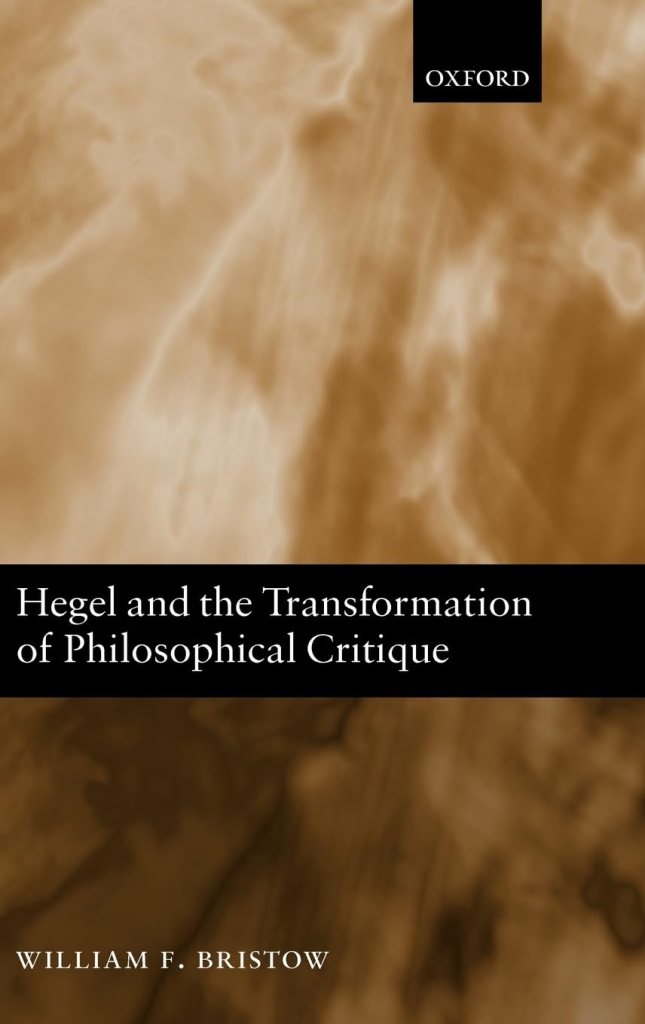
William F. Bristow’s Hegel and the Transformation of Philosophical Critique offers an analysis of the epistemological confrontation between Hegel and Kant, one that defines one of the most consequential moments in the history of modern European philosophy. In this rigorous study, Bristow examines Hegel’s Phenomenology of Spirit as a bold response to, and transformation of, the critical project initiated by Kant’s Critique of Pure Reason. Bristow’s work distinguishes itself by taking seriously the existential dimension of Hegel’s project—the “way of despair”—which Bristow argues is not merely a romantic embellishment but integral to Hegel’s strategy for overcoming Kantian subjectivism. The book reveals how Hegel’s method of self-loss and self-transformation is the very means by which he proposes to satisfy the demands of critique while moving beyond the limitations Kant imposes.
At the core of this work is a lucid reconstruction of Hegel’s objection to Kantian critique. Kant, in seeking to ground the possibility of metaphysical knowledge through a reflective inquiry into the limits of human cognition, Bristow explains, inadvertently circumscribes knowledge within the bounds of subjectivity. The conditions for knowledge in Kant’s system—the a priori forms of sensibility and the categories of the understanding—are subjective in the sense that they pertain to knowledge as it is structured by the human cognitive apparatus. The Kantian notion that we can only know things as they appear to us, not as they are in themselves, is the source of what Hegel identifies as a fundamental subjectivism in Kant’s philosophy. Bristow shows that for Hegel, the critical demand that knowledge justify itself in reflection cannot be met if the reflection presupposes an unbridgeable gulf between thought and being.
Yet, Bristow is careful to present Hegel’s critique of Kant with full philosophical charity. He does not allow Hegel to dismiss Kant’s insights lightly. Instead, Bristow tracks Hegel’s evolution from a wholesale rejection of the Kantian project in his early Jena writings to a more nuanced engagement with it in the Phenomenology of Spirit. In this later work, Hegel comes to recognize that the epistemological ambition expressed in Kant’s critical philosophy—the ambition to provide an account of the conditions of rational knowledge—is one that cannot be abandoned. The task, then, becomes one of transforming Kant’s critique so that it does not fall prey to the subjectivism inherent in Kant’s method.
The key to this transformation, Bristow argues, is the existential dimension of Hegel’s critique. In the Phenomenology of Spirit, the process of critique is not a detached, reflective exercise but a lived, transformative experience. Hegel’s “way of despair” refers to the subject’s willingness to risk its own self-conception, to undergo the dissolution of its own certainties, in the pursuit of truth. This self-transformational aspect of Hegel’s critique is what enables him to meet the demands of critical reflection without presupposing the fixity of the knowing subject. In Hegel’s method, the criteria by which knowledge is judged are themselves subject to revision through the course of the inquiry. Thus, knowledge and the knowing subject are co-constituted in a dynamic process that overcomes the rigid subject-object dichotomy that Kant’s philosophy reinforces.
Bristow’s analysis is particularly illuminating in demonstrating how Hegel’s method of immanent critique allows for the possibility of absolute knowledge. Unlike Kant’s approach, which brackets the possibility of knowing things in themselves, Hegel’s phenomenological method seeks to overcome this limitation by showing how consciousness, in reflecting upon itself, comes to recognize its own determinations as constitutive of reality. For Hegel, the categories are not merely subjective forms imposed on an independent reality; they are expressions of a rational structure that consciousness discovers within itself and the world. This presuppositionless inquiry into the movement of consciousness reveals a dialectical process in which subject and object, thought and being, are ultimately reconciled.
One of the most striking aspects of Bristow’s interpretation is his account of how Hegel’s critique of Kant challenges the modern notion of autonomy. Kant’s conception of critique is grounded in the idea that reason must legislate its own norms. For Kant, the authority of these norms derives from their being intelligible to the reflecting subject. However, Bristow argues that this commitment to the intelligibility of norms for the subject is itself a form of subjectivism, insofar as it restricts the scope of knowledge to what can be validated within the bounds of subjective reflection. Hegel’s response to this challenge is to propose a form of autonomy that is not fixed but dynamic, an autonomy that emerges through the subject’s openness to self-transformation. In Hegel’s view, true autonomy requires the subject to risk itself, to allow its criteria of rationality to be reshaped through the process of critique.
In his closing reflections, Bristow situates Hegel’s transformation of Kantian critique within the broader context of contemporary debates in epistemology and philosophy of mind. He shows how Hegel’s insights into the co-constitution of subject and object offer a compelling alternative to the dualistic frameworks that continue to haunt modern thought. By emphasizing the existential stakes of Hegel’s critique, Bristow also highlights the relevance of Hegelian philosophy to questions of selfhood, identity, and the possibility of transformative knowledge.
Bristow’s book is, therefore, not merely an exercise in historical scholarship but a work of original philosophy. It challenges us to rethink the nature of critique, the limits of subjectivity, and the possibility of knowing the world as it truly is. His engagement with Hegel and Kant, his sensitivity to the existential dimension of philosophical inquiry, and his clarity in articulating complex ideas make Hegel and the Transformation of Philosophical Critique essential reading for anyone grappling with the legacy of German idealism. In Bristow’s hands, Hegel is seen not as a dogmatic metaphysician but as a philosopher who dared to risk everything in the quest for absolute knowledge—a quest that remains as exhilarating and perilous today as it was in Hegel’s time.
 Simon Gros
Leave a comment