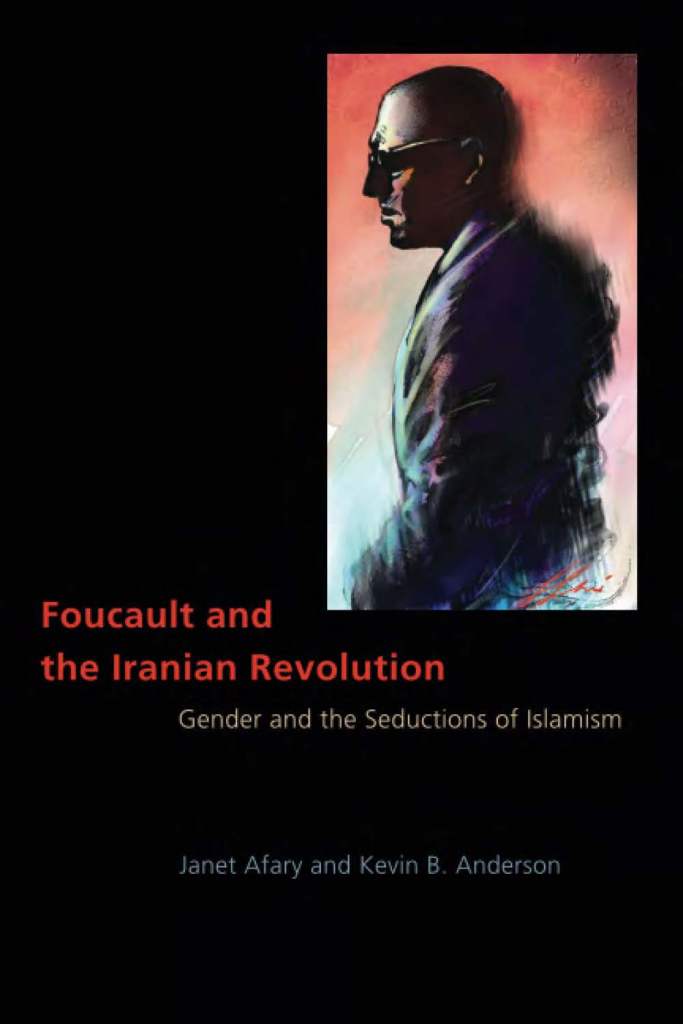
Foucault and the Iranian Revolution: Gender and the Seductions of Islamism by Janet Afary and Kevin B. Anderson offers a deeply layered, contextualized, and philosophical analysis of a historical encounter that still reverberates through contemporary intellectual landscapes. Within its pages, readers are confronted with the dynamics between a revolutionary upheaval in late 1970s Iran—one charged with a spiritual and political fervour that would topple the Shah’s regime and enthrone an Islamic Republic under the austere guidance of Ayatollah Khomeini—and the astonished yet fascinated gaze of Michel Foucault, one of the twentieth century’s most influential and iconoclastic thinkers. This book, therefore, does not merely analyze a handful of journalistic pieces penned by a renowned French philosopher who seemed, at first glance, to stand apart from any easy ideological categorization; it draws the reader into the very heart of a moment when Western modes of rationality encountered a radically different political spirituality and found themselves unsettled, seduced, perplexed, and compromised. Afary and Anderson deliver a rich variety of evidence—annotated translations of Foucault’s previously untranslated essays on the revolution, careful examinations of contemporary rejoinders from leading critics such as Maxime Rodinson and Simone de Beauvoir, and a sophisticated philosophical inquiry into gender, sexuality, power, and the allure of Islamist discourse—that together form a relentlessly detailed and extraordinarily complex portrait.
The book demands that readers grapple with the very definitions of politics, revolution, and authenticity. Foucault, previously known for his analyses of Western regimes of truth, punishment, discipline, and sexuality, here encounters a phenomenon that refuses to submit to the guiding assumptions of the secular, Enlightenment-oriented frameworks he so often critiqued. Instead, in the Iranian Revolution of 1978–79, he appears to discover a counterdiscourse, a possibility of “political spirituality” that challenges both Western materialist narratives and the well-trodden paths of socialist or communist revolutionary paradigms. The reader witnesses Foucault’s excitement and willingness to embrace an uprising that, in his view, seemed to promise a radical departure from the rationalizing forces he had so carefully dissected at home. Yet Afary and Anderson do not allow us to remain at that seductive surface level. They peel back the layers to show that Foucault’s celebration of the revolution’s religious core, his romanticizing of a collective existential experience on the streets of Tehran, and his dismissal of liberal, democratic, or feminist warnings reveal fault lines in his conceptual architecture. The authors bring into sharp relief how his lack of engagement with feminist discourse, his troubling stance toward Iranian women’s rights, and his willingness to overlook certain authoritarian tendencies of the nascent Islamist regime complicate any simplistic reading of his involvement.
The narrative unfolds against the backdrop of an Iran at a historical crossroads. The old Pahlavi order, bolstered by Western interests and ideology, had sought modernization from above and systematically suppressed dissent. The revolutionary surge that took shape under Khomeini’s leadership, though diverse and multifaceted, expressed an aspiration to restore authenticity, spirituality, and cultural continuity against what was perceived as oppressive foreign domination. It is here that Foucault’s writings—published in European newspapers and magazines—offered a startling counterpoint to the usual narratives of Iran. Instead of deploring a potentially theocratic future, he seemed entranced by the mass demonstrations, the penetrating role of Shi’ite mysticism, and the willingness of ordinary people to embrace danger, martyrdom, and even death in the name of faith. Afary and Anderson’s scholarship shows that Foucault’s captivation derived from his own philosophical quest to escape Western paradigms of power and to find alternative models of resistance, yet this search led him into perilous territory. The authors point out that while Foucault intuited something genuinely new and world-altering—what he called “political spirituality”—he also failed to ask difficult questions about the direction this spirituality might take once institutionalized. He overlooked those who would soon be marginalized: women, religious and ethnic minorities, and homosexuals. His silence on these matters, especially at key historical junctures where feminists and Middle East scholars sounded the alarm, is scrutinized by the authors with exceptional nuance and fairness, placing his stance in direct dialogue with harsh critiques and urgent warnings from contemporaries.
Central to the book is the revelation that the Iranian episode was not merely a footnote to Foucault’s career, but rather a complex event that illuminated some of his central philosophical preoccupations. Afary and Anderson show that his sojourn into Iranian politics offered him a direct encounter with techniques of resistance that relied heavily on religious and cultural idioms rather than on the secular Enlightenment tradition he had so often interrogated. Yet, ironically, his openness to Islamic militancy’s authenticity came at the cost of overlooking its repressive potential and the suffering it would inflict on many Iranians after the initial euphoria subsided. The thorough presentation of annotated translations of Foucault’s Iran writings allows readers to experience the immediacy of his reflections: the excitement in his voice, the underlying biases and limitations of his analyses, and ultimately the absence of a robust theoretical framework capable of dealing adequately with gender oppression and religious authoritarianism. Complementing these writings are the detailed responses of his critics. Rodinson’s commentary, which warned against idealizing a political force that could yield “a type of archaic fascism,” and de Beauvoir’s solidarity message to Iranian women’s demonstrations, sharply contrast with Foucault’s own ruminations and show the complexity of the intellectual debates swirling in Paris at that time. The exchanges of these voices—Foucault, his critics, the Iranian feminists, and the historians of Islam—provides readers with an extraordinarily rich source of philosophical tension and intellectual cross-examination.
The book functions simultaneously as a history of ideas and a deeply conceptual investigation. Afary and Anderson carefully situate Foucault’s writings within the evolution of his own thought, tracing how his earlier critiques of modern disciplinary power and his nascent interest in the “technologies of the self” influenced his response to the events in Iran. They engage thoroughly with his well-known genealogical methods, his critiques of Enlightenment rationality, and his fascination with the Greco-Roman concept of ethical self-mastery. By placing the Iranian Revolution within Foucault’s shifting perspectives, they highlight how deeply these events shaped his subsequent turn to examining ethics, sexuality, and the care of the self. At the same time, the authors do not flinch from noting the paradoxes. Here, the philosopher who had dissected punitive power and knowledge systems in the West seemed temporarily dazzled by a mass movement whose leadership, once in power, would impose veiling, sanction the execution of homosexuals, and enforce rigid social norms that belied the dream of a spiritual politics untainted by modern forms of domination. Yet Afary and Anderson do not reduce Foucault to a caricature of intellectual folly; rather, they present him as a thinker genuinely struggling to find alternatives to what he regarded as the stifling horizons of Western modernity, caught in a moment of historical upheaval where his desire to witness something radically new led him to overlook critical voices and feminist forewarnings.
These feminist concerns occupy a central position in the book’s critical apparatus. Afary and Anderson delve deeply into Foucault’s problematic relationship with feminism. They document how he ignored or dismissed the warnings of Iranian and French feminists who predicted that the Islamist regime would curtail women’s rights. They also examine the broader pattern of Foucault’s thought, his relative silence about gender issues in Europe, and his failure to incorporate a systematic feminist critique into his genealogies of power. In so doing, the authors expose a wider lacuna in his philosophical project. The Iranian case, with its stark transformations in the public sphere and its immediate assault on women’s freedoms, served as a glaring reminder that ignoring gender dynamics led to analytical blind spots. The book’s precise and unflinching assessment of these silences makes it essential reading for philosophers, political theorists, historians of the Middle East, and gender studies scholars who strive to understand how high theory intersects with the messy realities of social upheaval.
This intellectual history occurs against the broader background of the West’s relationship with political Islam, a topic that has only gained urgency in the decades since the revolution and especially in the aftermath of the September 11 attacks. Afary and Anderson’s scholarship implicitly raises the question of how Western intellectuals, eager to transcend their own traditions’ constraints, have sometimes romanticized anticolonial or anti-imperialist movements without fully grappling with the authoritarian potentials within them. By illuminating Foucault’s stance, the authors invite readers to reflect anew on what happens when Western thinkers uncritically embrace the “Other” as a source of authenticity and renewal, neglecting to probe how that “Other” might repackage old structures of domination with religious or cultural legitimacy. The text thus resonates with contemporary debates about cultural relativism, human rights, and the moral responsibilities of intellectuals, illustrating that the philosophical inquiries Foucault undertook remain acutely relevant.
By reexamining this moment through critical translations and responses, Afary and Anderson restore Foucault’s Iran writings to the full light of scholarly scrutiny. No longer can these writings be brushed aside as minor miscalculations or peripheral oddities. They form a core puzzle in understanding Foucault’s trajectory—one that compels readers to acknowledge the complexity of his engagement with non-Western traditions and the significance of the lessons he drew (or failed to draw) from the Iranian experience. Far from diminishing Foucault’s intellectual legacy, this critical reengagement with his Iranian episode enriches our appreciation of his work. It reveals the tensions that arise when a philosopher known for diagnosing the hidden operations of Western institutions attempts to comprehend and even celebrate an ostensibly non-Western revolutionary energy. It also sheds light on the fact that philosophical inquiry, no matter how keen or penetrating, cannot be divorced from the concrete and often brutal realities of political life.
Foucault and the Iranian Revolution: Gender and the Seductions of Islamism is thus a tremendously valuable contribution to a variety of fields. It serves as a historical sourcebook, a philosophical critique, and a meditation on the responsibilities of intellectuals who engage with foreign revolutions. It stands as a cautionary tale of what can occur when theory yearns so ardently for an otherworldly political renewal that it fails to heed the voices calling for attention to the concrete conditions of women, sexual minorities, and religious or ethnic groups who are endangered by the very movements that appear to promise liberation. In that sense, the book resonates with contemporary readers who grapple daily with the tensions between cultural authenticity and universal human rights, between local religious traditions and global discourses of equality, and between the transcendent dreams of revolution and the sobering aftermath of power’s triumph.
Long after closing this volume, readers are left pondering how a philosopher as brilliant and unconventional as Foucault could be drawn into the allure of an uprising that soon revealed decidedly illiberal traits. They are left considering how to navigate the minefield of cultural otherness while maintaining a critical stance that does not slip into apologetics. And perhaps most importantly, they are reminded that intellectual inquiry must remain vigilant against the temptation to privilege the sublime aesthetics of collective action and its spiritual fervor over the pressing demands of justice, gender equality, individual dignity, and human flourishing. Afary and Anderson’s work does not merely guide the reader through the complexity of Foucault’s Iranian moment; it immerses them in an ongoing philosophical and moral dialogue that invites careful, critical, and ethically engaged reflection on the entwined legacies of modern revolutions, Western intellectualism, and the seductive yet dangerous promise of political spirituality.
 Simon Gros
Leave a comment