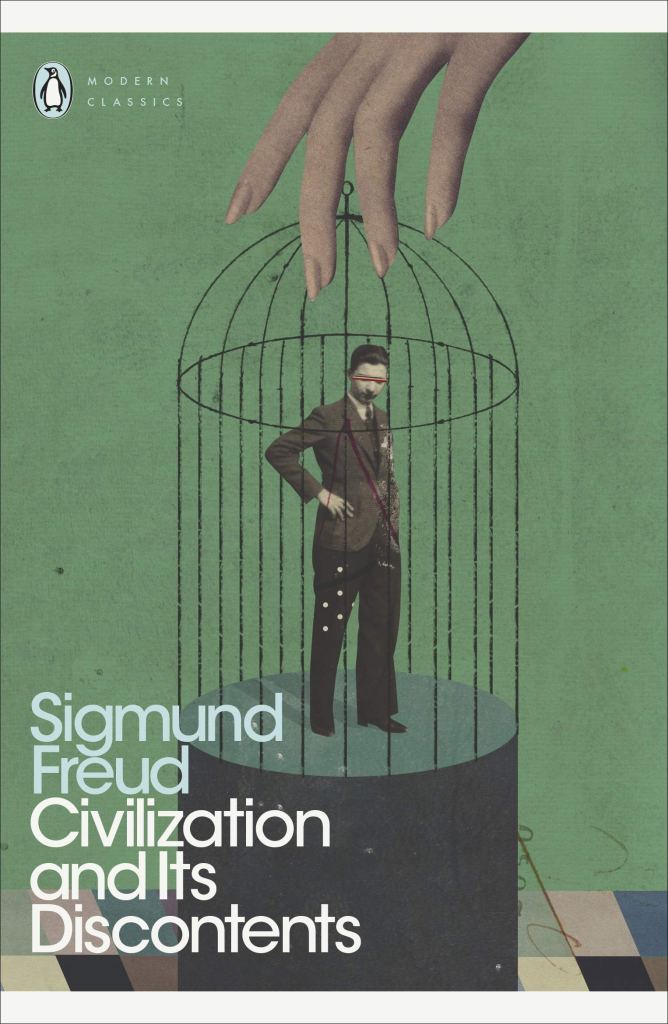
Civilization and Its Discontents, translated by David McLintock, is of Sigmund Freud’s most well-known and troubling meditations on the precarious balance between the individual psyche and the communal demands of modern society. In this pivotal work, first published in 1930, Freud considers the vast historical struggle that has led human beings into forms of collective life, and he exposes how the very achievements that define civilization—the cultivation of order, cleanliness, beauty, intellectual refinement, justice, and the rule of law—bear within them the seeds of profound and inevitable discontent.
In tracing the origins of civilization back to the efforts of humankind to protect itself from the cruel forces of nature and the perils of individual isolation, Freud reveals that what we call progress often comes at the price of significant inner suffering. More than a mere critique of society’s failings, the text unravels the subtle psychological mechanisms through which human beings have come to embrace certain moral restrictions, internalize authority, and repress elemental instincts. Freud shows that neither religion nor advanced science, neither vast accumulations of knowledge nor painstakingly codified ethical systems, can finally spare us the discomfort generated by the tension between our deepest urges and the claims of the collective.
At the heart of this essay lies the recognition that human beings are driven not only by self-preservative instincts that promote survival and object-directed eroticism that fosters communal ties, but also by an immutable, often unconscious aggression. This aggressive component, which Freud identifies as an expression of the death drive, stubbornly resists total reconciliation with the life-affirming forces of love and community. Consequently, the individual’s quest for instinctual freedom stands in perpetual conflict with the community’s demand for restraint, sublimation, and sacrifice. Civilization, Freud argues, can be understood as a fragile and never-completed project to bind people together through cultural achievements, intellectual endeavors, aesthetic ideals, and religious consolations. Yet the more civilization tightens its regulations—imposing taboo, shame, repression, and super-egoic surveillance to maintain order—the more the individual chafes under those restrictions, generating chronic guilt, anxiety, and an ever-present sense of psychological malaise.
Freud’s treatise gains its disquieting depth by unveiling the hidden layers of subjectivity that link infantile helplessness to the longing for a protective paternal authority, the oceanic feeling of boundlessness sometimes experienced as religious ecstasy, the slow process by which love itself is first narrowly directed and then broadened or inhibited, and the ambivalence of libido and destructive energy in our internal lives. According to Freud’s reasoning, when civilization compels us to forgo many direct satisfactions, neither our ingenuity in science and technology nor our cultivation of the sublime in art can extinguish the residual feeling that something important has been lost. He emphasizes that at the earliest levels of development, the primordial family dynamic already imposes drive renunciations that foreshadow the restrictions of larger communities. Later, these larger formations must manage a vastly magnified version of the same tension: how can a multitude of individuals, each wrestling with personal aggressions and desires, live peacefully together without devolving into violent chaos?
Freud locates the core of human spiritual dissatisfaction in the fact that no matter how refined the cultural edifice, no matter how noble the ideals that adorn it, no matter how stringent the moral commandments that order it, civilization’s stability can only be maintained by controlling and deflecting the instincts it aims to exclude. Thus, our capacity to form large social units and maintain them rests largely on a perpetually uneasy compromise: the sublimation of instinctual impulses into less immediately gratifying but culturally enriching activities, the redirection of destructive drives outward against suitable scapegoats or inward against the self, and the cultivation of an internal agency—the super-ego—that presides over the ego with merciless vigilance.
This psychic restructuring, born out of primal ambivalences and old conflicts, instills a permanent sense of guilt. Initially anchored in fear of punishment and loss of parental love, guilt is later internalized, divorced from its original external references, and turned into a ceaseless inner voice that can never be fully appeased. This super-ego, harsh and often stricter than any real authority, pursues the ego’s hidden desires, scorns its temptations, and ensures that even those who appear most virtuous find themselves beset by self-reproach and disquiet. The paradox thus emerges that every advance in cultural sophistication intensifies the demand for instinctual renunciation, and every renunciation deepens the conscience’s severity, culminating in the restless dissatisfaction that defines the modern condition.
In analyzing religion’s role, Freud does not deny that religious sentiment, possibly arising from an “oceanic” feeling of oneness, may offer comfort. He acknowledges religion’s historical utility: it both tames asocial instincts and forges a community of believers bound by illusions and father-longing. Yet he also regards organized religion as exacting an immense psychological toll. By systematically transforming the helplessness of childhood into the imagined protection of a heavenly father, it buoys a civilization’s moral structure but at the cost of inhibiting intellectual freedom, stunting emotional honesty, and leaving unresolved the fundamental instincts that threaten harmony. Religion’s discontents mirror those of civilization at large, for neither can entirely reconcile the deepest wellsprings of human nature with the security, cleanliness, and order they strive to establish.
Freud situates these insights historically, reminding readers that the terrors of World War I played no small part in sharpening his sensitivity to the conflict between the individual’s archaic, aggressive propensities and the cooperative ideals society venerates. The horrors unleashed by rational, technologically advanced nations revealed that behind the veneer of civilization lurked an immense store of cruelty and destructiveness that no thin moral coating could reliably contain. In this light, the moral commandments “Love thy neighbor as thyself” and “Love thine enemies” appear as noble yet fantastically ambitious demands that betray the reality of human ambivalence.
According to Freud, such demands fail precisely because they run so counter to the natural aggressiveness, the hostility, and the selfishness so entrenched in the human psyche. The problem, as he sees it, is not merely one of education or social engineering, but of instinctual constitution. Any civilization that aims to bring large groups together in cooperative harmony must reckon with this internal resistance. The ultimate conclusion Freud reaches is that there may be no final reconciliation, no utopian resolution in which love fully overcomes hate. Instead, the best we can hope for is a never-ending negotiation—a dynamic exchange where civilization attempts to handle the timeless duel between Eros and Death, between the life instincts that seek unity and the destructive impulses that threaten dissolution.
Civilization and Its Discontents, in McLintock’s translation, retains all the urgency and lucidity of Freud’s original language. Its sentences carry the force of a master clinician diagnosing the human condition, as well as a philosopher acknowledging that no final cure is possible. The book’s relentless probing into the origin of morals and conscience, its insistence that guilt is not a simple social artifact but arises from deep inner conflicts that are themselves a product of cultural formation, brings readers to face uncomfortable truths. Freud does not promise relief; rather, he insists that understanding these psychic tensions is itself a kind of liberation, if only a partial one. By exposing the hidden springs of unhappiness that bubble beneath the surfaces of our proudest achievements, the text not only deepens our comprehension of the subjective price we pay for civilization but also situates human suffering in a framework that merges anthropology, psychoanalysis, cultural history, moral philosophy, and plain-eyed realism.
As one reads this description of the fault-lines running through every civilized society, one grasps why this work has been esteemed as one of Freud’s most influential contributions to modern thought. It challenges readers to consider that the very essence of human life is shaped by ongoing contests between contending forces. To find oneself implicated in this tragic complexity can be unsettling, yet it also reveals why Freud’s grim assessment of human destiny has stimulated so much debate, reinterpretation, and critical reflection. The question Freud poses—whether the conditions that civilization creates can truly foster happiness or whether they necessarily produce a form of widespread psychic malaise—resonates through subsequent generations of thinkers, critics, and ordinary individuals struggling to navigate the demands of modern life.
Civilization and Its Discontents is no ordinary cultural commentary. It is a disciplined presentation of the psychological costs of communal living, of the moral edifice erected on layered illusions, and of the eternal conflict between the individual’s pursuit of pleasure and freedom and the society’s imperative for order and mutual restraint. It speaks to anyone who wonders why, in the midst of technological wonders and elaborate moral systems, humans remain prey to anxiety, guilt, frustration, and aggression. It is an invitation to look without flinching at the tensions that animate our deepest interior lives, and to acknowledge that these tensions are not extraneous failings of an otherwise perfectible civilization, but integral elements of the complex human condition.
 Simon Gros
Leave a comment