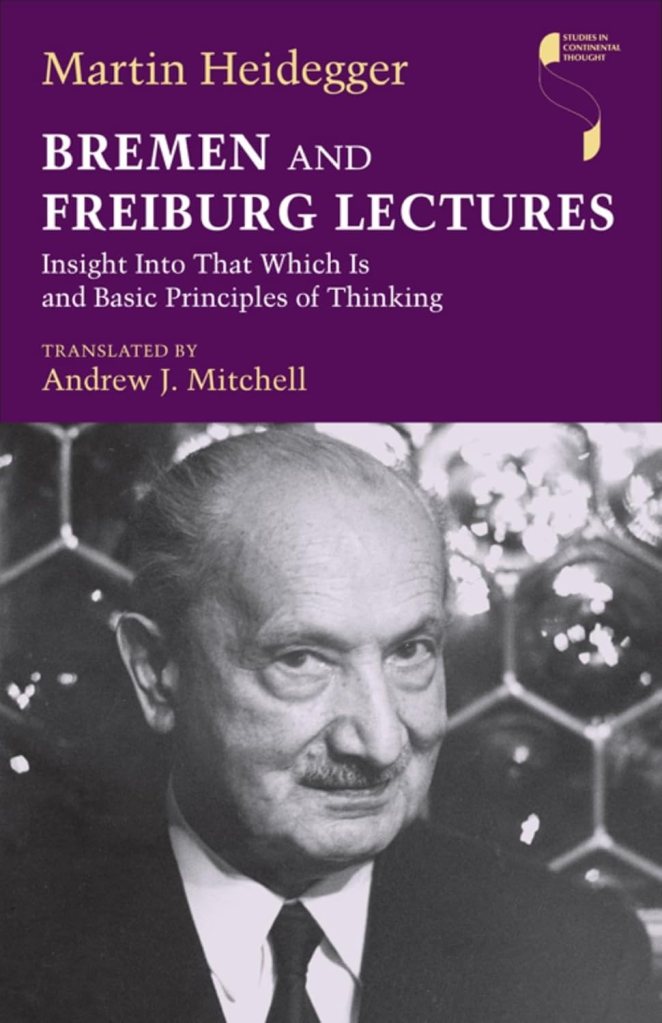
Insight Into That Which Is and Basic Principles of Thinking by Martin Heidegger shows the unceasing flow of philosophical questioning, the subtle folding of language and thought, and the daring confrontation with the concealed essence of what we too readily call reality. This volume, composed of two crucial lecture series delivered in the aftermath of World War II and moving into the charged atmosphere of the mid-twentieth century, provides an exceptionally powerful glimpse into Heidegger’s later meditations and the paths of thinking that run through his engagement with Hölderlin, the German idealists, and the ancient Greek thinkers, all of which resist any simplistic classification. Here, Heidegger does not merely recapitulate his earlier inquiries into the meaning of Being; rather, he brings them into new constellations, enabling them to shine within the haunted epoch of post-war Germany, marking a time not only of technological ascendency and scientific exactitude, but also of a precipitous forgetting of what is essential.
In these pages the reader is drawn into a terrain where Heidegger grapples with the weight and gravity of language itself, treating words not as neutral communicative tools, but as essential sites of an original unfolding in which Being reveals and conceals itself by turns. The lectures that compose this volume, first those given in Bremen—Heidegger’s first public lectures after his official teaching ban—and then those delivered in Freiburg, stand at a unique juncture in Heidegger’s thought. They open themselves to the resonant timbre of Hölderlin’s poetry, expanding previous efforts to think through the question of Being as it was posed in his seminal work Being and Time and subsequently refracted through meditations on language, art, and technology. These lectures do not simply form a continuity with earlier works, but create a new space in which Heidegger’s attempts to think beyond metaphysics, to move from understanding beings to understanding Being, are given fresh impetus. They do so even as they engage directly with the philosophical traditions—Greek and German—whose intellectual provocations first spurred his path of thinking, and whose energies continue to vibrate here, modulating how we approach the very process of thought itself.
The effort of Andrew J. Mitchell’s translation brings these challenging texts fully into the English-speaking philosophical world. The translator’s work is an event unto itself, carefully preserving the tensions and nuances of Heidegger’s lexicon. The text approaches words not as static entities but as pliant forces—nimble, scarce, and precious indicators of a thinking that is always on the edge of language’s capacity to say what must remain partly unsaid. The translator’s attentive rendering allows an encounter with Heidegger’s prose that avoids reductive explanations or forced analogies, instead opening the reader to the full subtlety of the original’s terminological plays and etymological resonances. Terms that Heidegger bends into new shapes—like the “thing” that things, the “world” that worlds, the “near” that nears—find their English correlates as close as possible to their German roots, preserving that originary tension in which thinking takes place as a fundamental event of language. Mitchell’s version, therefore, should not be seen as a mere linguistic transfer but as a philosophical intervention, one that keeps the strange vitality and shaking power of Heidegger’s words available to us without diluting their challenging implications.
As a result, English-speaking readers can now engage with these lectures and perceive crucial moments when Heidegger sets forth his meditations on science and technology—not as the familiar themes that we have often encountered in truncated or decontextualized excerpts, but rather as nodes of a comprehensive, unfolding questioning. These lectures show that Heidegger’s reflection on the essence of technology, his probing of language’s primal essence, and his re-articulation of the relation between mortals and divinities, earth and sky, are not isolated essays one may approach piecemeal. Instead, they form part of a larger movement of thinking characterized by a constant striving to confront the still unthought. In these texts, Heidegger invites us into a realm where the categories of modern metaphysics—subject and object, cause and effect, matter and form—are not simply inadequate but are themselves symptoms of a more pervasive danger, a forgetting that must be understood from within. Only by reading these lectures in their integral arrangement can we witness how the question concerning technology emerges not as a technical inquiry alone, but as a provocation into the heart of Being and the human’s role as a guardian or shepherd of that Being.
Such a reader’s journey also reveals how these lectures, and Heidegger’s endeavor to think what thinking itself might be, constitute a kind of radical introduction—not only for novices approaching his later thought, but also for seasoned interpreters who must re-learn Heidegger’s language anew. The lectures from Freiburg, on “basic principles of thinking,” remind us that what is at stake is not an abstract set of axioms but the very “Grundsätze” that must remain fluid, attuned to the concealed essence of Being’s event. They show Heidegger as he further dismantles the idea that we can rest safely in well-established conceptual frameworks, leading us toward an attentive stance in which thought becomes a listening, a waiting, and a corresponding to the silent claim of Being. This text can serve simultaneously as an introduction and as a deepening of one’s involvement in Heidegger’s thought: for the less familiar, it shows concrete points of entry into his seemingly opaque ideas, while for the more knowledgeable, it re-situates well-known essays and later meditations in their proper textual and historical context.
This volume is an indisputable contribution to English-language Heidegger scholarship. Both its accessibility and its fidelity make it stand apart, allowing the texts to appear in a new clarity where the philosophical rigor and poetic sensitivity of Heidegger’s language are neither flattened nor concealed. These lectures also hold significant interest for the general academic reader, offering insights into historical and political questions pertinent to the period, even while Heidegger’s principal task remains one of radically rethinking the foundations of Western thought. Their importance is thus by no means limited to a narrow philosophical cadre; rather, they speak to anyone who would seek an understanding of the transformations in science, technology, and society that mark our age, and who would question how we might stand in relation to them.
Within the space created by these texts, the subtle dynamic of forgetting and remembering unfolds. We find Heidegger persistently attempting to step back from representational thinking—an attitude that reduces beings to objects at human disposal—toward a commemorative thinking that lets beings appear in their own independence, in the fluid interchange of world and thing, of presence and absence. Such shifts in attunement require that we abandon many of our intellectual habits and engage language in a richer, more patient manner. As the translator’s foreword so carefully details, Heidegger’s reactivation of Germanic roots, of old linguistic usages, and of multivalent terms like Ereignis, Gegen-wart, and Verwindung, is not an etymological ornamentation but a philosophical necessity. It shows how no aspect of language is neutral, and each subtle variation in phrasing can guide thought toward or away from the essential.
Reading these lectures thus becomes less a matter of mastering philosophical content than of undergoing a transformative experience in which we learn to dwell in nearness to truth and essence. The “thing” ceases to be a mere object and becomes a site where earth and sky, mortals and divinities, abide together. The “insight” ceases to be human ocular possession, turning instead into a sudden appropriation in which we ourselves are seen and addressed by the primordial powers of Being. The “basic principles” no longer lie like building blocks at the foundation of a stable theoretical edifice; instead, they are exposed as processes, as ways in which thinking must remain receptive to the ongoing event of truth, language, and world.
The volume ushers us into a philosophical landscape where what matters is neither the mere accumulation of knowledge nor the repetition of inherited concepts, but the capacity to perceive anew what Heidegger calls the fourfold of existence, the interconnections between hiddenness and revelation. It is here that Heidegger locates the possibility of another inception of thinking, one that does not merely reformulate old questions but seeks to transform our relation to the world. In doing so, the text helps us understand that the philosophical act requires not only intellectual effort but a fundamental reorientation of our being-in-the-world. By taking up these lectures, one does not simply learn about Heidegger’s thought; one risks entering into an interval where language, thought, and Being are no longer settled, where the “danger” of technology’s forgetting may suddenly be reversed in a flash of guardianship, and where the “saving power” hinted at by Hölderlin may yet break through.
The significance of this edition, and its indispensable value, stems from the careful translation that not only preserves the complexity and strangeness of Heidegger’s word choice but also exposes the fault lines where meaning is wrested free from familiar conceptual molds. This makes the text invaluable for seminars, collaborative study, and personal contemplation. Students new to Heidegger can discover a less daunting point of entry by following the translator’s subtle signposts, while scholars deeply versed in Heidegger’s thought can return to these lectures and encounter them as if for the first time, free from the filters and fragmentary presentations that have too often shaped the English reception of Heidegger’s later work.
Insight Into That Which Is and Basic Principles of Thinking invites a reflection on the very essence of thinking, into the nature of language, and into the concealed dimensions of our technological age. It encourages a thoughtful vigilance, reminding us that the philosophical path is neither linear nor closed off, but always a fragile crossing, an approach that attempts to preserve the essential while exposed to the winds of forgetting and refusal. Within these lectures, we find Heidegger’s meditations spanning ancient Greek insight, Hölderlinian poetry, and the looming world of technology as a continuously unfolding scene, giving us the rare opportunity to reflect upon our epoch from its depths rather than from its surface. This book is not merely a contribution to scholarship; it represents an essential pathway for entering the clearing where thinking discovers its vocation and where the vibrant tension of word and world resonates anew.
 Simon Gros
Leave a comment