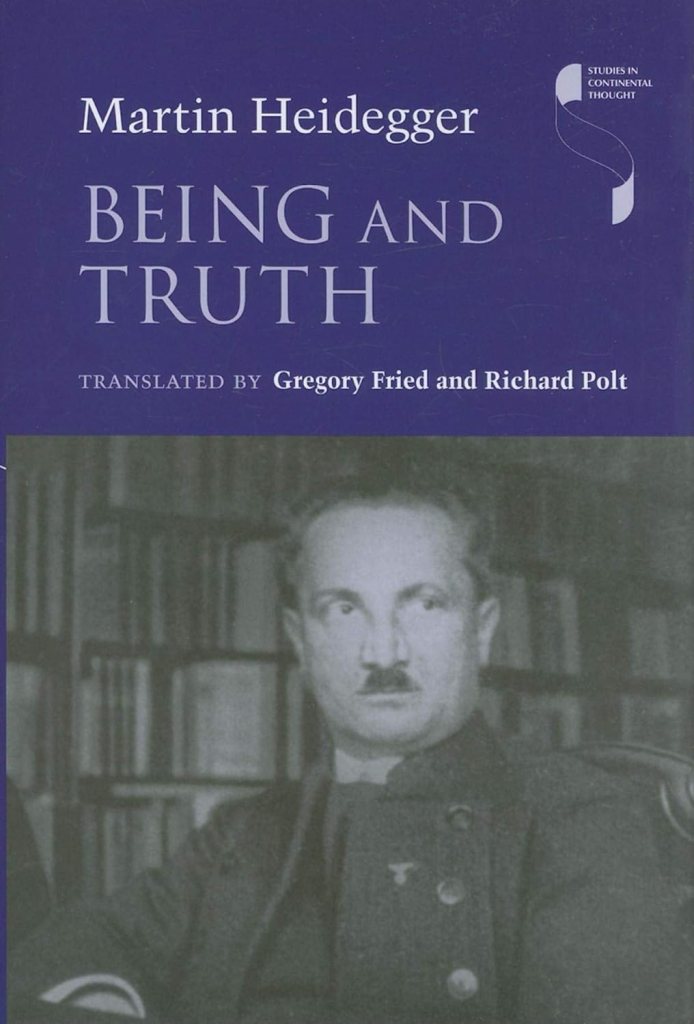
In Martin Heidegger’s Being and Truth, one encounters a text of extraordinary philosophical and interpretive complexity, a work that demands a kind of attentiveness beyond the usual forms of philosophical reading, a work which emerges from a time and place marked by intense political upheaval and ideological fervor. These lectures, delivered in 1933–1934, originate in a historical moment when Heidegger served as Rector of the University of Freiburg, at the height of his involvement with the National Socialist regime. What unfolds within their pages is not a mere historical curiosity nor a simple philosophical treatise, but a sustained inquiry that probes the very roots of Western metaphysics, the meaning and essence of truth, and the role of language, struggle, and peoplehood. The work offers a revealing insight into Heidegger’s thinking at a crucial juncture in his intellectual career, a period in which he sought, with deep ambition and fervor, to integrate his philosophy into the tumult of world-historical events, to bind the fate of thought with the destiny of a people, and to transfigure metaphysical inquiry into something that might genuinely engage and transform a polity.
In these two lecture courses, never fully prepared for publication during Heidegger’s lifetime and only brought to print in German in 2001, the reader confronts Heidegger’s sustained dialogue with a series of philosophical voices reaching back to Heraclitus and stretching forward to Hegel. This arc of thinkers, representing the inception and the culminating turns of the Western metaphysical tradition, frames Heidegger’s attempt to illuminate how the historically sedimented conceptions of Being and Truth have shaped the modern world, rendering it increasingly distant from more original forms of questioning. Heidegger’s aim is not simply to recount a history of ideas, nor to recite doctrines familiar to academic philosophy; rather, in the lectures that comprise Being and Truth, he aspires to place the student and reader into an immediate encounter with the question of what it means for beings to be and for truth to prevail. One sees him searching for a vocabulary sufficient to express how human existence is primordially bound to the superior power of Being, how human Dasein stands in a realm of essential disclosure and concealment, and how truth, traditionally understood as correctness or correspondence, must be grounded in something more originary, more intimately intertwined with the fundamental possibilities of human understanding.
It is precisely in the delicate exchange between the historical horizon of 1933–1934 and the timeless force of fundamental philosophical questioning that this text acquires its extraordinary complexity. While Heidegger stands before his audience as a thinker attempting to respond to the energies and confusions of a revolutionary moment in German political life, he simultaneously attempts to delineate a more profound sense of “revolution” that does not collapse into the biologistic or racial theories advocated by National Socialist ideologues. Heidegger’s approach to the idea of the Volk, or people, exemplifies this tension. On the one hand, he adopts a strongly nationalistic tone, speaking to a Germany in the throes of radical social transformation; on the other hand, he seeks to unmoor that sense of peoplehood from simplistic notions of race, urging instead a deeper understanding of how a people coalesce into a historical destiny. He insists that any authentic people must remain in living dialogue with its own inheritance, questioning and reawakening itself to what it means to belong to a shared heritage, a shared language, a shared horizon of possibility. In this attempt, Heidegger sets himself apart from the more reductive elements of the regime he is simultaneously serving, endeavoring to purify the notion of community by linking it to a metaphysical openness rather than to fixed biological determinations. Yet even as he strives for this conceptual refinement, the reader remains confronted by the troubling historical reality that these lectures are delivered under the shadow of a catastrophic political alignment, illuminating one of the most vexed episodes in twentieth-century intellectual history.
Being and Truth thereby presents a paradoxical synergy of political ambition and philosophical depth. Nowhere is this more evident than in Heidegger’s remarks on language. Throughout these lectures, language is seen not as a mere instrument of communication, nor as a simple system of signs and expressions, but as the primordial domain in which truth itself comes to pass. Heidegger repeatedly stresses that language is not simply an external labeling of objects or states of affairs. Rather, language is that clearing in which beings reveal themselves as what they are; it is the essential medium by which the human being, distinguished from the animal by an open relation to Being, can dwell authentically. He labors to demonstrate that human beings do not first encounter pre-constituted objects and then assign words to them; rather, it is by virtue of our capacity for language that we have a meaningful world at all. Yet this approach to language is complicated by Heidegger’s insistence that the originary ground of language rests in silence, that the capacity for keeping silent—far from being a mere negation of speech—constitutes the fundamental source from which speech emerges. Silence is not a deficiency but a primordial possibility, and in these lectures, Heidegger’s emphasis on silence and reticence stands in stark contrast to the noisy declamation of ideological slogans that characterized much of the era’s public life.
This tension between the essential stillness at the heart of language and the fervid political environment in which Heidegger speaks reveals the layers of complexity that Being and Truth brings into focus. It is a text in which the structure of its language—born of hastily collated lecture notes, varying sources, student transcripts, and Heidegger’s own partial manuscript—reflects the uneven terrain of its subject matter. The translation presented here painstakingly endeavors to remain faithful to Heidegger’s peculiar terminological consistency, striving to track his nuanced use of words like Sein, Seiendes, Dasein, Volk, and Kampf, and working to convey the resonance these terms had in their original historical-linguistic setting. The translators, as they explain, wrestle with manifold textual difficulties, resulting from the varied nature of Heidegger’s delivery: at times careful and precise, at times loose and aphoristic, occasionally elliptical to the point of enigma. The aim is to preserve both the sharp conceptual rigor that Heidegger could display when expounding a thought and the abrupt stylistic transitions that mirror the restless evolution of his thinking as he speaks. In so doing, the translation invites the reader not only into the philosophical content of the lectures but also into the palpable uncertainty that haunts the text, the sense of a thinker testing and retesting the limits of his conceptual apparatus as he confronts the present historical moment.
Thematically, the lectures circle around the question of truth, understood not as an inert property of statements but as something inseparable from the historical unfolding of the understanding of Being. Heidegger moves through the inherited tradition of metaphysics, challenging simplistic definitions of truth and pressing toward a reawakening of the original Greek insight that truth involves unconcealment (ἀλήθεια). He seeks to uproot the preconceptions that have congealed around the idea of truth as mere correctness. By confronting Heraclitus’s conception of war (πόλεμος) as the father of all things, Heidegger aims to show that struggle, in the original Greek sense, is not simply conflict but the dynamic tension that makes possible any disclosure of what is. This insight has political reverberations: at the time of these lectures, the German word Kampf echoes with the energy of contemporary political struggles. Heidegger attempts to appropriate that term away from National Socialist reductionism and turn it into a more originary notion of philosophical contestation, a wrestling with Being itself that should define the essence of a people’s spiritual life. This “spiritual” dimension, once again, must not be confused with theology or religiosity; for Heidegger, spirit signals the realm of self-transcending engagement, astonishment, and meaningful commitment, qualities he believes the National Socialist movement requires but fundamentally misunderstands if it reduces them to mere slogans or racial principles.
Thus, Being and Truth challenges any reader to hold together many layers of meaning. On one level, it is a historical document of enduring controversy, illuminating the complex and fraught relationship between one of the twentieth century’s most influential philosophers and a regime that would plunge the world into unprecedented horror. On another level, it is a profound philosophical meditation on the meaning of truth, the nature of language, and the possibility of a people’s destiny conceived as an ongoing task of questioning and self-interpretation. On yet another level, it constitutes a challenge to the customary ways in which we understand metaphysics, for Heidegger’s argument throughout these lectures urges that we must break free from the habitual patterns of representation, from the easy comfort of pre-given concepts, to re-learn how to stand in awe of the sheer fact that beings are.
In this sense, the complexity of Being and Truth cannot be reduced to an intellectual curiosity or a historical footnote. Instead, it demands that the reader confront precisely that intersection where philosophy and politics, language and silence, tradition and revolution, truth and error, all come to the fore. It demands a self-aware reading that does not flinch from the text’s horrific historical moment, nor fails to acknowledge the audacious reach of its metaphysical ambition. One must read it alert not only to the entanglements of Heidegger’s political alignment but also to the moments where he reaches beyond the crudities of his time, attempting to retrieve the essential powers of thought, speech, and existence itself. The philosophical quest here is to understand the nature of truth differently, to see truth not as a derivative feature of propositions but as something that rules over the entire field of human intelligibility, shaping and structuring the way beings come into presence. This quest, however, is inseparable from the concreteness of human existence in a particular historical community, and this double demand—that philosophy be rigorous and primordial while also politically and historically grounded—situates the text at a complex crossroads.
The present edition’s translation further deepens the reader’s engagement by providing not just a faithful rendering of Heidegger’s conceptual lexicon but also nuanced guidance where the text’s elliptical and fragmentary qualities require careful mediation. Words like Dasein, Volk, Sein, and Kampf, which carry heavy conceptual and historical baggage, are handled with fidelity and consistency, allowing the reader to follow the subtle shifts and emphases in Heidegger’s reasoning. The translator’s afterword and glossary offer the necessary framework to approach these lectures as something more than a monolithic philosophical statement. Rather, they show us a multifaceted artifact: a variety of philosophical meditations, rhetorical strategies, and historically charged utterances. Through this mixture, one can begin to appreciate the singular intensity that marks Heidegger’s attempts to negotiate the meaning of thought in the face of a volatile historical horizon.
In reading Being and Truth, one witnesses how Heidegger’s radical rethinking of philosophy’s basic terms coincides, tragically and problematically, with a readiness to connect these terms to the fate of the German nation. Even as he grapples with Heraclitus, Hegel, and the entire spectrum of the metaphysical tradition, even as he attempts to redefine truth as the becoming-unconcealed of beings and to reimagine the human being as essentially linguistic, he stands under the burden of contemporaneous political engagement. The result is that the text does not yield simple answers or comforting resolutions. Instead, it exposes the dramatic stakes involved in asking fundamental questions about Being and truth in a time of national fervor and political violence. It does not do so through a neutral academic tone, but through a passionate, often urgent style, even when the words themselves vary in register from carefully prepared manuscript passages to looser, more spontaneous formulations drawn from student transcripts.
Thus, this book’s importance lies in its capacity to confront readers with a distinctively Heideggerian vision of what it means to think philosophically at the intersection of metaphysics, language, and life. It invites reflection on the uneasy blending of metaphysical inquiry and political enthusiasm, on the conditions that permit a philosophy to align itself with a revolutionary spirit while simultaneously contesting and subverting some of that revolution’s most pernicious ideas. It asks us to reconsider the boundaries between thought and action, tradition and rupture, and to rethink the responsibility of the philosopher when confronted by the massive and often perilous forces of history. In these ways, Being and Truth stands as a text that cannot be approached lightly. To read it thoroughly is to step into a field of tensions: between the attempt to retrieve an original sense of truth and the complicity with a regime that stood for falsification and horror; between the call to restore the vitality of a people’s spiritual destiny and the reduction of that destiny by others into narrow biological terms; between a linguistic understanding of human existence and the widespread abuse of language for propaganda and subjugation; between the silence that conceals the deepest grounds of speech and the pervasive clamoring of political slogans.
Ultimately, the value of Being and Truth, for those courageous enough to engage with it, lies in the very interstices of these tensions. It is a text that exemplifies the height of Heidegger’s philosophical daring and the depth of his historical entanglement. To read it is to confront the question of whether the pursuit of philosophical authenticity can ever be kept separate from the moral and political conditions of its time. It is to contemplate the nature of truth as an event in which human beings, caught between silence and speech, find themselves both gifted and burdened by the power of Being. It is to consider how a people might shape itself not through the mere repetition of inherited notions but through a vigilant wrestling with essence, destiny, and the concealed grounds of its own existence. It is to reflect on how language itself, when freed from the simplistic notion of being merely a tool, emerges as the medium of revelation and the home of humanity. In short, Being and Truth presents itself as an extraordinary philosophical journey, one that challenges and disturbs, that enlightens and alarms, and that compels the reader to think anew what it means to stand before the fundamental questions of philosophy in a world that is constantly in flux and never lacks for peril.
 Simon Gros
Leave a comment