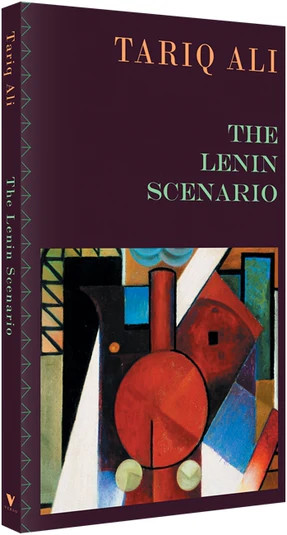
Within the pages of The Lenin Scenario, Tariq Ali ventures into historical imagination with extraordinary rigor, constructing a scenario as lucid in its detail as it is alive in its philosophical implications. What we encounter here is no mere screenplay, no ordinary chronology of events, but a painstakingly accurate dramatic blueprint for the cinematic interpretation of a figure who not only changed the course of a nation’s destiny but also shaped an era’s collective psyche. Published on the centenary of Lenin’s death, this work stands as both a creative endeavor and a contribution to the collective effort to understand, with utmost seriousness, a leader whose legacy has never ceased to intrigue, inspire, repel, and challenge. It does so by layering historical evidence, revolutionary theory, intimate human relationships, and the relentless press of circumstance into a textured tapestry that speaks to cinema, history, and political thought all at once.
In his introduction, Ali acknowledges the difficulty of capturing Lenin on film, conceding the monumental problem of translating the intellectual debates and class struggles, the nerve and verve of clandestine meetings and midnight negotiations, the bristling ideological clarity and the infinitely complex human yearnings, into images that do justice to the man and the times. He laments that earlier attempts to bring Lenin’s life to the screen have floundered, their failure symptomatic of the broader struggle to frame Lenin in ways that move beyond caricature or hagiography.
Yet here, in this first draft, he lays a foundation that seeks a higher fidelity. He insists there is something that must still be reckoned with: a serious cinematic assessment of Lenin, a figure whose name summons the ideological drama of a century, the tension between aspiration and terror, the paradox of liberation and the machinery of state control. In capturing the febrile atmosphere of Russia’s revolutionary ferment, from the smoldering resentment in the countryside to the embattled cries in the factories and barracks, he reminds us that Lenin’s story is also the story of a society that cracked open under the strain of war and oppression. One senses the careful excavation at work here, as if Ali is an archaeologist brushing dust off unstable ruins to reveal pathways that might—if followed with caution—lead us to understand not only what happened in 1917 but why it happened and why it continues to matter.
The Lenin Scenario is poised at the intersection of the personal and the political. The author of The Dilemmas of Lenin, Ali reintroduces us to the character of Vladimir Ilyich Ulyanov not as an austere statue or a mere signifier of ideological fervor, but as a human being bound to others by desire, loyalty, irritation, and love. In these pages, Lenin does not appear as a seamless revolutionary automaton. Instead, we see him as a man shaped by sorrow—his brother’s execution, the brutal weight of Tsarist oppression—and by an intellectual restlessness that chafes against established norms and conventions. We see him in Switzerland, poring over newspapers with exiled comrades; we see him at moments of doubt, wrestling with strategic decisions whose outcomes he cannot fully predict; and, most poignantly, we witness his complex emotional life as it intertwines with that of Inessa Armand and Nadya Krupskaya.
The drama recognizes that the course of revolutionary politics is never just made up of manifestos and decrees, but of human entanglements, long evenings debating matters of fate and freedom, and private hopes that must find room in a life devoted to public struggle. In the swirl of these interpersonal tensions, Ali’s script underlines the philosophical question at its core: Is it possible to love not only an idea but an individual, and to maintain such devotion amidst the ceaseless demands of historical necessity? Can tenderness subsist in a life yoked to a cause that admits no compromise?
What distinguishes this scenario is its refusal to present Lenin as a fixed icon. Ali is interested in Lenin as a problem, both to himself and to others. He explores Lenin’s capacities for ruthlessness and creativity, for empathy and calculation, and he never forgets to position him within the tumult of his era. This Lenin is acutely conscious of the forces at play: war, hunger, anti-Semitic violence, the constant threat of repression, and the stubborn resilience of a ruling order that clings to the old world. Ali’s rendering does not abstract Lenin from his milieu. Instead, it immerses us in the thrum of St. Petersburg’s streets, the fervor of the factories, the disillusionment of soldiers who have seen too much death, and the intellectual crossfire that defines the socialist movement’s internal struggles.
As the screenplay unfolds, we witness the Bolsheviks huddled together to weigh critical decisions, we listen in as Mensheviks and others balk at the speed of events, and we observe how ordinary people—railway workers, sailors, Jewish communities targeted by pogroms—gradually align themselves with one or another side. The scenario insists that individuals do not act in isolation; they are formed and deformed by their historical conditions. Thus, Ali’s Lenin emerges out of this field of forces as one factor among many, a singular personality responding to mass energies that exceed his control and yet, at key junctures, depend crucially on his intervention.
The scenario’s philosophical dimension extends beyond the character study of Lenin and into the deeper questions of revolution itself. What does it mean to seize power in the name of the oppressed? Is it possible to dismantle an old order and simultaneously avoid constructing a new machinery of domination? Ali portrays Lenin’s revolution not as a neat narrative culminating in a heroic victory, but as a drama in which far-reaching aspirations collide with the stubborn realities of post-revolutionary governance. In the debate scenes and the heated exchanges with rivals and allies, one senses the difficult truth that the Russian Revolution was no simple binary: it did not neatly split the world into good and evil.
Instead, it unleashed the boundless complexity of forging something entirely new in conditions far from ideal. The scenario thus prompts us to think about the line dividing liberation from coercion, about how quickly the exalted cry of freedom can be followed by decrees that must muzzle dissent or reorganize the economy by force. Within the dialogues and narrative arcs, one can discern Ali’s awareness of Marx’s warning that people make their own history but not under conditions of their own choosing, as well as a recognition that history itself can become a merciless verdict on revolutionary hopes.
Yet, the scenario never collapses into cynicism. It keeps alive the tension between the grandeur of the revolutionary impulse and the tragedy of its constraints. Ali uses the visual language of cinema—the crowded squares, the sealed trains, the clamorous meetings in cafés, the hushed conversations in exiled apartments—to suggest that despite the disillusionments and the eventual bureaucratic degenerations that would follow, the moment of revolution was a genuine eruption of mass creativity.
It was not simply Lenin’s will imposed upon Russia, but rather a collective effervescence in which so many dreamed that another world could be born from the ashes of the old. It is in the refusal to treat Lenin as either saint or demon, and the revolution as either paradise or hell, that The Lenin Scenario achieves its most profound insights. By framing his screenplay within the layered complexity of that epochal year, Ali invites us to see that the Russian Revolution, and Lenin’s role in it, were simultaneously extraordinary and earthbound, visionary and painfully compromised.
The personal dimension returns again in the figure of Inessa Armand, whose presence reminds us that even those who march beneath a revolutionary banner have inner lives that can neither be fully contained nor entirely subsumed into the political project. By focusing some of his narrative energy on the relationships that accompanied Lenin through his journey—his love for Armand, the long companionship with Krupskaya—Ali pushes us to consider how human bonds, affections, and betrayals shape the destiny of revolutions just as much as treaties and manifestos do.
The philosophical problem of balancing the personal and the political is embodied here, inviting reflection on how leaders with seismic historical roles can still be vulnerable and limited, subject to heartbreak, frailty, and regret. This underscores the central paradox of revolutionary leadership: if a revolution is made by the many, why do we remain so fascinated by the few at its apex? Ali does not provide a definitive answer. Instead, he highlights that it is precisely such contradictions that must be confronted if any honest cinematic treatment of Lenin—and indeed of any revolutionary figure—is to be achieved.
By including extensive historical context, by allowing characters who opposed Lenin to have their say, and by gently exposing the arrogance and blindness that can accompany even the best-intentioned revolutionary leaders, The Lenin Scenario engages with the question of how not to descend into hagiography. It does this by openly dramatizing the internal critiques and the forewarnings of those who insisted that reducing the revolution to a single leader’s will, or concentrating power too narrowly, would inevitably lead to bureaucratic ossification.
Martov’s laments, Trotsky’s admonitions, and the workers’ petitions appear here like choral voices that warn of future perils. In illustrating these tensions, Ali suggests that the revolution’s outcome was never foreordained. Its tragic arc—culminating in Stalin’s rise and the subsequent gulags—was neither the pure product of Lenin’s designs nor the inevitable conclusion to Marxist theory. Instead, the revolution emerges as a contingent event whose trajectory was shaped by human choices made in impossible circumstances. To read this scenario is to feel the fullness of that contingency and to be pressed into rethinking the meaning of historical agency, inevitability, and moral responsibility.
In the end, The Lenin Scenario is a remarkable feat of interpretation. Written as a screenplay, it is already more than that. It is a philosophical excavation of a revolutionary moment, a political meditation on the possibilities and limits of social transformation, and a bittersweet reflection on what it costs human beings to try to remake their world. One senses Ali’s deep immersion in the scholarship—his desire to rescue Lenin from polemical distortions and to restore a measure of realism to the understanding of his thought and deed. The screenplay stands as a narrative platform upon which a grander cinematic project might someday stand, but even on the page it demands engagement from the reader: to question, to learn, to empathize and to judge. This is less a simple historical reenactment and more a philosophical invitation to wrestle with the ghosts of the twentieth century’s defining experiment in anti-capitalist revolution.
In placing these events and personalities at the center of a dramatic scenario, Ali encourages us to acknowledge the grandeur and fragility of the revolutionary tradition. One could easily fail by over-simplifying the tensions, but Ali does the opposite: he makes them so vivid and intricate that we appreciate how challenging it would be to capture Lenin on film without succumbing either to crude demonization or zealous devotion. Reading The Lenin Scenario is, therefore, an encounter with the messy lifeblood of historical change. It shows Lenin as a human force, a master strategist, a flawed lover, an intellectual powerhouse, and a driven revolutionary who dared to imagine a new social order.
And because Ali never flinches from the complications, the screenplay attains a stature that goes beyond its immediate subject: it emerges as a testament to the complexity of radical politics, the uncertain births of new worlds, and the delicate interplay of individual will and historical necessity. The Lenin Scenario does not simply invite us to watch Lenin and his comrades from a distance; it compels us to reflect anew on what it means to stand at the hinge of history, poised between dreams of liberation and the heavy inheritance of a past that resists easy redemption.
 Simon Gros
Leave a comment