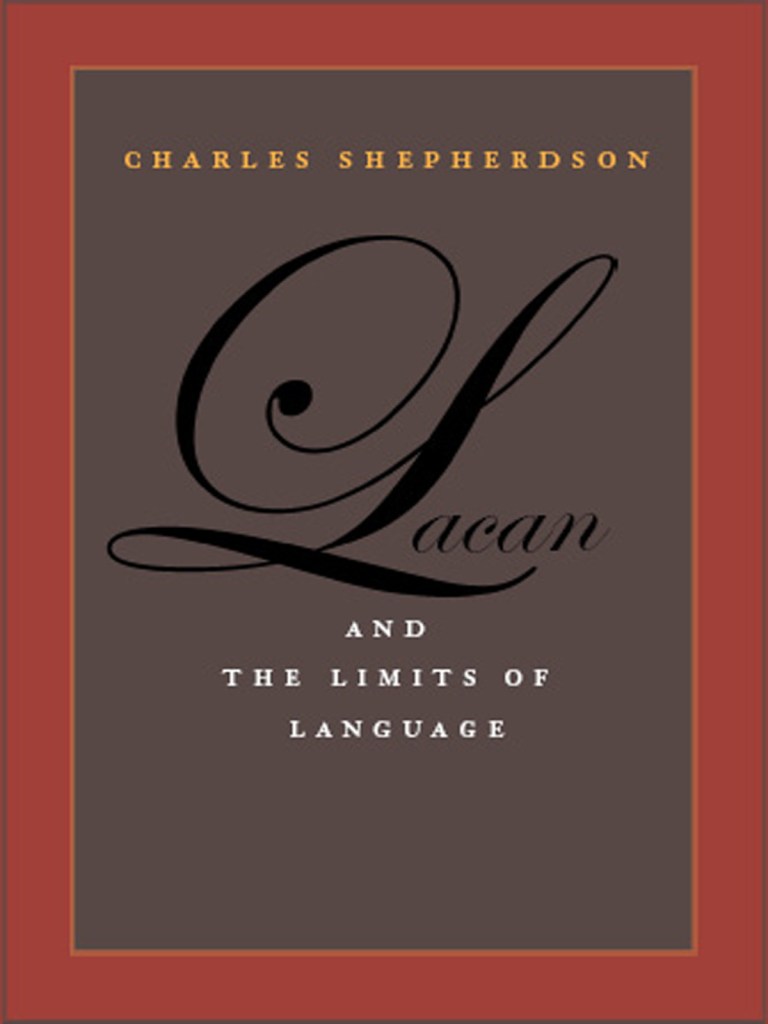
Lacan and the Limits of Language by Charles Shepherdson is an extraordinarily rigorous analysis of the intersection of psychoanalysis, philosophy, literature, and the life sciences, a painstakingly elaborate exploration that refuses the comfort of established disciplinary boundaries and invites the reader to confront, with fearless intellectual candor, the fundamental questions that arise when language meets its inherent limits. This book does not merely offer a supplementary reading of Lacan’s oeuvre; rather, it reconfigures the space in which Lacan’s thought speaks to contemporary conceptual dilemmas, from the persistent questions of time and memory in relation to historicity, to the urgent conundrums posed by race, biology, and evolutionary theory. In the process, Shepherdson reveals both the necessity and the impossibility of fully subjugating human experience—affect, bodily existence, sexuality, and historical becoming—to the sovereign order of the signifier. Instead, this study probes the sites where Lacan’s complex theoretical system comes closest to an aporetic point: where “law” and “structure” encounter something radically other, something irreducible, some remainder that the symbolic cannot easily domesticate, something that both emerges from and resists the generative power of language.
The result is a sprawling, deeply informed reflection on how the question of temporality—initiated by Heidegger’s inquiries into historical time and the subject’s finitude—echoes through the Lacanian concept of the subject’s formation and deformation in language. By implicating Lacan in an ongoing philosophical dialogue with Heidegger, Derrida, Kristeva, and others, Shepherdson dislodges the too-common characterization of Lacan as simply a structuralist thinker uninterested in history and affect. Instead, the text moves beyond a simplistically synchronistic model and shows how questions of time, memory, and the unconscious already inhabit Lacan’s discourse, forcing a reconfiguration of what we understand by “ahistoricism” in psychoanalysis. The subject, in Lacan’s teaching, occupies a precarious temporality and cannot be imagined as a stable nucleus; it emerges through processes of symbolization that never quite complete themselves, leaving a “real” that is both a remainder and a product of these symbolic operations. Shepherdson’s work clarifies how Lacanian theory’s alignment with structural principles is not a refusal of history, but rather generates a critical approach to it, disclosing how the subject itself stands at a crossroad where past and future reverberate in the interstices of memory, forgetting, and the interpretive labor that marks the analytic encounter.
From this vantage point, Lacan and the Limits of Language takes on the formidable challenge of exploring how the body, affect, and emotion inhabit Lacanian theory. Conventionally, Lacan’s work is thought to downplay affect and reduce the body to mere symbolic coordinates. Yet Shepherdson’s sustained analytic effort shows that the concept of jouissance constitutes precisely Lacan’s response to the dimension of affect that resists purely symbolic capture. By attending to bodies as not only imagined or symbolically inscribed, but also as formed at the edge of language—where corporeality and the real leave their irreducible mark—Shepherdson demonstrates how the affective dimension, inseparable from the somatic and the libidinal, complicates any hasty declaration that Lacan is a thinker of the signifier alone. Jouissance is not simply a structure’s epiphenomenon; it inaugurates a break in the chain of signification. Affect, anxiety, suffering, and pleasure here appear not as neglected residuals but as crucial motifs through which we comprehend the subject’s deeply entangled relation to symbolic mediation and its inevitable shortfall. This concern with jouissance and affect leads directly into considerations of aesthetics and tragedy, culminating in the author’s incisive use of canonical literary texts—Antigone, Ovid, Hamlet, Wordsworth—to show how literary figures have long staged the haunting interplay of bodily experience, ethical dilemmas, and historical memory. Poetry, literature, and tragedy force philosophical and psychoanalytic reflection to heed the provocations of language’s own failure to fully master what it attempts to represent, compelling a renewed recognition that narrative forms and aesthetic practices exceed any purely conceptual containment.
Through such textual engagements, Shepherdson sets his inquiry into a much wider dialogical field, inviting a renewed conversation between psychoanalysis and phenomenology, between Lacan and Heideggerian ontological insights, between the structuralist logic of the signifier and Derridean considerations of the trace and the supplement. In following these subtle but forceful connections, the book shows how the questions of affect and the body reveal a Lacan who is far more attentive than often assumed to fields beyond language’s grid of differential relations, and also to the ethico-political implications of this attention. The body, the emotions, and the real cannot be reduced to the relational play of signifiers, and yet they cannot be thought outside of it either. This tension leads Shepherdson’s analysis into domains often shunned by more orthodox Lacanians: matters of race, the historical specificity of what we consider “human physiological diversity,” and even evolutionary theory. In placing Lacan beside the insights of anthropological, biological, and cultural-critical thought, Shepherdson upends the simplistic binary that would reduce race to either a cultural or a biological category. The book argues that Lacan’s conceptual elaborations, the triangulation of imaginary, symbolic, and real, can help us articulate a nuanced understanding of bodily difference, physiological variation, and human genealogies without succumbing either to reductive essentialisms or to the overly confident pronouncements of anti-biologism. Race, as a concept, remains deeply and problematically invested in the exchange between symbolic codifications of difference and the elusive “real” of the body, and the book shows that psychoanalysis, equipped with Lacan’s insights, can open onto a richer dialogue with the life sciences than the sterile stand-offs currently dominating academic discourse.
It is thus no coincidence that Lacan and the Limits of Language receives the esteem of eminent scholars, who note that Shepherdson’s approach is both admirably clear and stunning in its use of philosophical history. Traversing Plato and Plotinus, navigating through Romantic poetry and tragedy, recalling the ramifications of Hegel’s and Aristotle’s perspectives on catharsis and dramatic effect, and mobilizing Derrida’s critiques of totalization, Shepherdson constructs a powerful panorama that re-situates Lacan as a thinker who cannot be fully appreciated without engaging these broader frames. Leading commentators such as Ewa Ziarek acknowledge the text’s courageous refusal of the dogmatic boundaries that have isolated psychoanalysis, philosophy, and literature from one another. Jean-Michel Rabaté affirms that Shepherdson demonstrates how psychoanalysis sustains a vibrant anthropology of love, hate, desire, memory, and beauty, illuminating contemporary debates on sexuality, race, and even war. Kelly Oliver admires Shepherdson’s expansive philosophical mastery, while Arden Reed and Elizabeth Weed underscore his deftness in staging “patient encounters” across disciplines and in challenging the complacent recourse to either biological determinism or discursive constructionism. It is a reading that renders Lacan more supple, more historically sensitive, and more ethically provocative—a Lacan attuned to the time “out of joint,” to the precarious textures of affect, and to the political hazards of defining human difference.
What arises, then, is not a portrait of Lacan as someone who simply insists on the priority of signification at the expense of bodily life, but a Lacan for our time, who can help navigate the persistent theoretical impasses, from the constitution of subjectivity in cultural and historical flux to the tensions between scientific knowledge and philosophical reflection, from the challenges in conceptualizing sexuality and race to the impossibility of fully articulating the real within any symbolic system. Shepherdson’s own literary and philosophical training enables him to keep faith with the unique complexity of each domain he engages. Rather than assimilating philosophy, literature, and biology to psychoanalysis—an act that would simply recast Lacan as master-theorist—he allows each discourse to interrogate psychoanalysis, displacing and revising it so that it becomes more open, more truly responsive to the multiplicity of phenomena that trouble the borders of the symbolic. The resulting vision resonates with the author’s original introductions—his refusal to remain within neat borders of “discipline,” his acceptance of the necessity of crossing lines and boundaries, and his insistence that what is ethically at stake in all this is the capacity to think and converse freely, without falling into the sterile worship of intellectual fathers, or setting up rival citadels of thought.
Lacan and the Limits of Language is thus more than a scholarly treatise; it is an event in contemporary theory, a space of encounter where multiple traditions, texts, and conceptual problems converge. The reader is confronted not with tidy resolutions but with precisely the kind of complexity and difficulty that marks the limit of language—an encounter that stirs thought to its ethical and philosophical depths. This book will appeal not only to Lacanian theorists, but also to anyone interested in the relentless inquiry into how language, in its structural power and its inherent failures, shapes what is thinkable, how it conditions our historicity, and how it both enables and impedes the process of understanding ourselves as embodied beings moving through time. In doing so, it opens new vistas for a renewed conversation among psychoanalysis, philosophy, biology, critical race theory, and literature, ensuring that Lacan’s legacy, as Shepherdson shows, is not a sealed system, but an ongoing, generative, and critically transformative engagement with the very limits of what can be said.
 Simon Gros
Leave a comment