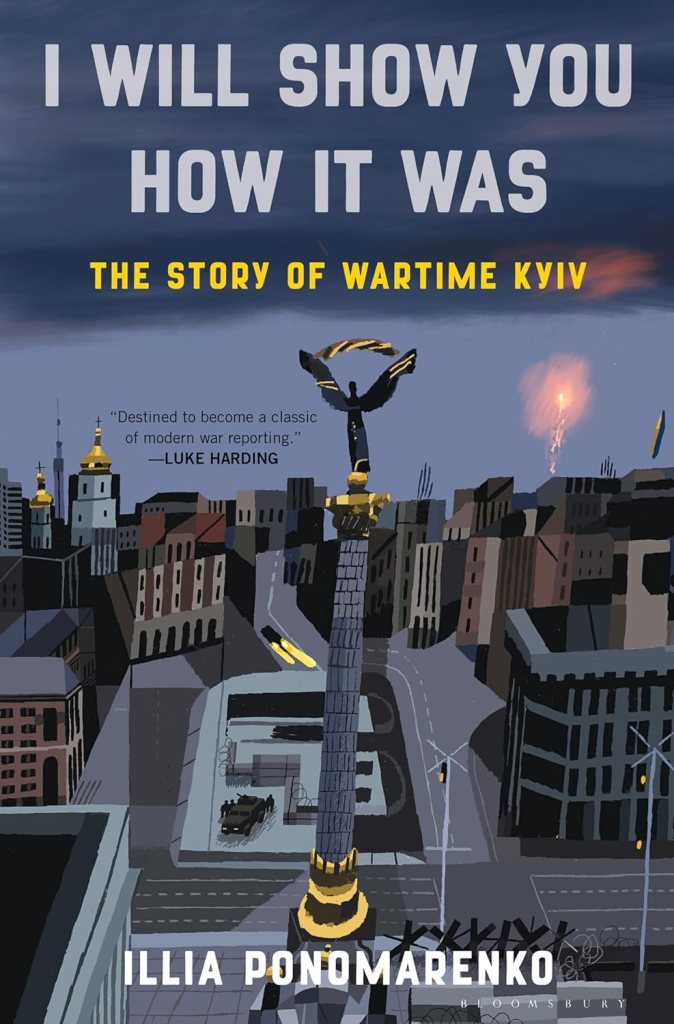
I Will Show You How It Was: The Story of Wartime Kyiv by Illia Ponomarenko is a sprawling, unflinchingly intimate immersion into a conflict that most would prefer to keep at arm’s length. It is the book that punctures the neat categories of “us and them,” “invader and invaded,” and “hero and villain,” forcing readers to face the banal mechanics and absurd cruelties of war as though they were crouched beside the author in the half-shuttered windows of Kyiv’s embattled districts. Yet this work is far more than reportage. It is an extended meditation on what it means to fight back in the face of annihilation, and how a city—the Ukrainian capital, no less—becomes a tomb, inspiration and mourning-ground, a living fortress onto which the threads of fear, bravery, loyalty, and bitterness are woven daily.
In these pages, Ponomarenko allows no simple illusions. He shows you Kyiv before the missiles fell and during the inferno of combat, clinging to a fragile normalcy even as the world outside its thresholds collapses into chaos. He resurrects the awkward silence around breakfast tables in makeshift refuges, the hollow laughs exchanged amid the choking tension of imminent attack, and the wavering hesitation between flight and resistance, safety and duty, that frames nearly every decision. Throughout, the people who appear are neither mythic warriors nor helpless victims, but humans locked in the vise of history—teachers, parents, friends, colleagues, exiles, returning sons, fearful daughters, and anxious lovers, all contending with circumstances they never truly believed would arrive.
The newly revealed segment of the book brings into sharper relief the multifaceted nature of war as lived experience. Here, Ponomarenko wakes from a stupefied slumber in a borrowed cottage, somewhere beyond Kyiv’s immediate war-scarred perimeter. In that moment, the war has already begun, but daily life teeters in an absurd halfway state: there are pancakes and condensed milk, hot coffee and jokes, and yet everyone knows that Russian tanks have advanced to within hours of the capital, that tens of thousands are fleeing desperately by any means possible, and that the very city which once offered hope and opportunity is now being stalked by death. The tension is unbearable precisely because it is so acutely mundane: the clinking of forks on plates, the warm smile of a motherly hostess, the sound of the television reporting incomprehensible losses, and the uneasy hush that befalls the table when someone shares a rumor too awful to discount.
In this extended glimpse, the author’s philosophical wrestling with the madness swirling around him intensifies. There is, for example, the protective maternal energy of Natalia’s mother, who fusses over her sudden guests, desperately clinging to normal courtesy as if it could repel mortar shells. There is the father’s grim silence, the teacher whose world has shrunk to radio broadcasts and a damaged arm that keeps him from fighting. There is the anxious girlfriend weeping quietly at night, and the uneasy friend who came along for the escape but now teeters on the edge of returning to face the oncoming storm, uncertain of his motivations yet compelled by a moral gravity that is impossible to shake.
Ponomarenko expertly lays out the inner calculations that happen under duress: the hollow reassurance that no one will take unnecessary risks, the understanding that war often makes a mockery of our promises, the dawning realization that returning to Kyiv might not just be suicidal heroism, but a kind of existential necessity. The war’s gravitational pull is so strong that even distance does not guarantee safety; it only deepens the pangs of conscience. We see how a man can sit in a warm cottage with pancakes and coffee and feel as though he is deserting a lover on her deathbed. Kyiv, in this narrative, is not merely a city: it becomes a moral test, an arena where the Ukrainian identity—an identity forged through centuries of imperial oppression and renewed year by year through tireless striving for independence—must now prove itself or be lost forever.
This intensity is not simply a matter of psychic struggle; it is made concrete in the savage geometry of the war itself. The text lingers on logistics and geography: the Russian advance groups near Hostomel, the blockages on highways, the rumors of Belarusian involvement, the suspicious infiltration by Russian subversives into Kyiv’s very bloodstream. Each place name resonates differently now. Streets once known for cafés and weekend bike rides are now reference points on a shifting front line. Pavements that once echoed with laughter now clatter with the boots of hastily armed civilian militias. Each topographical detail—the blown-up bridge, the jammed thoroughfare, the abandoned railway station—is a signpost on the road to destruction or salvation. To read these lines is to imagine, at a granular level, how war bleeds into every corner of ordinary life, shattering the distinction between the private and the public, the domestic and the military sphere.
Through close observation, the writing unveils the moral complexities that swirl around each choice. There is the matter of leaving one’s mother behind, or convincing her to flee. There is the question of how best to serve one’s duty to a beloved city without merely adding another senseless death to the tally. There are the conflicting imperatives of helping one’s friends and shielding one’s family, of preserving one’s soul and preserving one’s life. The author’s voice crackles with frustration at European and Western ambivalence, fury at Russian hypocrisy, and the gallows humor that surfaces inevitably in situations too absurd for sober reflection. It is this irreverent energy, the mixture of raw anger and bitter wit, that prevents the book from becoming a dry historical chronicle. Instead, it is a living document of a soul under siege, of a mind that refuses to yield to propaganda and suffering, that insists on parsing these events with all the tools of skepticism, reportage, and empathy it possesses.
The philosophical dimension runs deep. The war, as depicted here, is not just a moment of violence: it is a metaphysical rupture. It calls into question the structure of international order, the possibility of truth in an age of disinformation, and the capacity of human beings to recognize one another’s dignity. Ponomarenko’s Kyiv, encircled and threatened, stands as a symbol for all places where power seeks to subdue truth. His insistence on bearing witness—a stance affirmed by the endorsements from notable journalists, historians, and authors—transforms the personal narrative into an enduring moral statement. In reading his journey back to Kyiv, against all common sense and logical self-preservation, we grasp that what is at stake is not merely a patch of land or a capital city, but the very principle that humans can shape their destinies, that a community’s identity is worth defending, that freedom has value beyond convenience.
Throughout the narrative, the interplay of humble domestic scenes and seismic political shifts creates a hallucinatory effect. We see motherly affection and fresh pancakes on one page, and on the next, we encounter crumpled Russian vehicles on a shell-cratered highway. We sense how fear, love, confusion, and determined courage cohabit the same cramped space. The clash between the personal and the historic is so stark that it becomes almost surreal, a heightened reality in which every gesture carries the weight of destiny.
I Will Show You How It Was is a defiant answer to Russian demands for capitulation and the West’s hesitant policy maneuvers. It says: “This is how it truly is. Look closer. Face it.” The newly included sample, by revealing more of the day-to-day decisions and moral dilemmas, only enriches our understanding of how civilians become soldiers, how journalists become chroniclers of humanity’s most tragic failings and most miraculous strengths. The book functions as a testament that ordinary individuals, caught in extraordinary times, can embody principles that even the most refined diplomatic statements cannot express. In the face of hostile armies and hollow justifications, they can still choose to stand, to struggle, to refuse the lie.
The front lines shift minute by minute, alliances form and dissolve, and hope and despair tussle in the human heart. The book helps us see that war is not only about big names and shifting front lines but also about the cramped back room where a man tries to persuade a friend to return home with him to share the city’s fate. It is about the stubborn silence of a father who wants to fight despite an injured arm, and the unrelenting kindness of a mother who cannot imagine not feeding her guests. It is about the pain of leaving a family heirloom behind, the sobering chill of empty streets, and the silent vow that what is right must be done, even if it leads to unknown horrors.
By lingering over details the narrative breathes, allowing the reader’s mind to rest momentarily on each scene before plunging deeper into the maelstrom. The shifts in focus—from the city battles to the hush of a hidden rural cottage, from national news reports to personal cell phone messages, from historical analysis to street-corner rumors—underscore the war’s omnipresence and complexity. The reader emerges with an appreciation of the war not as a single grand narrative arc but as a mosaic of countless lived moments, each with its own texture, taste, and sound.
In this sense, the book’s approach to storytelling challenges the simplifications that strip conflicts down to a handful of strategic bullet points. It pays tribute to the multiplicity of human experiences that war both destroys and reveals. We gain a panoramic view of the author’s experiences and thoughts, while at the same time never losing track of the granular, trembling reality of life under artillery fire.
I Will Show You How It Was stands shoulder to shoulder with the great war writings of our time, melding the immediacy of frontline journalism with the emotional depth of personal memoir, and fusing it all with a philosophical core that probes the roots of violence, courage, and loyalty. The expanded passages and the newly featured section of the book sharpen the reader’s sense of the stakes at hand: a nation’s identity, a city’s soul, a journalist’s conscience, and a world order that now must reckon with the fact that a people’s resilience can shatter the best-laid plans of tyrants.
Nothing here is neat or resolved. Rather, the text leaves us with the tremor of uncertainty, the ache of loss, and the incandescent spark of human resolve. For all the horror, there remains a kernel of hope: if these people, in these impossible conditions, can hold on to their truth, then perhaps the rest of the world can learn to see more clearly, to understand more deeply, and to stand with them in solidarity. Ponomarenko’s memoir, now more vividly illuminated and structured through thoughtful expansion, reminds us that the real cost of war is measured not in abstract geopolitics but in laughter cut short, breakfast tables abandoned, and the fragile courage of those who, against all odds, choose to return and defend their home.
 Simon Gros
Leave a comment