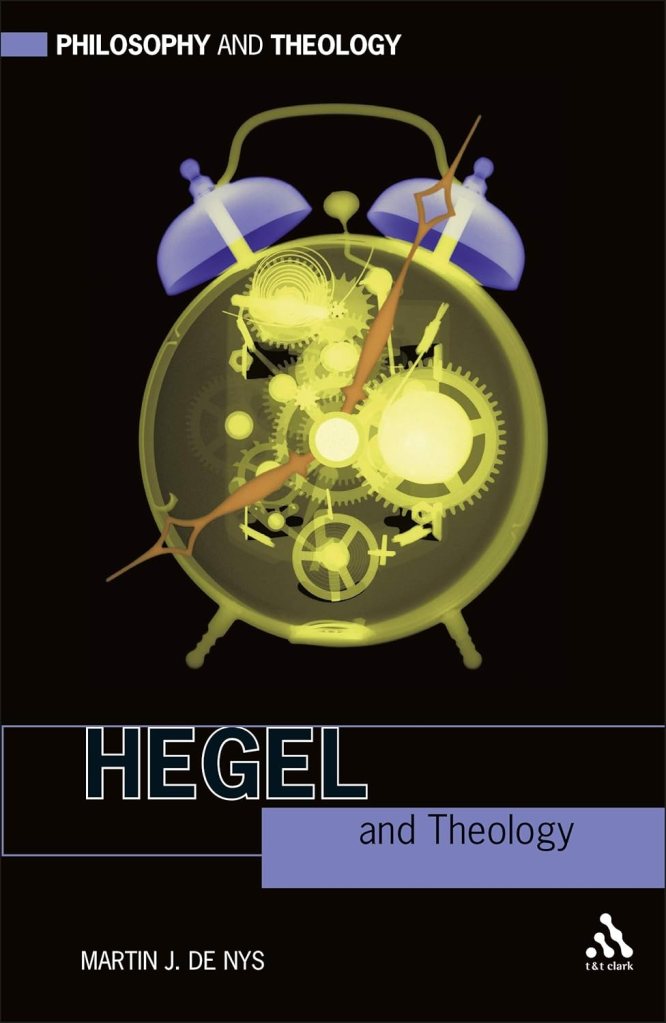
In Hegel and Theology, Martin J. De Nys offers a philosophically charged reading of the complex relation between Hegel’s philosophy of religion and the contemporary theological imagination, a meditation that demands a careful and extended reflection on the proper place and function of religious thought in a world shaped by both the Enlightenment’s critical legacy and the conceptual richness of the Christian tradition.
The book takes as its departure point the radical insight that religion, according to Hegel, belongs fully within the ambit of philosophy’s most rigorous self-articulation, and that Christianity, for Hegel, is not merely one among many religious forms but bears a kind of speculative richness uniquely suited to philosophical reflection. Here, De Nys engages with Hegel’s sweeping account of spirit, world, and God, examining how Hegel frames religious consciousness, how he mines and transforms religious experience, and how he sets forth philosophical proposals concerning the very nature of divinity and divine transcendence. In so doing, the book insists that Hegel’s views not only belong to their own historical moment but also continue to press upon the resources of contemporary theology in a manner that is neither comfortably dismissible nor easily integrated, challenging theologians now as much as ever to consider what it might mean for theology to think itself anew in response to the subtlety and systematic daring of Hegelian speculation.
What emerges in De Nys’s text is a picture of Hegel’s theology as a dialectical process in which religious representation and conceptual philosophy are fused into a single movement of thought. The author details how Hegel’s idea of philosophy requires a serious engagement with the content of religion, and how that engagement unfolds as philosophy attempts to comprehend the full meaning of religious representations, including those central Christian mysteries that cannot simply be considered as isolated doctrinal data but must be rendered intelligible within the conceptual articulation of absolute spirit.
For Hegel, religion—especially Christianity—proves to be indispensable. It provides the rich conceptual material through which the philosophical idea of absolute knowing might finally be attained, but not as a mere footnote or illustration of philosophical truths. Rather, Hegel holds that religion is the self-consciousness of spirit itself, the domain in which finite selves apprehend their finitude and, by so doing, gain an orientation toward something genuinely transcendent, something that discloses divine life in the midst of finite historical existence. De Nys painstakingly elucidates Hegel’s insistence that what we call God is not a distant, static entity utterly beyond our range of understanding but rather the very actuality of the divine life made manifest and knowable through the interplay of finite and infinite, through the incarnation of the divine in the finite realm, and through the movement by which the transcendent is immanent in human communities and reconciled forms of self-understanding.
At the basis of De Nys’s presentation is the delicate and ambitious manner in which Hegel invites us to consider God not as a mere first principle or highest object of faith but as a living, self-revealing spirit. Drawing on Hegel’s phenomenological explorations, the book emphasizes that religious consciousness arises at the point where finite selves recognize their own limitations and discover in the shape of religion something that makes them aware of their self-transcending nature.
This transcendence is not simply the humble admission of finitude but rather a passage into a richer life of thought, one in which reconciliation is made possible only by acknowledging that God comes forth in and through human activity, community formation, and historical evolution. De Nys underscores how central Christianity is to Hegel in this respect, for it is within the Christian tradition that Hegel finds an account of the incarnation—God becoming human, and thereby rendering divine self-consciousness accessible to finite minds—that serves as the paradigm for understanding the essential unity of finite and infinite being.
Hegel and Theology unfolds its analysis to show that this philosophical engagement with Christian faith, its mysteries, and its symbols does not simply confirm what ordinary religious consciousness might presuppose. Rather, it draws out from the Christian experience a complex speculative structure, one that Hegel believes brings religion to a conceptual maturity philosophy can at last clearly articulate. The book stresses that such articulation, however, is neither a simple reduction of religious truth to philosophical argument nor a neutral metaphysical summary. Instead, De Nys reveals how Hegel’s approach demands a rethinking of the categories of divine transcendence and immanence: God is not external to the world but is realized in the unfolding of spiritual life and human history, while also preserving a dimension of otherness that human beings must constantly approach if they are to know themselves more deeply.
This accounts for the subtlety of Hegel’s position on God’s transcendence. It is never allowed to collapse entirely into the finite, but neither can it remain a remote, unhistorical abstraction. The tension between God and world, the infinite and the finite, is itself a crucial dynamic that Hegel’s system seeks to mediate, and it is precisely this mediation that De Nys’s study brings to the fore as a decisive theme in the complex legacy Hegel bequeaths to theology.
The text is also mindful of the critical issues that arise in Hegel’s bold intellectual synthesis. De Nys acknowledges that Hegel’s philosophical theology, while comprehensive, invites serious challenges. Philosophers and theologians will wrestle with whether Hegel succeeds in granting proper emphasis to historical contingency, personal religious experience, and the manifold expressions of worship that do not neatly align with a rational conceptual framework.
Similarly, the relation of God’s self-manifestation and human self-understanding calls forth questioning about whether Hegel’s formulation risks overshadowing divine freedom or diluting the radical uniqueness and mystery of the divine reality. De Nys shows that these objections are not external addenda to Hegel’s thought but can be understood as immanent tensions belonging to Hegel’s own essential proposals. By engaging these tensions directly, the book gives readers a nuanced sense of where Hegel’s legacy might be generative—infusing contemporary theological inquiry with a new sense of intellectual possibility—and where it poses certain unresolved problems that might spur ongoing debates. The upshot is that Hegel is not simply an authoritative voice instructing theology but rather a permanent interlocutor, whose deepest claims about the nature of God, religion, and historical existence demand critical yet constructive re-appropriation.
What makes Hegel and Theology especially compelling is the rigorous philosophical lens through which De Nys presents these matters. Writing from a background steeped in Continental philosophy and its conversation with modern theology, De Nys unfolds how Hegel’s legacy impinges upon and informs our current theological horizons. The significance of this approach is that it neither merely restates Hegel’s arguments nor treats theology as a domain that can be enclosed within historical conditions or simplistic dogmatic formulations. Instead, it maps out how Hegel’s dynamic and comprehensive system sets a high standard for theological reflection, in that it calls theology to address itself to the full scope of human self-understanding, social life, and conceptual intelligibility. This philosophical challenge has reverberations into the present, where theology must consider not only the content of faith but also the way that content might be made rationally transparent and conceptually credible in a contemporary context where faith and reason are often held apart.
De Nys’s treatment shows that for Hegel the Christian mysteries—such as Trinity, Creation, Incarnation, and the reconciled indwelling of God in human life—are not mythic curiosities to be dismissed by critical reason. Instead, when properly understood, they represent the points at which religious representation and philosophical thought achieve a reciprocal intelligibility.
The doctrine of the Trinity, for instance, is not a mysterious cipher to be accepted on authority alone but a narrative and conceptual articulation of God’s inner life, wherein unity and difference, subjectivity and otherness, reciprocity and self-relation are philosophically illuminated. The story of Creation is not simply a distant origin tale; it reveals the necessity of a world that comes forth from God and yet is other than God, establishing the conditions under which finite life and divine self-revelation can unfold. Similarly, the Incarnation is more than a singular event confined to the past; it is the logical and existential center of a theological vision in which spirit achieves full self-consciousness precisely by uniting finite and infinite nature in one divine-human reality.
The resulting reconciliation is not a static state but an ongoing, living reality: a divine indwelling in the community of believers, wherein history and ontology converge, and wherein the substance of divine life and the subjectivity of human persons achieve a profound reciprocity. In drawing out these dimensions, De Nys shows that the richness of Hegel’s theological vision is that it strives to incorporate rather than exclude, to comprehend rather than flee from complexity, and to give philosophical voice to what had previously been accessible primarily through symbolic religious consciousness.
As the book moves toward its conclusion, De Nys illuminates how Hegel’s thought finds a permanent legacy in ongoing theological inquiry. This legacy is marked by the unyielding need to consider how religious belief, symbol, narrative, and doctrine might be integrated into a larger systematic account of reality and meaning. Contemporary theology may question aspects of Hegel’s metaphysics, his sometimes audacious claims about the unity of divine and human, or his vision of a reconciled social world that can manifest spirit’s presence so thoroughly. Yet the force of Hegel’s proposals, as De Nys presents them, is that they cannot be dismissed out of hand. They demand a response, precisely because they try to do justice to both the uniqueness of Christianity and the universal, rational structure of reality. Such a demand echoes strongly in our time, when theology struggles again and again to articulate its insights in a world that values critical reflection, historical consciousness, and rational accountability alongside religious depth, existential significance, and communal integrity.
Hegel and Theology is a work that does not merely report on what Hegel said but reanimates the enduring philosophical and theological conversation that Hegel’s writings provoked. De Nys’s study is a sustained invitation to think seriously about the nature of God, the meaning of divine transcendence, and the character of religious experience in a manner that transcends tidy disciplinary boundaries. By portraying how Hegel conceives of religion and Christianity as integral to philosophical understanding, the book stakes a claim that theology’s future lies in ongoing critical reflection, in the capacity to engage with philosophy rather than retreat from it, and in the willingness to see in Hegel not an adversary but a challenging guide who insists that reason and faith, concept and mystery, transcendence and immanence, divine life and human community, are interwoven strands in the tapestry of spirit.
In so doing, De Nys provides a resource that will resonate with philosophers seeking to understand the religious dimension of speculative thought, as well as theologians willing to embrace the conceptual rigor that Hegel insists faith requires. The result is a rich, dense, and philosophically profound account, one that does not shy away from complexity but instead honors the complexity of a thinker whose intellectual legacy continues to shape and stir our deepest theological questions.
 Simon Gros
Leave a comment