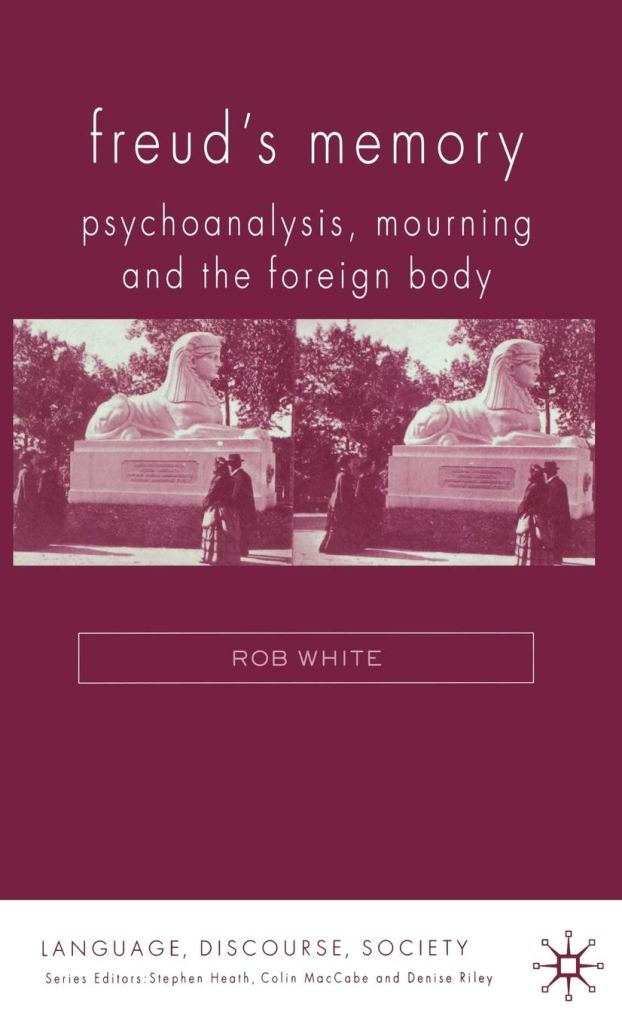
Freud’s Memory: Psychoanalysis, Mourning and the Foreign Body by Rob White is an extraordinary and challenging intellectual venture into the most recalcitrant territories of Freudian theory, a work that refashions our understanding not only of Freud’s controversial notion of inherited memory but also of the deep melancholic undertow that runs through his entire conceptual edifice. Proceeding with a scrupulous exactitude that avoids psychoanalytic jargon in favor of lucid literary-critical close reading, White probes at the very heart of Freud’s complex speculations on transgenerational memory and shows how, far from being a mere theoretical oddity or quaint relic of late-Victorian scientific thought, Freud’s recourse to psycho-Lamarckism reveals a persistent retrospective anguish at the core of his thinking, a haunted temporality in which meaning is always lost and recovered only in transfigured, never wholly coherent forms.
This book elucidates the tensions between what might seem at first to be irreconcilable tendencies in Freud’s corpus. On the one hand, Freud repeatedly declares the scientific aspirations of psychoanalysis, asserting the decisive clarity of his insights into human culture, myth, art, and the psyche. On the other hand, as White’s reading shows, Freud’s body of work never achieves that final reassurance of meaning for which it yearns. Instead, Freud’s texts introduce us to a conceptual landscape suffused with the language of wounds, foreign bodies, and ghosts; it is a philosophical and rhetorical labyrinth where rigorous attempts at empirical validation stand alongside incorrigible enigmas, where grand narratives of origin and phylogeny both clarify and disassemble the familiar grounds of experience. White’s focus on Freud’s theory of inherited memory—an infamous theoretical gesture that claims that primal scenes of murder, incest, and other ordeals in the ancient past still echo in the minds of individuals who never witnessed them—discloses just how much Freud’s theoretical framework is shaped by a deep and inescapable sense of lost meaning, displaced onto an unreachable archaic horizon.
What emerges in this careful exegesis is a vision of Freud not as a triumphant founder of a discipline confidently mapping the mind’s hidden topographies, but as a profoundly strange and unsettled writer, a thinker whose works are riven by doubts and haunted by absent presences, by traces of lives and events not personally experienced but inexplicably retained. White, by insisting on reading Freud’s language closely and philosophically, shows that these elusive concepts—ghosts, relics, traces, foreign bodies—are not simply illustrations or metaphors. Rather, they reveal that Freud’s thought is fundamentally organized around the paradoxes of mourning: he posits a narrative of mental life shaped at its roots by trauma, death, loss, and an originary suffering that cannot be neatly consigned to the past. The painstaking analyses White provides demonstrate that Freud’s many analogies—his archaeological metaphors, his references to telephones and technology, his fascination with entombed relics and crypt-like recesses of memory—constitute more than rhetorical ornamentation. They testify to the uneasy stasis at the heart of psychoanalysis, in which the search for explanation, classification, and coherence continually runs up against the foreign and unknowable, straining to recuperate a past that is both essential and impossible to fully grasp.
The reading of Freud that White offers is startling because it reverses the conventional order of understanding: instead of seeing Freud’s theory of inherited memory as an isolated speculative misstep, White shows it to be emblematic of a larger pattern. This pattern points to a persistent attempt on Freud’s part to retrieve meaning from a lost origin, to master a history that defies assimilation, and to render the psyche’s ancient layers knowable. Yet these attempts never lead to tranquil certainty. Instead, they give rise to serial crises of interpretation, paradoxical recognitions of untranslatable contents, and moments where Freud’s writing, compelled by what it cannot name or assimilate, doubles back on itself. Under White’s guidance, the reader witnesses Freud’s theory-making as a form of mourning: an effort at once ethical and argumentative, a grappling with a fundamentally estranged heritage of the human mind that never settles into stable meaning.
In White’s account, mourning becomes more than an affective response to loss; it becomes an intellectual and ethical dimension of Freud’s work as a whole. Freud’s theorizing continually attempts to complete a work of mourning for what has been lost—origins, primal causes, ancestral memories—and in so doing, it paradoxically replays and prolongs that loss. His conceptual frameworks for explaining culture, religion, and subjectivity fold into one another like layers of buried strata, never quite yielding a confident, terminable account. Instead, they reveal, through their very disruptions and reiterations, the pain of a mind pressed to admit that it cannot be at one with itself and that the supposed interior home of psychic life is inhabited by what Freud repeatedly identifies as foreign matter, alien impulses, and the uncanny persistence of others’ secrets and sufferings.
White’s book thus uncovers the deeply troubled nature of Freud’s legacy. Psychoanalysis, often heralded or criticized for its claims to uncover psychic truth, turns out in this account to be a sophisticated practice of close reading dedicated to mapping its own failures of meaning. Freud’s Memory displays with remarkable sensitivity how Freud’s rhetoric and argumentation move towards moments of explanation only to be stalled by contradictory evidence and obscure symbolisms. By refusing to rely on psychoanalytic terminology, White lays Freud’s strangeness bare, allowing us to register just how intricately wrought his texts are. Without the comfort of psychoanalytic jargon, we see Freud as a writer struggling with language itself, haunted by archaic forces that elude direct conceptualization.
The book’s scholarship is evident not only in its careful treatment of Freud’s own words but also in its dialogue with post-structuralist critiques and Anglo-American commentaries. White is not content to let post-structuralism’s celebration of failure as a kind of aesthetic or intellectual hedonism stand uncontested. Nor does he embrace the rationalist Anglo-American tradition that would dismiss Freud’s theories as groundless speculation. Instead, he tries to illuminate the ethics of Freud’s dilemmas: by showing that Freud’s psycho-Lamarckism is not a gratuitous flourish but the symptomatic disclosure of a theoretical mourning, White forces us to confront the idea that psychoanalysis was never about achieving a neat resolution, but about bearing witness to the obdurate complexity of human memory, transgression, and pain.
In doing so, White redefines the stakes of reading Freud. No longer can we assume that his lapses, contradictions, or unorthodox hypotheses are merely incidental flaws. Instead, they emerge as signs of a radically difficult project, an incomplete and perhaps unfinishable attempt to understand how the psyche is shaped by non-experienceable events, how it is always inhabited by spectral presences, how meaning itself comes to be lost and recovered in distorted form. Freud’s Memory, by pointing to these counterintuitive patterns in Freud’s writing, reveals a thinker who is not simply a precursor to modern psychological science, but also a mournful philosopher of the psyche’s limits, as he circles back again and again to the impossibility of fully grounding truth in personal recollection.
In the process, White shows how profoundly Freud’s work challenges our notions of identity, subjectivity, and historical time. If memories that are not our own can invade and shape our inner life, then what does it mean to be an individual with a stable sense of self? If the psyche is haunted by archaic murders and vanished traumas beyond personal recall, how can we trust in linear narratives of development or coherent stories of cultural progress? White’s far-reaching interpretation suggests that for Freud, truth lies not in the stable reconciliation of these questions but in the perpetually unsettled effort to articulate them. The haunting relics of the past persist as foreign bodies in the tissue of the present, and psychoanalysis becomes a kind of mournful ethics and argument, a discipline that insists we attend to the ghosts of meaning that forever slip beyond our explanatory reach.
In the end, Freud’s Memory offers an utterly transformative lens through which to understand one of the most influential thinkers of the modern age. By taking Freud’s psycho-Lamarckism seriously, by reading him without the distorting filters of analytic language, and by meticulously piecing together the implications of his strange figures—ghosts, wounds, telephones, entombments, and foreign bodies—White renews our encounter with Freud’s texts. He reveals Freud as a writer unsettled by his own discoveries, his inherited memories, and his tortured retrospections, a thinker who has led us unwittingly into the shadowy domain where knowledge fails, where mourning is never complete, and where the human mind must perpetually confront the foreign elements lodged within it. In so doing, Rob White’s study can be wholeheartedly recommended as a uniquely unsettling, richly detailed, and profoundly illuminating journey into the lost heart of Freud’s memory.
 Simon Gros
Leave a comment