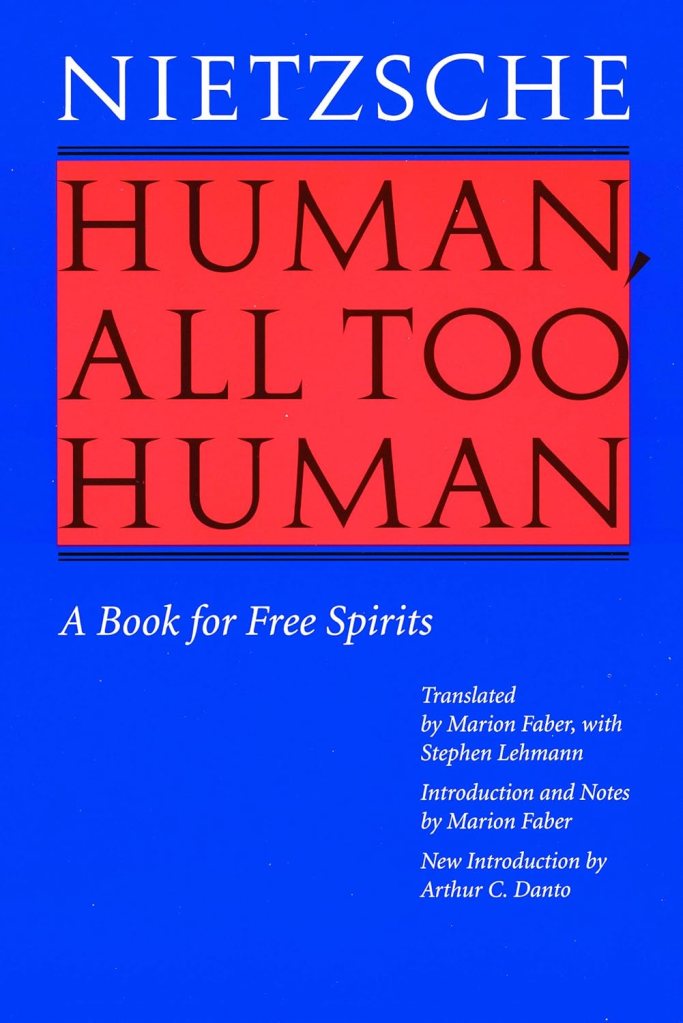
In approaching the Revised Edition of Friedrich Nietzsche’s Human, All Too Human: A Book for Free Spirits, as translated by Marion Faber and Stephen Lehmann, with an introduction and introductory notes by Arthur C. Danto, one is immediately struck by the unique historical and philosophical significance of this work and by the profound care with which this particular edition has been rendered. First published in 1878, Human, All Too Human represents a critical juncture in Nietzsche’s thought, marking the point at which the formerly Wagnerian and Schopenhauerian-romantic philosopher takes a decisive step toward an almost defiant embrace of rationality, skepticism, and the ethos of scientific enlightenment. It is the place where his philosophical persona breaks free from metaphysical consolation and aesthetic mystification and commences a journey toward what he calls “the Free Spirit”—a figure neither bound by religious dogma nor seduced by the charms of metaphysical idealizations, but prepared instead to face the world and the human condition with an unflinching gaze, grounded in reason, philological rigor, and a willingness to probe the conventional, the institutional, and the inherited illusions that shape our lives.
The new translation by Marion Faber and Stephen Lehmann, following a century during which the only readily available English version was a reprint of a 1909 edition of uncertain origin, restores to the English reader the linguistic precision, the stylistic nuance, and the scholarly framework that this indispensable text within the Nietzschean canon has long deserved. Prior translations, often archaic in phrasing and inattentive to textual details, left English-language scholars and students grappling not only with Nietzsche’s complexities but also with the frustrating absence of reliable textual landmarks. This new edition corrects that deficit. Where older versions often failed to include Nietzsche’s original paragraph numbers—an omission that verges on the unforgivable in serious Nietzsche scholarship, given the central importance of these reference points for cross-comparisons, textual analysis, and citation in academic discourse—Faber and Lehmann restore them meticulously. This apparently small but indispensable step allows the text to align once again with the broader Nietzschean corpus, whose numbering systems are vital for navigating differences in pagination across the many German and English editions that have appeared over the decades. With these paragraphed aphorisms, the scholar, the student, and the general reader can more readily perceive the architecture of Nietzsche’s thought: the careful unfolding of themes, the transitions from skepticism to irony, from metaphysical speculation to a genealogy of moral prejudices, and ultimately toward a stance that embraces intellectual freedom and methodological clarity.
In addition, Faber and Lehmann’s edition enriches the text with extensive footnotes, a critical scholarly apparatus that Nietzsche himself—working in a largely aphoristic and allusive mode—did not provide. Where Nietzsche offers a passing reference to a Homeric laugh, to a Latin phrase from Horace, or to a subtle echo from Descartes, the translators and editors now painstakingly supply the relevant sources, clarifying obscurities and illuminating the dense intertextual web in which Nietzsche’s thinking is suspended. These are not trivial additions; they embody the new historical sensibility that Nietzsche himself demanded from all who would endeavor to understand the genesis and evolution of philosophical concepts. In Human, All Too Human, Nietzsche insists that an authentic understanding of morality, religion, and aesthetic values requires nothing less than a ‘chemistry of ideas,’ a historical and genealogical approach that can dissolve seemingly eternal truths into their constituent cultural and psychological elements. The footnotes, in their way, exemplify this historical philology, enabling the reader to trace the genealogies of Nietzsche’s own references and thus recognize how deeply his aphorisms are implicated in a network of intellectual traditions.
Arthur C. Danto’s introduction, meanwhile, situates this edition within the trajectory of Nietzschean scholarship and clarifies the philosophical significance of the text at the time of its initial publication and in the century and more that has passed since. It was Danto, a philosopher famous for careful argumentation and a nuanced understanding of Nietzsche’s legacy, who made a compelling case that Human, All Too Human heralded an intellectual “coming of age” for Nietzsche. If Nietzsche’s earlier works—especially those under the spell of Wagnerian mythopoetics and Schopenhauerian pessimism—betrayed a preoccupation with the metaphysical and the redemptive art-work, in Human, All Too Human Nietzsche now turns his gaze to the patterns of human folly, the illusions of metaphysics, the petty truths of everyday existence, and the liberating potentials of skepticism and rational inquiry. Danto’s introduction underscores how this text belongs in the center of the Nietzschean canon, not as a transitional oddity, but as the very crucible in which Nietzsche’s mature style and philosophical temperament were forged. Here emerges the spirit who would later produce Thus Spoke Zarathustra and Beyond Good and Evil, the thinker for whom conventional morality and traditional metaphysics would no longer suffice, and who instead pursues a fearless examination of the conditions under which knowledge, ethics, and creativity become possible.
This particular edition also helps us to appreciate how Human, All Too Human is a brilliant early articulation of themes that have become central not only to Nietzsche studies but also to contemporary critical theory and moral psychology. The aphoristic form—638 aphorisms, each a small explosion of intellectual energy—allows Nietzsche to articulate a range of concepts in a style that is both scientifically influenced and literary, scientifically skeptical yet not devoid of wit and playful irony. It was this very tension that made the book so perplexing to Nietzsche’s contemporaries and still makes it riveting today. While the German audience of Nietzsche’s time may have found these aphoristic experiments too intellectually demanding and too remote from the established philosophical hierarchies, a modern readership, guided by a translation that preserves Nietzsche’s stylistic precision and Danto’s philosophically informed introduction, can fully enter into the matrix of Nietzsche’s critical engagements. The book’s urgent interrogations—what if our moral ideals have their origins in entirely mundane and historically contingent practices? What if the supposed eternal truths of metaphysics are merely projections of human longing and fear, mere surface phenomena misread as the heart of reality?—resonate with ongoing questions in philosophy, cultural criticism, and the interpretation of human cognition and belief.
As the reader moves through these aphorisms in this revised English translation, supported by scholarly footnotes that remove the once formidable linguistic and cultural impediments to understanding, a richer portrait of Nietzsche’s intellectual process emerges. Each section unveils a different problematic—the chemistry of concepts, the genealogical dismantling of moral dogmas, the dismantling of metaphysical illusions, the revaluation of aesthetics and religious sentiment—and from each vantage point, we see how Nietzsche was wrestling to invent a new philosophical method. This is a method that does not deny the importance of moral, religious, or aesthetic phenomena, but rather insists that their true significance can only be understood through a scientific-historical lens, one which tracks their evolution from simpler impulses, from psychological needs, from primitive fears and imprecise conceptions. Nietzsche’s historical sense—the very sense he accuses previous philosophers of lacking—becomes the tool with which to scrutinize the seeming inevitability of our highest values. And this historical sense requires, in turn, a text that can be reliably navigated, cited, and discussed across scholarly traditions, which is precisely what this revised edition provides. The restored paragraph numbering and the introduction of meticulous footnotes transform the reading experience from one of puzzling obscurity into one of luminous clarity, enabling a close hermeneutic encounter that does not sacrifice the difficulty of Nietzsche’s aphorisms but makes them available for rigorous study.
The philological and historical sensibility of this edition is further underlined by the emphasis on translation choices. The translators explicitly acknowledge Nietzsche’s wordplay, his habit of inventing or repurposing German compounds, and his interlacing of foreign language quotations. By translating these linguistic experiments into English and acknowledging them as such, Faber and Lehmann’s approach provides English readers with a textual integrity that allows them to appreciate both the letter and the spirit of Nietzsche’s prose. Instead of having to rely on one’s own attempts to track down obscure classical references, to puzzle out Nietzsche’s bilingual puns, or to guess at what a Homeric laugh might have implied for an ancient Greek audience, the scholarly apparatus here guides the reader to a more nuanced and confident understanding of Nietzsche’s sources and targets.
What emerges from engaging with this volume is a richer, more complex Nietzsche: a thinker not confined to the brilliant metaphors of his earlier essays or the prophet-like persona of his later works, but a philosopher calmly and deliberately breaking illusions, rejecting romanticism, and exploring an unsentimental vision of human nature and human destiny. Through a chemically minded, historically alert skepticism, he attempts to isolate the molecular elements of morality, aesthetics, and metaphysics, not to annihilate them but to understand how they have emerged, hardened, and persisted—and how, given such understanding, the free spirit might navigate beyond them. In reading this Revised Edition, one no longer confronts the text as an isolated monolith; instead, one views it as an integrated component of Nietzsche’s entire intellectual enterprise, its significance for the later Nietzsche, for the broader Nietzsche canon, and for philosophy in general incontrovertibly affirmed by its careful editing, reliable translation, textual fidelity, and scholarly framing.
This Revised Edition of Human, All Too Human: A Book for Free Spirits by Friedrich Nietzsche, presented with an introduction by Arthur C. Danto and translated by Marion Faber and Stephen Lehmann, stands as the definitive English-language edition for scholars, students, and intellectual explorers alike. Its fidelity to the original structure, including paragraph numbering, its wealth of explanatory footnotes, and its careful attention to linguistic and historical detail place it at the center of Nietzsche scholarship. The text encapsulates a pivotal evolutionary moment in Nietzsche’s thought, a moment in which the philosopher emerges as an advocate of a new intellectual conscience, determined to confront the world without metaphysical blinders, without romantic delusions, and yet also without despair. It is a crucial document for anyone seeking to understand how Nietzsche came to value enlightened reason and the methods of science so highly, and how the protean notion of the Free Spirit took shape as an incarnation of intellectual courage. This edition restores the text’s rightful place in the philosophical canon, ensuring that future generations will encounter Human, All Too Human not as a dimly mediated relic of nineteenth-century German philosophy, but as a vivid, challenging, and indispensable contribution to the modern conversation about truth, knowledge, and human values.
 Simon Gros
Leave a comment