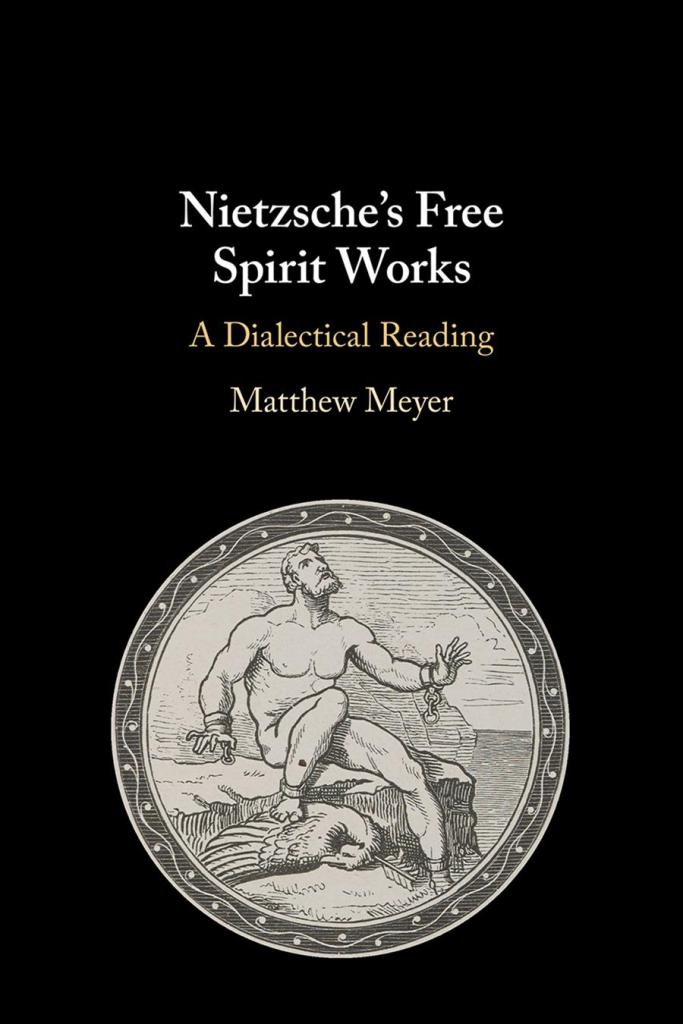
Matthew Meyer’s Nietzsche’s Free Spirit Works: A Dialectical Reading offers a key interpretation of Nietzsche’s middle period works, which span from 1878 to 1882 and include Human, All Too Human, Assorted Opinions and Maxims, The Wanderer and His Shadow, Daybreak, and The Gay Science. These texts, often dismissed as mere collections of aphorisms, are, according to Meyer, far more cohesive and intentional. He proposes that they form a dialectical Bildungsroman—a narrative of self-education—that chronicles Nietzsche’s philosophical evolution toward becoming a “free spirit,” culminating in a reconciliation between the scientific pursuit of truth and artistic life-affirmation.
Meyer’s interpretation reframes these works, challenging the conventional scholarly treatment that tends to regard them as disjointed or unfinished reflections. By examining these writings as part of a unified project, Meyer uncovers the deeper structure Nietzsche wove through these texts, viewing them as stages in the philosopher’s self-development. Through this lens, the free spirit works represent Nietzsche’s methodical pursuit of freedom, grappling with the legacies of metaphysics, religion, and conventional morality, while simultaneously confronting the Enlightenment’s rationalism and its impact on modern life. At the heart of these works lies a tension between Nietzsche’s early commitment to scientific truth-seeking and his later turn to a more life-affirming, artistic ethos.
According to Meyer, this dialectic unfolds over the course of these five works, each contributing a crucial chapter to Nietzsche’s philosophical maturation. Initially, in Human, All Too Human, Nietzsche embarks on a rigorous dissection of metaphysics and traditional moral values through the lens of scientific rationalism, which he associates with the Enlightenment’s exaltation of truth. However, this early stage is fraught with contradictions. Nietzsche’s exploration of truth-seeking, though liberating, leads to an existential crisis, as it strips life of meaning, causing a sense of nihilism that Meyer argues Nietzsche must confront. This period of intellectual asceticism is depicted as the “ascetic camel” phase of Nietzsche’s self-education, a stage marked by self-denial and a dedication to the uncompromising quest for truth.
This tension reaches its apex in The Gay Science, where Nietzsche’s dialectic resolves with the declaration of the death of God, a pivotal moment that signals the collapse of absolute truth and opens the door for the reintegration of art and life-affirmation. Meyer argues that Nietzsche’s assertion of the death of God in this context represents not a mere nihilistic gesture, but the overcoming of the “will to truth” that has dominated modern thought. This self-overcoming—what Nietzsche later calls the Selbstaufhebung—frees Nietzsche from the metaphysical commitments that have bound him, and this freedom allows him to embrace artistic creation as a legitimate and essential response to the tragic nature of existence.
The free spirit works, then, do not merely reflect Nietzsche’s intellectual development but also embody a shift in his view of art and its role in human life. Through his dialectical journey, Nietzsche moves from the rejection of art as escapism in favor of scientific objectivity to a renewed appreciation for art’s redemptive power. Meyer’s reading highlights how Nietzsche’s eventual embrace of a “gay science” aligns with the Dionysian celebration of life and the affirmation of existence despite its inherent suffering. This culminates in the figure of the “Dionysian child,” who is not just the artist but the one who has transcended the binary of truth and art, realizing that the creation of meaning itself is a vital and joyous act.
Meyer’s thesis also ties Nietzsche’s free spirit works to his larger philosophical trajectory, suggesting that these middle-period works are not merely preparatory or transitional but integral to the full expression of Nietzsche’s philosophical vision. By portraying Nietzsche’s self-education as a narrative of dialectical stages—scientific detachment, moral disillusionment, and artistic renewal—Meyer convincingly argues that Nietzsche’s middle period works must be understood as part of a coherent philosophical project. This approach helps explain the apparent contradictions in these works, including Nietzsche’s shifting views on truth, morality, and art. Meyer draws parallels with Hegel’s Phenomenology of Spirit, showing that Nietzsche’s works echo the process of self-realization through dialectical stages, even as Nietzsche moves from a strict commitment to truth toward a more expansive and artistic conception of life.
Through his detailed analysis, Meyer offers a fresh reading of Nietzsche that not only clarifies the internal coherence of the free spirit works but also reveals their significance within Nietzsche’s broader philosophical development. His thesis challenges the prevailing interpretations that reduce these texts to mere aphorisms or fragmented thoughts. Instead, Meyer positions the free spirit works as a critical moment in Nietzsche’s philosophical journey, one that anticipates and informs his later works, including Thus Spoke Zarathustra. Ultimately, Nietzsche’s Free Spirit Works: A Dialectical Reading provides a compelling argument that Nietzsche’s middle works should be understood not as isolated or incomplete, but as essential steps in a larger philosophical project that transforms the way we understand freedom, truth, and art.
 Simon Gros
Leave a comment