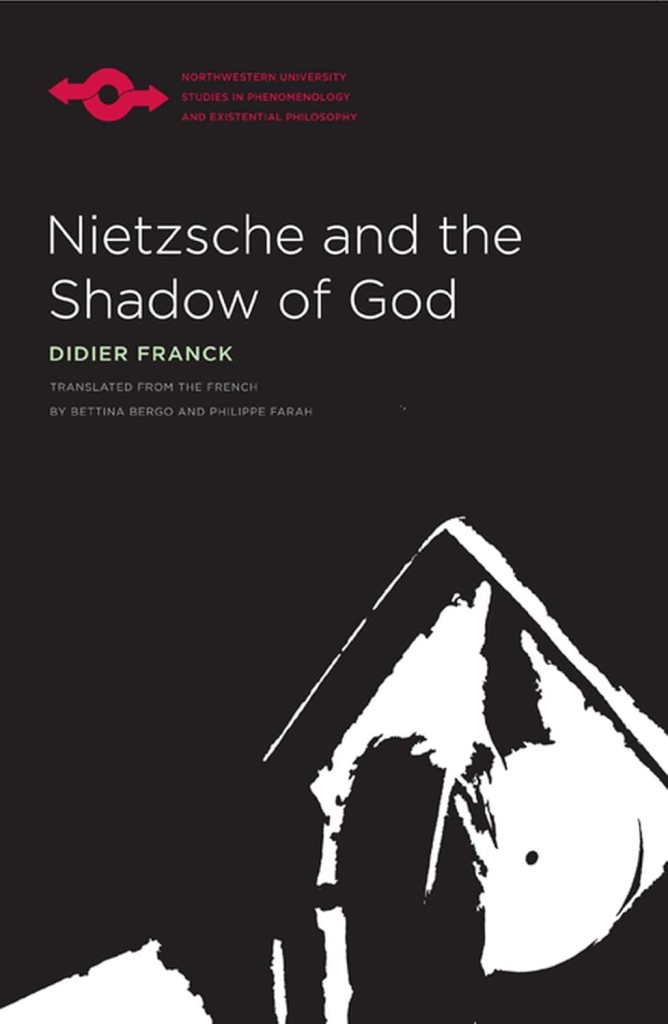
Nietzsche and the Shadow of God is a work that ventures into the fraught terrain where Nietzsche’s philosophy confronts the two-thousand-year-old religious heritage of the West. Didier Franck’s study, here introduced for the first time to English-speaking audiences through a careful and readable translation by Bettina Bergo and Philippe Farah, does not aim at either a superficial critique or a laudatory reaffirmation of Nietzsche’s destruction of Christian thought. Instead, it reveals a far more subtle and immensely richer scene, where Nietzsche’s ideas engage with and ultimately reshape the understanding of justice, revelation, and the fragile yet persistent figure of the divine. In this book, one finds more than a historical exercise in philosophical exegesis; one encounters a systematic rethinking of the relation between metaphysics and theology, reason and faith, body and flesh, and one that pivots on a careful confrontation with Heidegger’s powerful reading of Nietzsche. Yet Franck does not stop at Heidegger’s interpretations. Instead, he returns to the fundamental sources—most especially the Epistles of Saint Paul—without which the Christian body, as a community bound by the law and by faith, would never appear as the antagonist that Nietzsche’s philosophy demands.
God’s eternal essence “before the creation of nature and a finite mind.” But this statement, which Heidegger elides, precisely provides the key to understanding the theological dimension of Hegel’s thought. Since, in starting and ending with God, the science of logic—i.e., the exposition of pure thinking—discloses itself as a theologia. For Hegel, God is not simply one object among others, nor is he an object at all; God is the absolute subject who, in positing itself as thought, is pure Being. The “speculative proposition” characteristic of Hegel’s logic is thus essentially theological. Its nature must be sought in the fact that thinking, elevated to the rank of absolute subject, proves to be thinking-as-God, and God to be the innermost essence of thinking.
Is this not the hallmark of metaphysics in general, for which the highest ground, the first cause, the summum ens, is always also the supreme being and the supreme intellectus—the unity of beings and thought, the One that grounds all that is? Heidegger calls the determination of God as the highest ground and cause of beings—and thus the most real being—onto-theo-logy. Onto-theo-logy characterizes the overall structure of metaphysics from Plato and Aristotle to German Idealism, for it always seeks to think being as such and as a whole by grounding it in a supreme Being. This supreme Being is God, conceived as the first cause and final reason, the foundation and the consummation of all that is.
In Hegel’s system, onto-theology reaches its final, most complete, and most explicit form. There, the logical Idea is the absolute that unfolds itself in the history of the world, and the history of the world is the manifestation of the divine life. The departure from immediacy and the return to itself of the concept, as well as the sublation of all mediations, ultimately yield the pure thinking of thinking, which is God “in his eternal essence.” God stands at the beginning as well as at the end, for the beginning-without-presuppositions leads back to what is presupposed as final, and thus absolute, truth. The circle of logic is divine life, the conceptual articulation of the Godhead before creation, and logic is but the self-science of the divine.
Yet this infinite circle has a price: the subordination of philosophy to theology. Philosophy, taken as the science of absolute knowledge, is no longer an independent inquiry. It becomes speculative theology, an articulation of God’s self-knowledge. Heidegger’s step back from Hegel consists precisely in calling into question this identification of philosophy with theology, and more radically, the very structure of onto-theo-logy. For Heidegger, the attempt to ground the truth of beings in a highest being remains blind to the meaning of Being itself and to the ontological difference between Being and beings.
Hegel’s logic, which as a logic of the concept coincides with a theology of the absolute Idea, demonstrates the essential onto-theo-logical constitution of metaphysics. In Hegel, the identity of God and pure thought reaches its consummation, such that metaphysics and revelation, philosophy and theology, form a single circle. It is this coincidence that Heidegger, by radicalizing the question of Being, aims to overcome. But as long as metaphysics endures, the logic of onto-theology continues to determine the horizon of all thinking.
In order to understand how the metaphysics of the will—and indeed, the entire trajectory of Western thought—has arrived at a point where it not only pervasively entangles itself with theology but also becomes, in its highest expressions, a form of speculative theology, one must confront the culmination of metaphysics in German Idealism, and preeminently in Hegel’s thought. Hegel’s logical system, and the Science of Logic in particular, stands as a grand recapitulation of philosophical history. More than merely summarizing all previous attempts to think being, Hegel subsumes them into a circular, self-enclosed movement of pure thought thinking itself. The result is that metaphysics, in becoming absolute logic, also becomes theology. Not theology in the provisional sense of a historically contingent or church-bound dogmatic system, but theology in the sense that the ultimate principle of philosophy—pure Being as pure Thought—coincides with the divine. This coincidence is neither an accidental byproduct nor a rhetorical flourish; it is inscribed at the very core of Hegelian speculation, and indeed at the heart of the “onto-theo-logical” structure of metaphysics itself.
To see why this is so, one must consider the nature of Hegel’s philosophical beginning. Philosophy, as Hegel argues, cannot simply begin anywhere: it cannot start with something derivative, conditioned, or presupposed. Rather, philosophy must begin without presuppositions; it must begin at the purest, most indeterminate immediacy of thought. Yet, this beginning, if taken in isolation, would remain abstract and empty. The philosophical beginning must also be its own end; it must contain within itself the entire dialectical movement that unfolds all determinations of thought and reality and then returns to the original immediacy, now understood as the unity of result and beginning. Hegel’s logic does not start with an arbitrary datum but with what is purest and simplest—pure Being—and then proceeds through a vast array of logical categories until it culminates in the Absolute Idea, which is thinking’s absolute self-relation, the truth knowing itself as truth.
It is this final point—Hegel’s identification of the culmination of the logic with absolute truth—that reveals the hidden theological dimension. In his Science of Logic, Hegel states that the logic “is the exposition of God as he is in his eternal essence before the creation of nature and a finite mind.” In making this identification, Hegel does not merely annex a religious concept to philosophy. Rather, he shows that the logical Idea, the content of philosophy itself, is God in his purely conceptual form, prior to any externalization in nature or spirit. That is to say, the pure medium of logical thought, being both the ground and result, is not a neutral philosophical entity, but the divine life as pure intelligibility. The narrative of the concept’s development into absolute knowledge is simultaneously the narrative of God’s own self-articulation. In Hegel, the “transcendental” foundation of all things merges with the “theological” arche that all theology seeks to articulate. This is the moment in which philosophy becomes speculative theology.
In classical metaphysics, from Plato and Aristotle through the Scholastics and onto modernity, we repeatedly encounter an attempt to think being as a whole (the ontological dimension) and to think that whole as grounded in a highest principle or first cause (the theological dimension). Heidegger terms this dual structure “onto-theo-logy.” Ontology, the study of beings as such, requires a ground that ensures the intelligibility and constancy of being. Theology, the reflection on the highest or ultimate being (God), supplies such a ground. Thus, throughout the Western tradition, philosophy has often been guided by the search for a highest being, an ens realissimum, that guarantees the coherence and finality of beings. This highest being is at once the ultimate cause and the ultimate intellect—pure actuality, perfect form, or divine reason. Onto-theo-logy names this structure: Being is thought as what-is-highest, and the highest is thought as God.
In Hegel, the onto-theological structure attains its most perfected and explicit form. Rather than seeking a highest entity outside of thought, Hegel identifies the highest principle with pure thought itself. Being and divine intellect coincide in the absolute Idea, which is not a static first principle but a dynamic process that unfolds in history and returns upon itself in a circle of circles. The logic’s beginning and end are identical, and this identity is not a mere tautology, but a fully mediated, comprehensive identity. Here metaphysics and theology become indistinguishable: to think Being truly is to think God as absolute self-knowing reason. Thus, metaphysics culminates in speculative theology, where God is no longer one being among others, nor even “beyond” beings in a non-relational sense, but is precisely the intelligible totality of beings as sublated into conceptual, fully articulated truth.
Heidegger’s step back from Hegel arises precisely here. For Heidegger, the identification of Being with the highest ground—God conceived as absolute subject—remains caught in a framework that conceals the radical difference between Being and beings. To think Being qua Being, independent from the necessity of grounding it in a supreme entity, would require escaping the logic of onto-theology. According to Heidegger, we must attend to the ontological difference, to the fact that Being is not itself a being, and that to treat Being as a supreme entity—even if that entity is the self-thinking concept—misses the very essence of what it means for beings to appear at all. Heidegger sees in Hegel’s system the ultimate closure of a project that began with Plato and Aristotle: the project of thinking Being as presence, as something ultimately identifiable with conceptual intelligibility and divine unity. Against this, Heidegger calls for a rethinking of the question of Being that would leave behind the metaphysical compulsion to establish a highest principle. Only by moving beyond onto-theology can thought open itself to a more originary experience of Being, one not dominated by the categories of subject, object, ground, and supreme cause.
Yet, acknowledging this Heideggerian critique does not diminish the profound significance of Hegel’s accomplishment. In Hegel’s speculative theology, we see how Christian and metaphysical traditions merge. The Christian notion of the self-revealing God who incarnates and redeems human finitude is transmuted into a philosophical notion of the Absolute Idea that externalizes and internalizes itself in history, culminating in absolute knowledge. The story of salvation—original sin, historical revelation, and final reconciliation—finds, in Hegel’s system, its metaphysical counterpart: pure thought beginning from bare immediacy (Being), passing through alienation and negativity (the realm of finite concepts and determinate beings), and finally returning to itself in perfect clarity and self-transparency. In doing so, Hegel recasts theology in purely conceptual terms. God is not so much worshiped or petitioned as he is conceptually comprehended, and this comprehension itself constitutes the highest form of devotion. Philosophical thought is here the liturgy of reason’s self-celebration.
But this “divine liturgy” of pure thought thinking itself also reveals the costs of onto-theology: the subjection of philosophy to a predetermined teleology in which all difference, contingency, and particularity serve the unfolding of an absolute conceptual identity. The living richness of historical religions, the irreducible singularity of concrete existence, the mysteries of faith—all these become moments that are ultimately aufgehoben (sublated) within the triumphal procession of the concept. While this speculative theology proclaims itself the full truth of philosophy and theology, one may wonder whether it does not miss what theology once tried to safeguard: an ultimate mystery that resists total conceptual capture, a dimension of Being that eludes the reductive gesture of rational mastery.
Thus, the great coincidence—metaphysics and Christianity meeting in the pure luminosity of Hegelian speculation—is also a great dissolution: the dissolution of theology into logic and of philosophy into a rationalized form of religion. The God before creation is here concept itself, and the philosopher, interpreting and articulating logic’s necessity, stands as a priest of reason. Yet, by awakening us to this coincidence, Hegel also makes visible that philosophy has never been a neutral enterprise. From ancient Greece onward, philosophy bore the stamp of a quest for an ultimate foundation, a highest truth that would unify understanding. Over time, this led reason toward a horizon where theology and metaphysics blend, showing that the idea of a highest principle and the idea of God have been internally woven together all along. We see now that what Nietzsche, Schopenhauer, and eventually Heidegger confronted was not some peripheral anomaly, but the very heart of the Western tradition: philosophy’s transformation into speculative theology, and theology’s metamorphosis into a thoroughly conceptual metaphysics.
In the wake of this realization, one can begin to appreciate the gravity of Heidegger’s attempt to think beyond onto-theology, to allow Being to show itself without immediately translating it into the categories of highest cause or absolute Idea. His step back from Hegel is no mere academic shift in perspective; it is an attempt to release philosophy from its two-thousand-year-old destiny of culminating in theology. Yet the legacy of the great coincidence cannot be easily undone. The question is whether, and how, we can think philosophically without positing a sovereign, absolute ground—without making logic into a divine self-knowledge and metaphysics into a speculative religion. It is a question that Hegel himself invites, by exposing, in the grand transparency of his system, the necessity and limitations of the entire metaphysical tradition that preceded him.
What emerges from Franck’s reading is not a simple image of Nietzsche as a mere iconoclast of Christian piety. Rather, it becomes evident that Nietzsche stages a delicate battle with the inner core of Christian revelation, with its claim to justice, and with its elevation of divine will as the supreme origin of meaning and value. Franck shows how Nietzsche’s thought displaces the Platonic-Christian worldview and exhaustively revalues values, but does so not only by opposing theology. He engages with it from within, making it appear less like a foreign adversary than an intimately known horizon. By dwelling on the body’s place, at once seat of all evaluative thought and locus of transformation, Nietzsche’s philosophy tries to arrive at what lies beyond the Christian categories of sin and redemption, good and evil, commandment and submission. Franck reveals that Nietzsche’s famous revaluation of values, his teaching of amor fati, and the trial of eternal recurrence can no longer be understood as a series of mere parodic inversions of Christian values, but rather as the strenuous attempt to think through and surpass the logic of creation, fall, and salvation that stand at the heart of the Judeo-Christian legacy.
Within Nietzsche’s project, the critical point is the resurrection of the flesh, the very notion that the dead are raised in a spiritual body. From Paul onward, Christianity defined itself less by doctrinal correctness than by a fundamental “mood” marked by resentment and the quest for a divine justice that would surpass all human measure. Nietzsche saw in this not just an ascetic ideal, but the moralization of truth itself, a moralization that conceals the original innocence and purposelessness of becoming. From within the Pauline paradigm, justice names the relation of man to God, a relation that carries the weight of law, commandment, promise, and ultimate judgment. Yet if Christian theology, as Franck recounts through the filters of Luther and German Idealism, translated the old testamentary commands into a moral and metaphysical structure, Nietzsche’s enterprise can be read as subverting that structure by rethinking the meaning of truth, time, and eternity. Franck shows that this subversion is not a superficial act of rebellion, but the articulation of a philosophical and religious gesture that, by engaging intimately with the heart of Christianity’s deepest doctrines, exposes them to the risk of fundamental transformation.
The body, the flesh, and the will appear as crucial themes in this subtle drama. Franck traces their paths through Paul’s Epistles and Christian theology, and explains how Nietzsche’s work both inherits and transforms their meaning. Christian revelation, by bringing forth the notion of a resurrection of bodies, inaugurates a new sense of divine power and justice. This event folds metaphysics into theology, so that the ground of being and the ultimate cause of everything that is merges with a moral and creator God. Franck’s reading shows that Nietzsche’s confrontation with Christianity passes through this junction, and that his understanding of the will to power and eternal recurrence can only be fully grasped if the theological stamp that Christianity left on Western thought is taken into account. Indeed, Nietzsche’s critique of Christianity targets precisely its promise that the entire world could be justified by divine grace. It is by considering this promise and recognizing it as the core of the Christian transformation of values that Nietzsche invents his own counter-promise: a new weight beyond all previous values, a perspective from which even the death of God is not a calamity but the opening of a new—albeit terrifying—space for creative affirmation.
Franck’s study thus refuses simplistic readings of Nietzsche as a mere atheist or an enemy of religion understood trivially. Rather, it shows that Nietzsche pushes Christian and Pauline concepts to their limit. He makes them more explicit, drags them out into the open, tests their internal coherence, and then proposes a new horizon beyond good and evil, beyond Christian morality. Yet this beyond is never easy or comfortable. The death of God leads to the brink of the abyss, and the eternal recurrence confronts humankind with the question of how to affirm its existence without the metaphysical and theological guarantees that had so long grounded it. Franck interprets this passage not as a clear-cut victory of one worldview over another, but as the demonstration that Christian theology and metaphysical philosophy belong to a common destiny—one that Nietzsche radically alters by revealing their shared onto-theological structure.
At the heart of Franck’s interpretation lies the recognition that even in opposing Christianity, Nietzsche continues to think through and with the theological concepts that formed the history of European thought. The struggle with revelation is written into the warp and weft of metaphysical thinking. The result is a complex entanglement of concepts such as will, power, body, nature, sin, justice, eternal life, and eternal recurrence. By deftly associating Nietzsche’s doctrines with their biblical and theological sources, Franck shows that the superhuman perspective Nietzsche invites us to adopt can never be separated from what he has gained by passing through Christian morality. The so-called “anti-Christ” Nietzsche is, ironically, still deeply shaped by the moral and religious tradition he rejects. In Franck’s pages, this irony is neither a failure nor a shortcoming, but the essential sign of Nietzsche’s importance: to think against Christianity is still to think from within the horizon it established.
If Heidegger portrayed Nietzsche as the last metaphysician of the West, Franck returns to the Christian dimension that Heidegger’s interpretation neglected or minimized. By integrating both the philosophical history that runs from Greece to German Idealism and the theological narrative that runs from Paul’s Epistles to Luther, Franck illuminates the unprecedented coherence of Nietzsche’s project. The revaluation of all values appears not as a chaotic outburst of negativity but as a consistent philosophical engagement with the deepest Christian and metaphysical assumptions. The love of fate, the trial of eternal return, and the struggle to create beyond the categories of sin and salvation become legible as the conditions for a truly post-Christian justice, a world shaped neither by resentment nor by the longing for transcendent judgments. Instead, the body is reshaped into a creative existence beyond original sin, and morality itself no longer rests on the dichotomy of good versus evil, but on the affirmation of life here and now.
Nietzsche and the Shadow of God is thus a decisive contribution to Nietzsche scholarship. It insists that understanding Nietzsche cannot be done by confining him to the role of a secular philosopher who dismissed religion as a childish fable. On the contrary, to read Nietzsche after Franck is to acknowledge that Nietzsche’s confrontation with God’s shadow remains, as ever, a philosophical and religious problem. By weaving together metaphysics, theology, and the powerful confrontation with Pauline Christianity, Franck’s work reveals a Nietzsche who has absorbed the Christian tradition so profoundly that his attempt to move beyond it both depends on and transfigures it. This reading not only helps the reader see Nietzsche’s ideas in a new light, it also underscores the lingering presence of theological questions at the heart of modern and contemporary philosophy. In doing so, it shows how the figure of Nietzsche continues to mark, for the thinkers who come after him, the threshold at which philosophy and theology become entangled, where man’s relation to truth, justice, suffering, and redemption must be repeatedly re-examined, and where the figure of God—dead or alive—still casts its immense and unsettling shadow.
 Simon Gros
Leave a comment