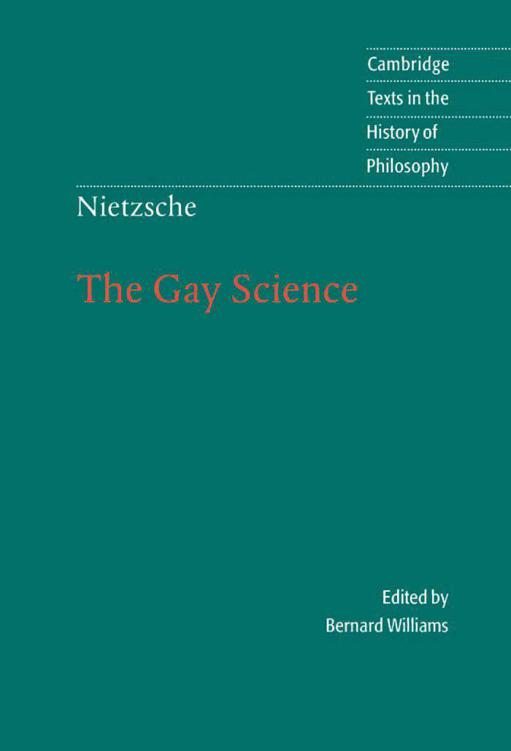
This new edition of Friedrich Nietzsche’s The Gay Science, with a Prelude in German Rhymes and an Appendix of Songs, translated by Josefine Nauckhoff and introduced by Bernard Williams, offers a transformative encounter with one of Nietzsche’s central works, a text that the philosopher himself once described as “perhaps my most personal book.”
Written at a time when Nietzsche’s intellectual powers were at their peak, this work stands as a conduit to the most crucial themes of his thought and an essential gateway into his enduring influence on philosophy, moral psychology, cultural criticism, and the genealogy of values. The Gay Science comes to the reader as a rich and layered tapestry woven out of aphorisms, verses and ideas, a literary and philosophical creation that rarely presents itself as a linear argument but rather draws the mind into a spiraling, dialogic engagement with the questions that define Nietzsche’s oeuvre.
Here, many of his signature concepts—the Death of God, the Eternal Recurrence, the relentless scrutiny of morality’s origins, and the unsettling demands that radical honesty places upon human beings—emerge for the first time in a form that is both celebratory and deeply searching. This edition, prepared with scholarly rigor and careful fidelity to Nietzsche’s stylistic nuances, surpasses previous translations, most notably that of Walter Kaufmann, by approaching the text with greater precision. Nauckhoff’s translation closely follows Nietzsche’s own punctuation, italics, and rhythms of thought, thereby preserving the aphoristic structure and the intense, shifting moods that define the original German. In doing so, it allows readers of English to experience the distinctive feel of the text as Nietzsche composed it: a single continuous flow of aphorisms within each numbered section, rather than the more artificially subdivided paragraphs and interventions that have sometimes crept into earlier renditions.
Adrian Del Caro’s translations of the poems—those that frame the work and the songs that appear in the appendix—also strive for a delicate balance between literal meaning and the spirited tone that Nietzsche intended, reanimating what is too often overlooked in the philosopher’s output: his poetic sensibility and the literary dimension of his philosophical enterprise. The book’s title itself—the “Gay Science,” or “the joyful wisdom”—already hints at a philosophy that seeks to break the stranglehold of solemn metaphysical systems, moral absolutes, and the oppressive spiritual gravity that Nietzsche believes has weighed heavily on Western thought for centuries.
Bernard Williams’s introduction proves invaluable in this regard, as it situates The Gay Science in the intellectual and historical landscape of Nietzsche’s development, explaining that “gay” here is closer to a troubadour’s gaiety, an art of graceful lightness and life-affirming inquiry, rather than any modern connotation. Williams clarifies that Wissenschaft in Nietzsche’s usage, commonly translated as “science,” extends beyond the natural sciences and encompasses rigorous scholarly endeavor in the humanities as well, casting Nietzsche’s work as an aesthetic, moral, and intellectual experiment rather than an exposition of a doctrinaire metaphysics.
The volume’s editorial apparatus, including footnotes and indices, is restrained yet informative, providing just enough historical and textual guidance to situate Nietzsche’s manifold allusions—both to well-known figures and lesser-known historical and literary references—without imposing a didactic interpretive framework. Instead, the reader is allowed to grapple directly with Nietzsche’s methods, which range from concise observational aphorisms to extended reflections that probe deep into the moral and psychological undercurrents of human life.
Nietzsche challenges his readers to stand on their own interpretive feet, not to passively consume a system of thought, but to experience philosophy as an ongoing process that demands intellectual honesty, self-overcoming, and a capacity to face uncomfortable truths. Central to this work is the realization that the Death of God—an event Nietzsche’s madman proclaims in the marketplace—has not yet been fully absorbed, nor its consequences fully reckoned with by modern European culture. God’s death serves as a shorthand for the collapse of the metaphysical and religious certainties that once upheld and stabilized moral values. Nietzsche insists that new values must be created, or at least discovered, to fill this void. The Gay Science articulates this theme with a gentler, more exploratory tone than the harsher critiques found in works like Beyond Good and Evil or On the Genealogy of Morality, yet it presses just as relentlessly on the question of what it would mean to say “yes” to existence without recourse to comforting illusions.
Book Five of the expanded 1887 edition, appearing for the first time in that year’s publication and included in its rightful place in this new translation, shows Nietzsche’s thinking at its most mature and daring. There, he returns to questions of morality’s genealogy that he will soon develop further in the Genealogy itself. The Gay Science’s final form also includes poems, a preface, and an appendix added to the original 1882 version, revealing in retrospect how these poetic and autobiographical texts function as reflections of his lived experience—his illnesses, travels, personal struggles, and evolving intellectual vantage points. These paratextual elements underscore that The Gay Science is more than a philosophical treatise; it is also a personal diary of spiritual convalescence, a festival of recovery after illness, a “sanctus Januarius” welcoming the new year of one’s existence, and an invitation to adopt a perspective that might resemble the joyful resilience of the ancient Greeks in celebrating appearance, art, and the surface’s shimmering truths.
Bernard Williams helps steer readers through Nietzsche’s complex engagements with truth, value, and suffering, pointing out that Nietzsche’s view of truth remains neither a mere pragmatic instrument nor a fully deconstructed fiction, but something that commands seriousness. The will to truth, once considered unproblematically noble, emerges as itself an inheritance from Christian and Platonic metaphysics. The old moral imperative—never to lie—became secularized into a modern unconditional will to truth, even as we learned to doubt God and metaphysics. Nietzsche asks why we still consider truth so sacred, and Williams’s commentary clarifies this subtlety, showing that Nietzsche’s uneasy relationship with truthfulness leads him not to dismiss truth, but to question its place and value in our intellectual and moral lives. The will to truth, including its ascetic scruples, can turn against itself, unraveling the metaphysical illusions that once justified morality and giving birth to nihilism.
Yet, as The Gay Science suggests, if one can face this unraveling without despair, if one can dance freely and joyfully on the precarious edge of existential uncertainty, one might find a new way of affirming life, a new “gay science” beyond both metaphysics and disingenuous comfort. Within the vignettes, dialogues, and poetic interludes of this volume, the theme of eternal recurrence also first arises, a test of one’s capacity to embrace the world’s entirety, all its suffering, ugliness, and trivialities, as something to be willed again and again. This is not a rational cosmological claim but a thought-experiment that measures the strength of one’s affirmation of life. Williams’s introduction helps free readers from overly literal interpretations, reminding us that Nietzsche likely never intended eternal recurrence as a scientific proposition, but rather as a spiritual challenge, one that tests our tolerance for the world’s horror and banality without granting ourselves metaphysical consolation.
All of these themes—the Death of God, the Eternal Recurrence, the revaluation of values—are crucial not only for understanding Nietzsche’s later works, such as Thus Spoke Zarathustra and Beyond Good and Evil, but also for tracing the trajectory of his entire intellectual journey. The Gay Science emerges as a center of gravity, pulling together the threads of his earlier Human, All Too Human and Daybreak and prefiguring his later genealogical approach. This new translation and edition enable us to confront the text as a subtle, carefully crafted literary and philosophical performance rather than as a mere collection of aphorisms or a stepping-stone to Nietzsche’s “major” works. The inclusion of the poetry and the faithful rendering of Nietzsche’s original textual idiosyncrasies remind us that philosophy in Nietzsche’s hands becomes an art form, a narrative, and a musical experiment in which the philosopher must earn the right to philosophical detachment by first enduring the most personal struggles.
The editorial and translational choices bring us closer than ever to the original texture of Nietzsche’s writing, to the interplay of metaphor, irony, and humor, and to the way his aphoristic form must be read: not as self-contained truths but as catalysts for the reader’s own interpretive vigor. The result is a book that should attract not only scholars of Nietzsche but anyone seriously interested in moral psychology, the formation of values, and the radical implications of living in a world from which the old gods have retreated. It does not pretend to offer a linear argument or a final solution; instead, it invites the reader into a landscape where thinking and feeling intermingle, where philosophy, poetry, and personal confession reflect and refract each other.
The Gay Science is thus, as Williams argues, one of Nietzsche’s central and indispensable achievements. This new edition, with its careful scholarship, contextual elucidations, and stylistic faithfulness, helps restore to The Gay Science the prominence it deserves in the study of Nietzsche’s corpus and in philosophical discourse more broadly. In doing so, it also makes the book more accessible to those who have previously relied on older translations and commentary, allowing a fresh encounter with Nietzsche’s voice, at once jubilant and searching, light-hearted and profound, skeptical and life-affirming. It opens the door to a richer engagement with Nietzsche’s philosophical artistry, granting new generations of English-speaking readers the opportunity to experience the daring subtlety and intellectual risks that characterize one of the most important texts of nineteenth-century thought, a text whose critical legacy still reverberates in contemporary debates about meaning, value, suffering, and the prospects for human flourishing in a disenchanted world.
 Simon Gros
Leave a comment