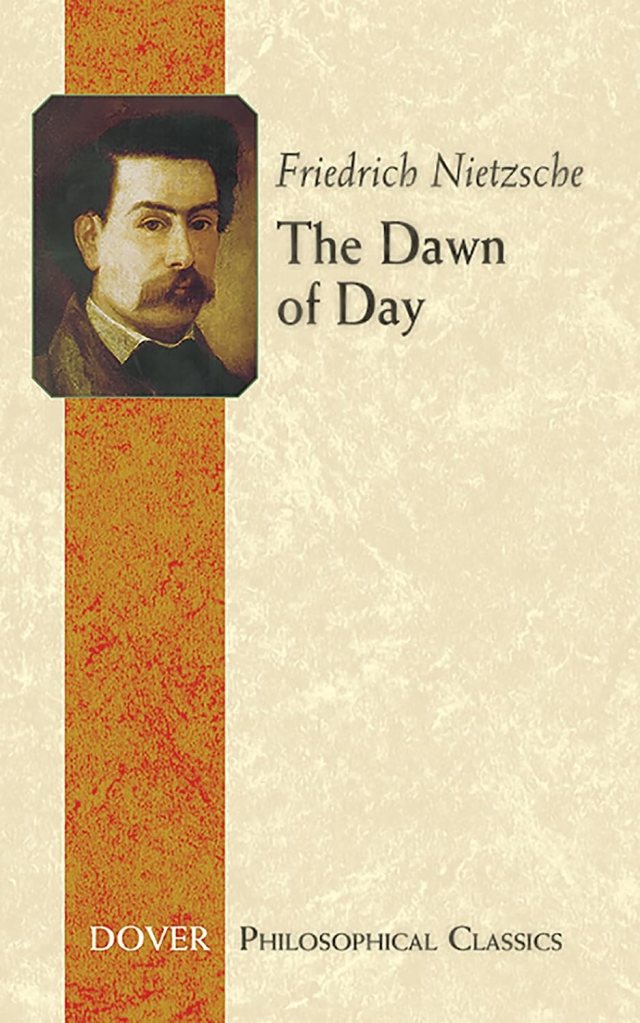
Friedrich Nietzsche’s The Dawn of Day (1881), translated by J. M. Kennedy, is a seminal work in the development of Nietzsche’s philosophical journey, bridging his earlier explorations and his later, more fully developed ideas. The book, a collection of aphorisms and prose poems, represents a profound moment in Nietzsche’s intellectual maturation. Written during a period of personal reflection in Genoa, the text marks his deliberate departure from the influences of Schopenhauer, Wagner, and other figures, as he sought to carve out a philosophy distinctly his own. It is here that Nietzsche begins to more fully articulate his critique of traditional moral and religious structures, offering a mature challenge to the values that had dominated Western thought for centuries, most notably the Christian moral system.
Nietzsche’s central thesis in The Dawn of Day is a deep interrogation of morality, especially its roots in Christianity and its effects on individual autonomy and cultural development. With razor-sharp psychological insight, he examines how individuals and societies cling to moral and religious frameworks that he sees as limiting and life-denying. The work is marked by a fundamental challenge to the very basis of moral values, emphasizing the need for a radical revaluation of all values. Nietzsche critiques the way in which religion, particularly Christianity, exalts suffering, humility, and sacrifice, arguing that such values prevent individuals from achieving their highest potential. He asserts that these values have stifled human creativity and vitality, creating what he sees as a “slave morality” that glorifies weakness and submission, while denigrating strength, power, and individuality.
A critical aspect of Nietzsche’s philosophy, emerging strongly in The Dawn of Day, is his notion of the “will to power” as the fundamental driving force in human beings. In this text, Nietzsche challenges the common assumption that hedonism, or the pursuit of pleasure, is the primary motivator of human action. Instead, he argues that it is the “feeling of power” that is the true source of human desire and ambition. This feeling of power, Nietzsche suggests, is not necessarily tied to the domination of others, but is rather a profound internal drive towards self-overcoming, creativity, and the flourishing of the individual. This perspective leads Nietzsche to champion a new form of moral and cultural philosophy, one that encourages individuals to break free from the constraints of traditional morality and embrace a path of self-mastery and self-creation.
Nietzsche’s critique is not limited to religion and morality; he also challenges the role of art, metaphysics, and science in shaping human experience. In his aphorisms, he often contrasts the world as it is with the idealized and distorted ways in which it has been interpreted by philosophy, religion, and the arts. For Nietzsche, art and culture must be understood not as reflections of some transcendent truth, but as expressions of the individual’s creative will to power. This reorientation challenges the long-held view that art should serve as a mirror to divine or moral truths, instead proposing that it be a vehicle for the artist’s own inner vision and self-assertion.
Throughout The Dawn of Day, Nietzsche also provides a deep psychological analysis of human beings, often employing paradox and wit to uncover the underlying motivations behind commonly accepted beliefs. One notable example is his analysis of the Apostle Paul, whom he presents as the true founder of Christianity, not Jesus Christ. Nietzsche sees Paul as a master manipulator, using his own psychological struggles and the idea of guilt to reshape religious thought in a way that would bind individuals to a life of self-denial and servitude to God. This critique of Christian doctrine is not merely theological but deeply psychological, as Nietzsche probes the ways in which religious teachings manipulate the human psyche, particularly through feelings of guilt and sin.
Nietzsche’s distinctive style in The Dawn of Day is one that seeks to provoke rather than persuade. His aphoristic approach encourages the reader to think critically and independently, without the expectation of definitive answers. The text does not lay out a systematic philosophy but instead offers a series of flashes of insight that demand engagement and interpretation. It is a work that invites reflection on the tensions between individual freedom and social conformity, between the will to power and the moral constraints of society, and between the quest for knowledge and the illusions created by human desires.
In the context of Nietzsche’s broader philosophical development, The Dawn of Day serves as a vital precursor to his later works, particularly Thus Spoke Zarathustra and Beyond Good and Evil. It introduces key themes such as the critique of morality, the rejection of traditional metaphysics, and the affirmation of life through the will to power. Nietzsche’s exploration of the individual’s relationship to societal norms and religious dogma becomes more nuanced here, as he delves into the ways in which these forces shape, limit, and often distort human experience.
Nietzsche’s engagement with cultural and intellectual history is also a critical aspect of The Dawn of Day. He challenges the German nationalistic and racialist ideologies that began to gain prominence in the late nineteenth century, offering a counterpoint to thinkers like Houston Stewart Chamberlain, who argued for the superiority of the Teutonic race. Nietzsche dismisses these ideas, emphasizing that the concept of race is a social construct that has no biological or historical foundation. His critique of race theory is grounded in his broader philosophy of human potential and cultural vitality, where the focus is on the individual’s ability to transcend inherited limitations, rather than on any notion of racial purity.
The work also explores Nietzsche’s growing skepticism towards contemporary intellectual movements, such as the German idealism of Hegel and the positivism of Auguste Comte. Nietzsche critiques the overreliance on reason and the systematic nature of philosophical inquiry, instead advocating for a philosophy that embraces the chaotic, irrational, and often contradictory nature of human existence. This rejection of systematic thought and the search for an all-encompassing worldview paves the way for Nietzsche’s later calls for a more experimental and life-affirming philosophy, one that is willing to embrace uncertainty and embrace the richness of human experience.
Nietzsche’s The Dawn of Day is a crucial text for understanding his philosophical evolution. It is a work that challenges readers to confront deeply held assumptions about morality, religion, and culture. Through its aphoristic style, Nietzsche invites the reader into a space of critical reflection, urging them to question everything from the role of religion in shaping human values to the very nature of existence itself. For those seeking to understand Nietzsche’s mature philosophy, The Dawn of Day offers essential insights into the development of his radical critique of Western thought and his vision for a new, more liberated conception of human life and creativity.
 Simon Gros
Leave a comment