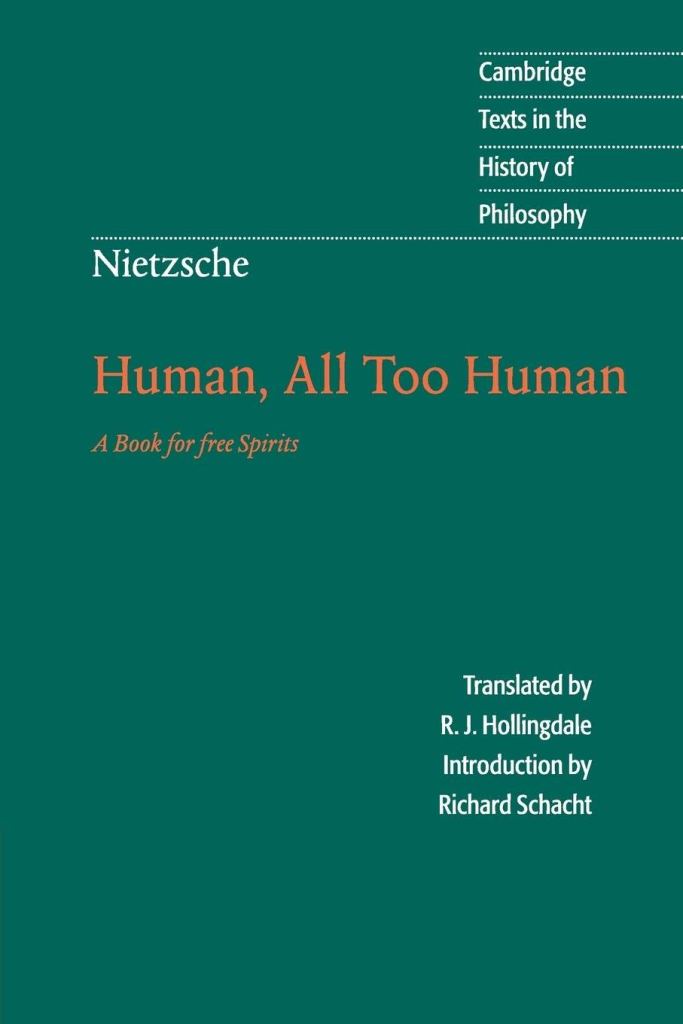
Friedrich Nietzsche’s Human, All Too Human: A Book for Free Spirits presents a striking departure from his earlier, more romantic and metaphysical works, marking a pivotal moment in his intellectual evolution. This collection, which contains almost 1,400 aphorisms, was originally published in three installments between 1878 and 1880. It reflects Nietzsche’s shift from his previous romanticism to a more skeptical, positivistic, and scientific approach to human nature and the world. This volume, edited by R. J. Hollingdale with a historical introduction by Richard Schacht, is an essential work for understanding Nietzsche’s transformation into the philosopher who would later declare the death of God and lay the foundation for modern existentialism and psychology.
In Human, All Too Human, Nietzsche grapples with the limitations of traditional metaphysical, theological, and philosophical frameworks, particularly the idealistic and romantic ideas that had previously shaped his worldview. The aphorisms reveal a Nietzsche in the midst of intellectual turmoil, seeking new ways to understand humanity, morality, religion, and society in the wake of Enlightenment thought. He aims to liberate himself from inherited systems of belief and thought, urging a return to more empirical, humanistic forms of inquiry that are grounded in the natural sciences. As Schacht notes in his introduction, this work is a turning point in Nietzsche’s philosophy, one that distances him from his earlier mentors like Richard Wagner and Arthur Schopenhauer. It is through this break that Nietzsche begins to forge a path toward a philosophy centered on human nature and its complexities, free from the transcendent ideals that had previously dominated Western thought.
Nietzsche’s skepticism in Human, All Too Human is evident in his unflinching critique of religious and metaphysical beliefs, particularly Christianity. He deconstructs these systems, revealing them as human constructs rather than divine revelations. His approach is radically empirical, drawing on evolutionary biology and psychology to explain human behavior and values. In this sense, the work can be seen as the precursor to Nietzsche’s later, more famous ideas on the will to power and the revaluation of all values. The aphorisms also engage with questions of morality, exploring the origins and implications of moral systems. Nietzsche dismisses conventional moralities, seeing them as products of societal structures and psychological forces that have little to do with human flourishing.
While Human, All Too Human is often overshadowed by Nietzsche’s later works, such as Thus Spoke Zarathustra, it remains an indispensable text for understanding the development of his philosophy. The book provides a glimpse into Nietzsche’s evolving view of the human condition, one that does not rely on external, otherworldly forces but instead seeks to affirm life as it is, with all its imperfections and contradictions. In many ways, this work marks the birth of a new Nietzsche, one that embraces the challenges of human existence without resorting to comforting illusions. His use of the aphoristic form in Human, All Too Human allows him to explore a wide range of topics—from psychology and culture to art, politics, and religion—without being constrained by systematic arguments or traditional philosophical structures. This reflects Nietzsche’s desire to engage with the world in a way that is both intellectually rigorous and creatively liberated.
In Human, All Too Human, Nietzsche introduces the concept of the “free spirit,” a key idea that recurs throughout his later work. The free spirit, for Nietzsche, represents the individual who has liberated themselves from the bonds of conventional thinking and is capable of critically examining society, values, and their own beliefs. This notion is deeply tied to Nietzsche’s own personal experience of isolation and intellectual rebellion, which he addresses in his preface to the work. The free spirit is not simply a detached observer but an active participant in the world, using their independence to navigate the complexities of human existence. Nietzsche’s call to become a free spirit is a call to embrace life fully, to question everything, and to develop a philosophy that is both deeply personal and universally applicable.
The text also contains Nietzsche’s reflections on the nature of suffering and the human will. While he rejects the idea that suffering has intrinsic meaning or purpose, he does not deny its transformative potential. The experience of suffering, Nietzsche suggests, can lead to the development of greater self-awareness and strength. This emphasis on the power of the individual to shape their own destiny is central to Nietzsche’s philosophy, and Human, All Too Human sets the stage for his later explorations of the will to power and the idea of the Übermensch, or “overman,” who transcends the limitations imposed by society and traditional morality.
While the themes introduced in Human, All Too Human are further developed in Nietzsche’s later works, this collection stands on its own as a profound and complex work of philosophical reflection. Its insights into human psychology, culture, and morality continue to resonate with contemporary thinkers, particularly in the fields of existentialism and psychology. Nietzsche’s exploration of the human condition in this book challenges readers to question their own beliefs and assumptions, to embrace the complexities and contradictions of life, and to seek a deeper understanding of what it means to be human. For anyone seeking to understand Nietzsche’s thought in its most formative stages, Human, All Too Human is an essential text that offers valuable insights into his intellectual journey and the development of his philosophy.
Human, All Too Human presents Nietzsche’s courage in confronting the most difficult questions of existence. It represents a pivotal moment in his career, where he begins to move away from romanticism and idealism and toward a more empirical, skeptical, and ultimately affirming philosophy. This work provides readers with a glimpse of the intellectual rigor, independence, and insight that would define Nietzsche’s later works, making it an invaluable resource for understanding the evolution of his thought and its impact on modern philosophy. Nietzsche’s call to embrace life in all its complexity, to challenge preconceived notions, and to create new values for the future remains as relevant today as it was when Human, All Too Human was first published.
 Simon Gros
Leave a comment