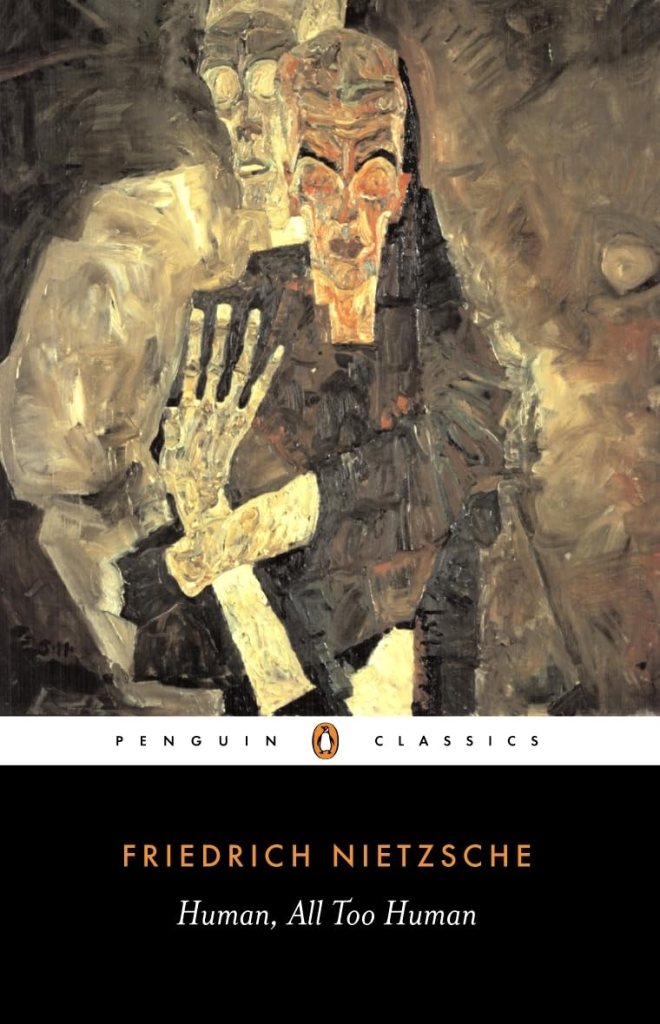
The following text is a depiction so unrelenting in the thoroughness of its philosophical inquiry, so immoderate in the density of its conceptual detail, that it seems to stand as a great cavern of thought into which the attentive reader must plunge, armed with nothing but the steadfastness of one’s reason and the lucidity of one’s interpretive prowess. In this Penguin edition of Friedrich Nietzsche’s Human, All Too Human, edited, introduced, and translated by Marion Faber and Stephen Lehmann, the work is at once an immense meditation on the evolution of Nietzsche’s philosophical mind and a formidable textual monument to the profound crisis that had overtaken him in the late 1870s. Imbued with a spirit both critical and genealogical, it operates like a reckoning—an unyielding, dissecting gaze—upon all that underlies our inherited notions of art, morality, religion, science, and the countless areas of culture. This book, often standing at a crossroads in Nietzsche’s intellectual development, is one that seeks not only to unearth the past from which all our hallowed ideals spring, but to show how our most venerable assumptions and cherished valuations may, in truth, rest upon fragile illusions and grand artifices.
Here is Nietzsche at a transformative juncture: separated painfully from Richard Wagner, a man once venerated as spiritual mentor and heroic figure of German culture, and forced out of the academic sphere by ill health. Here is Nietzsche no longer content with the German romanticism that he had once, under Wagner’s influence, exalted, but instead turning toward the critical spirit of the French Enlightenment, toward a more subtle and historically informed mode of analysis. He sifts patiently—and often with surgical precision—through the sedimented layers of belief that give shape to our world. At the heart of this enormous labor lies the recognition that what once appeared to be ultimate metaphysical truths may have no more solidity than intricate fictions. With this text, Nietzsche seems to say that the time has come to abandon the mystifying vapors of metaphysics and to grow rigorous in our inquiry, so that we might see with ever-clearing eyes the conditions that have permitted moralities, religions, and ideals of beauty to flourish and then degenerate in the cycles of human cultural life.
The method Nietzsche adopts in Human, All Too Human is aphoristic, a form in which idea after idea, observation after observation, stands forth as a concentrated crystal of insight. These 638 aphorisms chart a tremendous landscape of thought. They address and redefine a wide array of concepts and themes that once seemed so intimately bound to human dignity and purpose. From art and arrogance to boredom and passion, from science and vanity to women and youth, the aphorisms are not systematically arrayed as a philosopher’s magnum opus might be, but rather scattered like seeds. Yet it would be a mistake to suppose the seeds lie aimlessly. Each is planted, silently and often ironically, in the fertile ground of a project that Nietzsche has set himself: to recompose the philosopher’s stance not as a transmitter of timeless truths but as a restless genealogist and evaluator, a “free spirit” whose position above the old certainties comes with neither pious comfort nor redemptive clarity, but offers instead the stark honesty of disillusionment. He sets before us not a system but a path of becoming: the path by which a man who once believed in metaphysical absolutes comes to know that all valuations must be measured anew, that the delicate filigree of human morality is not the handiwork of divine craftsman but a fragile artifact of culture and history.
At the work’s base is the peculiar and crucial transition in Nietzsche’s thinking. Previously fascinated by Schopenhauer’s metaphysics of the will and Wagner’s musical drama as a means of cultural rebirth, Nietzsche now seeks surer foundations. He recognizes that these romantic and metaphysical illusions were, in some sense, born of an era’s cultural needs. But the time has passed. Nietzsche would have us understand that the philosopher’s duty is not to console or to enchant, but to comprehend, to stand before the great tower of our beliefs and probe the mortar that holds them. In doing so, he unearths the roots of human morality as historical events and cultural accumulations, not given facts of nature. He reveals how so much of our sense of beauty and transcendence arose not from an eternal realm, but from the longings, sufferings, and vanities of generations who knew not what they did. There is no better mirror for the complexity of human history than the aphorisms of this book, which, through cunning observation and sly paradox, hint that the “thing in itself” is either unknowable or altogether irrelevant—only the human gaze and human actions, shaped by countless errors and passions, weave the real we take for reality.
And yet, this is not a dry reduction to nihilism. If there are seeds, they are not seeds of despair but of possibility. Nietzsche shows that if moralities are human inventions, then we possess the power to re-invent them. If truths are the outcomes of complicated genealogical processes, then recognizing this frees us from dogma and opens the horizon of self-awareness. Hence, within these pages, we detect the faint music of Nietzsche’s later conceptual tools—the will to power, the striving to create one’s own values—that would emerge more fully down the line. We encounter the early blossoms of a mentality dedicated to the overcoming of old categories and to the forging of a life without recourse to metaphysical crutches. The honesty is severe, perhaps disquieting: what if we find that everything we revere is “human, all too human”? That what once seemed divine and ineffable is actually the product of our own all-too-imperfect species-being?
As the reader wends his or her way through Nietzsche’s rich and cryptic fields of insight, the experience can be shattering in the sense indicated by one of the reader’s reviews: it is “mind-blowing.” To read Nietzsche here is to face a text that can dissolve the veil of received wisdom, forcing a re-interpretation of one’s own moral, religious, and philosophical landscape. It is the book of a man whose skepticism and distrust of inherited ideas have become so acute that nothing can remain sheltered from scrutiny. He writes for “free spirits,” perhaps not for the many, but for the rare few willing to bear the uncertainties of a life without metaphysical guarantees. In that endeavor, Nietzsche’s prose can be both enlightening and dark. There is a gravity to his unmasking of values, and a resonant need to digest the implications of what he is doing. The traveler along this intellectual path may find it necessary, as one reader suggests, to take a long drive, to think and accept or struggle with Nietzsche’s naked honesty.
For all its subtlety, one must keep in mind that Human, All Too Human still preserves something of an early stage in Nietzsche’s journey. Some critics and readers have found it less biting than later works, and to a certain extent that is true. Much in these pages remains in germ. The later demolitions of Christian morality, for instance, are still only faint sketches here; the misogynistic asides and the hostility toward mass democracy are present but less thematically central than they would become as Nietzsche’s thought congealed around the idea of the Übermensch. Indeed, the figure of the “free spirit” of this book prefigures Zarathustra’s dance on the mountaintop but has not yet learned those more poetic and fiery dances. The hammer has not yet fallen. Still, we witness the seeds that will later grow into mighty and troubling philosophical forests.
Given these factors, Nietzsche’s Human, All Too Human is not a work that should be approached merely as a historical curiosity, but as a cornerstone in Nietzsche’s corpus. It is a carefully restored fragment of a philosophical edifice, whose translators, editors, and introducers have endowed the text with a vividness and fidelity that allows contemporary readers to feel its intellectual energy. Indeed, as noted in one of the scholarly appraisals included, it is a text often overlooked precisely because it is transitional, neither the romantic prophet’s dream nor the fully realized genealogist’s hammer. Yet its value stems partly from that transitional status: it stands as a monument to personal and intellectual crisis, and as a gateway into Nietzsche’s mature philosophy.
Any serious student of modern thought should therefore treat this work not as a footnote but as a chapter essential for understanding the origins of Nietzsche’s vision. In it, the precious seeds of what would become a new way of philosophizing—strict, genealogical, historical, untethered by illusions—are planted. For readers prepared to endure the rigor of these reflections and to concede that the world they know may be built on shifting sands, the reward is immense. They step closer to a philosophy that is honest in its doubt, energetic in its critique, and unflinching in its search for truth beyond comforting myths. In short, in these pages, Nietzsche invites each of us to forgo the tranquil slumber of ancient illusions and stand, disquieted, but newly aware, on the threshold of a more lucid comprehension of our own humanity.
 Simon Gros
Leave a comment