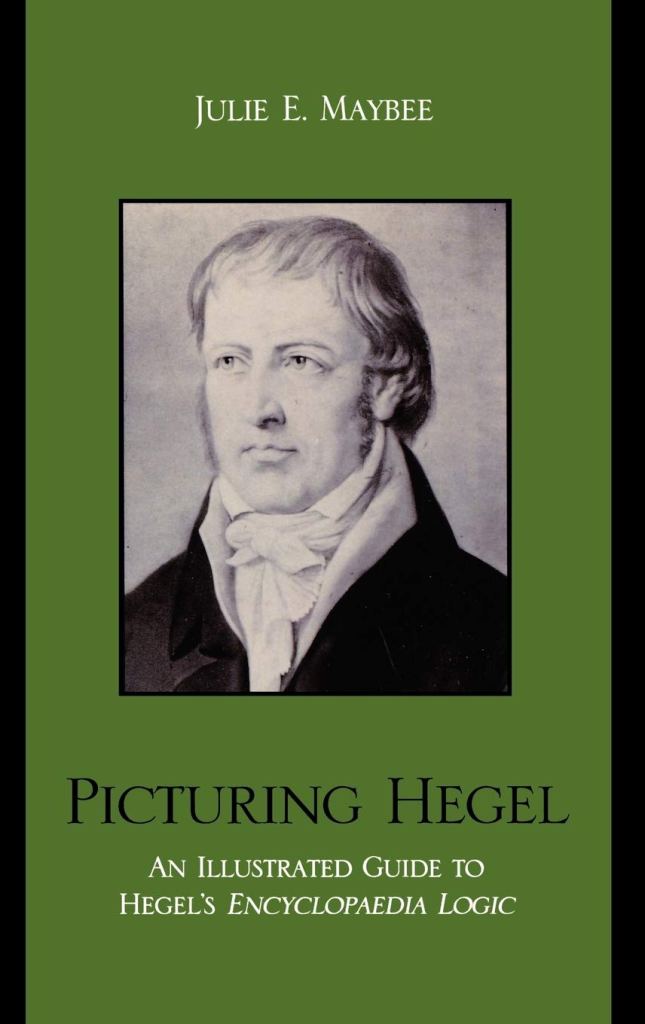
Picturing Hegel: An Illustrated Guide to Hegel’s Encyclopaedia Logic by Julie E. Maybee is a groundbreaking work that breathes new life into G.W.F. Hegel’s notoriously dense and challenging Encyclopaedia Logic. Maybee created an ambitious project to demystify Hegel’s philosophical system by employing diagrams and illustrations, offering a novel approach that caters to both newcomers and seasoned scholars of Hegelian thought. Her method transcends mere pedagogical aid; it unveils the logical architecture underpinning Hegel’s philosophy, illuminating the necessity and progression inherent in his dialectical method.
At the heart of Maybee’s work is the conviction that Hegel’s logic, often dismissed as opaque or arbitrary, is in fact a carefully structured system driven by necessity. She challenges the conventional misinterpretation that Hegel’s dialectic operates on the simplistic pattern of “thesis-antithesis-synthesis,” arguing instead that his logic is far more nuanced and scientific. By dissecting each stage of the Encyclopaedia Logic, Maybee demonstrates how Hegel’s concepts develop organically from earlier stages, adhering to definite logical patterns that are both coherent and compelling.
The use of diagrams in Picturing Hegel serves a dual purpose. Firstly, it acts as a visual grammar that cuts through Hegel’s laborious prose, revealing the syntactic structures that connect each logical step. This visual representation is particularly effective in elucidating Hegel’s complex concepts such as being-in-itself, being-for-itself, and being-in-and-for-itself, providing a level of precision and clarity that textual explanations alone often fail to achieve. Secondly, the diagrams highlight the dynamic movement of Hegel’s logic, emphasizing the necessity that drives the progression from one concept to the next. Maybee’s illustrations capture the essence of Hegel’s dialectical method, showcasing how each concept is both a result of preceding ones and a precursor to subsequent developments.
Maybee goes deeply into the nature of syntax and semantics in Hegel’s logic. She posits that for Hegel, concepts gain their meaning through their relations to other concepts, not merely through their definitions in isolation. This relational understanding is central to grasping Hegel’s philosophy, as it underscores the idea that meaning and identity are shaped by context and interconnection. By making these relationships visible through diagrams, Maybee enables readers to perceive the inherent necessity in Hegel’s logical transitions, thereby countering the criticism that his logic lacks coherence or rigor.
One of the significant contributions of Picturing Hegel is its rehabilitation of Hegel’s logic as a legitimate and rigorous system. Maybee addresses the skepticism that has historically plagued interpretations of Hegel’s work, particularly the notion that his logic is a series of arbitrary moves or that it relies on metaphysical imports from outside logic itself. She systematically demonstrates that Hegel’s transitions are not only logical but are compelled by the exhaustion of possibilities within the concepts themselves. This exhaustion necessitates the introduction of new concepts, which are, in fact, already implicit in the earlier stages—a process that underscores the self-generating and self-correcting nature of Hegelian logic.
Maybee’s work sheds light on the semantic depth of Hegel’s logic. She illustrates how Hegel’s logic is not merely a formal exercise concerned with abstract structures but is deeply invested in defining the content of central philosophical concepts. Concepts like universality, particularity, and singularity are explored not just as logical forms but as meaningful categories that have significant implications for understanding reality. Maybee shows that for Hegel, logic is inherently metaphysical, as it seeks to uncover the fundamental structures of being and thought.
The book also engages with contemporary discussions in logic and philosophy. Maybee draws parallels between Hegel’s logic and modern developments, such as the work of Jon Barwise and John Etchemendy, who advocate for the legitimacy of diagrams in logical reasoning. She argues that just as visual representations can enhance understanding in modern logic, they are instrumental in unpacking the complexities of Hegel’s system. This connection bridges the gap between Hegelian philosophy and current logical theory, suggesting that Hegel’s insights remain relevant and valuable for contemporary discourse.
Maybee does not shy away from the challenging aspects of Hegel’s logic. She confronts head-on the critiques that Hegel’s logic is metaphysical or that it introduces elements beyond logical reasoning. By tracing the development of concepts and the necessity driving their progression, she demonstrates that Hegel’s logic is self-contained and scientifically robust. Her analysis shows that Hegel’s logic encompasses both the form and content of truth, addressing the limitations of formalistic logics that focus solely on syntactic structures while neglecting semantic depth.
Maybee also explores the implications of Hegel’s logic for understanding the nature of reason and knowledge. She situates Hegel’s work within the broader philosophical context, referencing his engagement with predecessors like Kant and Hume. By doing so, she highlights Hegel’s attempt to redefine rationality in a way that overcomes skepticism and establishes a firm foundation for knowledge. This historical perspective enriches the reader’s appreciation of Hegel’s logic as part of an ongoing philosophical dialogue about the capabilities and limits of human reason.
Maybee also offers a thoughtful reflection on Hegel’s materialism, optimism, and faith. She connects the logical structures elucidated throughout the book to broader themes in Hegel’s philosophy, such as his views on ethics, politics, history, religion, and phenomenology. By doing so, she reinforces the idea that understanding Hegel’s logic is essential for grasping the full scope of his philosophical system.
Picturing Hegel: An Illustrated Guide to Hegel’s Encyclopaedia Logic is an invaluable contribution to Hegelian scholarship. Julie E. Maybee’s innovative use of diagrams transcends mere illustrative aid, offering key insights into the necessity and structure of Hegel’s logic. Her work invites readers to engage deeply with Hegel’s philosophy, challenging preconceived notions and encouraging a reexamination of what constitutes logic and rationality. By making Hegel’s logic accessible without sacrificing its complexity, Maybee opens the door for a renewed appreciation of Hegel’s contributions to philosophy and reaffirms the relevance of his thought in contemporary discourse.
 Simon Gros
Leave a comment