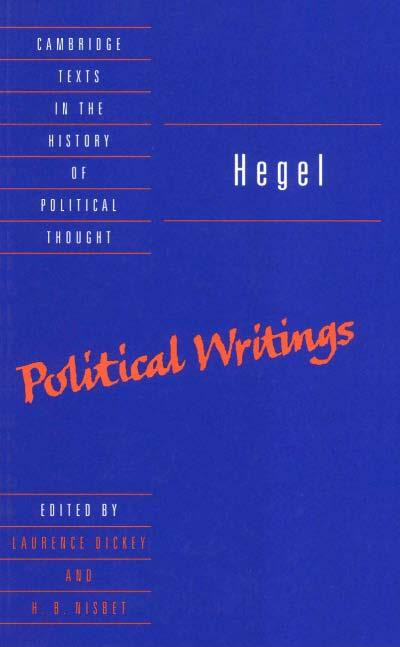
Hegel: Political Writings, edited by Lawrence Dickey and H. B. Nisbet, is an indispensable volume that offers a presentation of Georg Wilhelm Friedrich Hegel’s political philosophy beyond his renowned Philosophy of Right. This collection gathers Hegel’s most significant political writings, providing readers with unparalleled access to both the practical and metaphysical dimensions of his thought. The volume is structured to cater to students and scholars alike, especially those without specialist knowledge, through a comprehensive array of scholarly tools, including a full chronology of Hegel’s life and career, a substantial general introduction, detailed explanatory annotations, an extensive glossary, and a carefully curated bibliography.
The general introduction serves as a crucial guide, situating Hegel’s political writings within the broader context of his philosophical system and the tumultuous socio-political landscape of his time. It goes into Hegel’s unique critique of the confluence of religion, civil society, Western culture, and political association, offering valuable insights into his dialectical method and his conception of ethical life (Sittlichkeit). The introduction highlights how Hegel perceived the modern individual’s estrangement from the political community, a consequence of the privatization tendencies inherent in the burgeoning bourgeois society. This estrangement is characterized by a shift from communal ethical engagement to a focus on individual morality (Moralität), resulting in the depoliticization of the citizenry and the atomization of social life.
Hegel’s writings in this collection critically examine the implications of this shift, particularly in relation to the German context. In The German Constitution, for instance, Hegel offers a penetrating analysis of the fragmented nature of the German political system, emphasizing the weaknesses of the Holy Roman Empire’s decentralized structure. He scrutinizes the inefficacy of the Imperial Army, the complexities of fiscal policies, and the lack of unity among the German estates, attributing these deficiencies to the absence of a cohesive political authority. Hegel argues that without a unified state, the German nation cannot achieve true political freedom or realize the ethical life necessary for a flourishing society.
In On the Scientific Ways of Treating Natural Law, Hegel engages with the philosophical underpinnings of law and ethics, critiquing the methodologies of his contemporaries and predecessors. He challenges the formalism and abstraction of Kantian moral philosophy and natural law theories that fail to account for the concrete realities of social and political life. Hegel advocates for a dialectical approach that recognizes the dynamic interplay between individual freedom and communal ethical norms. He posits that true freedom is realized not in isolation but through participation in the ethical institutions of family, civil society, and the state, each representing different moments in the development of ethical life.
The collection also sheds light on Hegel’s views regarding the relationship between religion and the state. In his Address on the Tercentenary of the Submission of the Augsburg Confession and The Relationship of Religion to the State, Hegel explores how religious consciousness intersects with political structures. He emphasizes the role of Protestantism, particularly Lutheranism, in shaping the ethical and cultural foundations of the modern state. Hegel contends that religion, when properly integrated into the state’s ethical framework, can reinforce the unity and moral purpose of the political community. However, he warns against the dangers of religious institutions wielding political power or promoting doctrines that undermine the rational foundations of the state.
One of the central themes of the volume is Hegel’s concept of Sittlichkeit and its significance for his political philosophy. The editors provide an in-depth examination of this concept, explaining how Hegel sees ethical life as the synthesis of personal morality and communal values within the institutions of the state. Sittlichkeit represents the embodiment of freedom in concrete social practices and laws, transcending the abstract notions of individual rights prevalent in liberal theories. Hegel critiques the atomistic individualism of the bourgeois society, which he believes leads to social fragmentation and alienation. Instead, he envisions a state where individuals realize their freedom through active participation in a rational ethical order that harmonizes personal and collective interests.
The translators’ preface offers valuable insights into the challenges of rendering Hegel’s complex and often dense prose into English. They discuss the variations in style and terminology across Hegel’s writings, reflecting the evolution of his thought over time. The translators emphasize the importance of consistency in translating key philosophical terms, while also accommodating the nuances and context-specific meanings that Hegel assigns to these terms in different works. This careful attention to linguistic detail enhances the accessibility of the texts without sacrificing philosophical rigor.
The inclusion of previously untranslated works, such as Hegel’s Inaugural Address at the University of Berlin and his Latin Address on the Tercentenary of the Augsburg Confession, expands the scope of the collection and provides fresh perspectives on Hegel’s engagement with educational and religious institutions. These speeches reveal Hegel’s commitment to the role of philosophy in advancing knowledge and shaping the ethical foundations of society. They also illustrate his views on the importance of academic freedom and the pursuit of truth within the context of the modern university.
Throughout the collection, Hegel’s writings reflect his deep concern with the practical implications of philosophical ideas for political life. In On the English Reform Bill, he offers commentary on contemporary political developments in England, analyzing the implications of electoral reforms for the constitutional order. Hegel’s engagement with real-world political issues demonstrates his belief that philosophy must not remain abstract but should inform and be informed by the concrete realities of social and political existence.
The editors also address critical interpretations of Hegel’s political philosophy, particularly the contentious debate over the potential totalitarian implications of his conception of the state. Critics like Ralf Dahrendorf have accused Hegel of promoting a form of collectivism that subordinates individual freedom to the demands of the state. However, the editors argue that such readings overlook Hegel’s nuanced understanding of freedom and his emphasis on the mutual interdependence of individuals and the community. They contend that Hegel’s vision of the state is not one of oppressive control but of an ethical community where freedom is actualized through rational laws and institutions that reflect the common good.
The volume’s comprehensive glossary and detailed annotations are invaluable resources for readers navigating the intricacies of Hegel’s terminology and conceptual framework. They clarify the meanings of key terms like Sittlichkeit, Moralität, and bourgeois, which are essential for understanding Hegel’s critique of modern society and his proposals for political and ethical reform. The bibliography directs readers to further scholarly works that contextualize Hegel’s thought within the broader philosophical and historical discourse.
Hegel: Political Writings is a seminal work that offers a rich and multifaceted exploration of Hegel’s political thought. It illuminates the depth and complexity of his engagement with the critical issues of his time, many of which remain relevant today. The collection underscores Hegel’s contributions to discussions on the nature of the state, the role of civil society, the interplay between individual freedom and communal responsibility, and the ethical dimensions of political life.
By providing access to texts that have been previously inaccessible to English-speaking audiences, the volume opens new avenues for scholarship and critical inquiry. It invites readers to grapple with Hegel’s challenging ideas and to consider their implications for contemporary political theory and practice. The editors’ meticulous scholarship ensures that the collection is both authoritative and accessible, making it an essential addition to the library of anyone interested in Hegel, political philosophy, or the history of ideas.
Hegel: Political Writings not only enriches our understanding of Hegel’s philosophy but also contributes to ongoing debates about the nature of freedom, the role of the state, and the possibilities for ethical life in modern society. It challenges readers to reflect on the conditions necessary for genuine political community and the ways in which philosophical reflection can inform and transform our collective existence. Through this collection, Hegel’s profound insights continue to resonate, offering guidance and inspiration for those seeking to navigate the complexities of the modern world.
 Simon Gros
Leave a comment