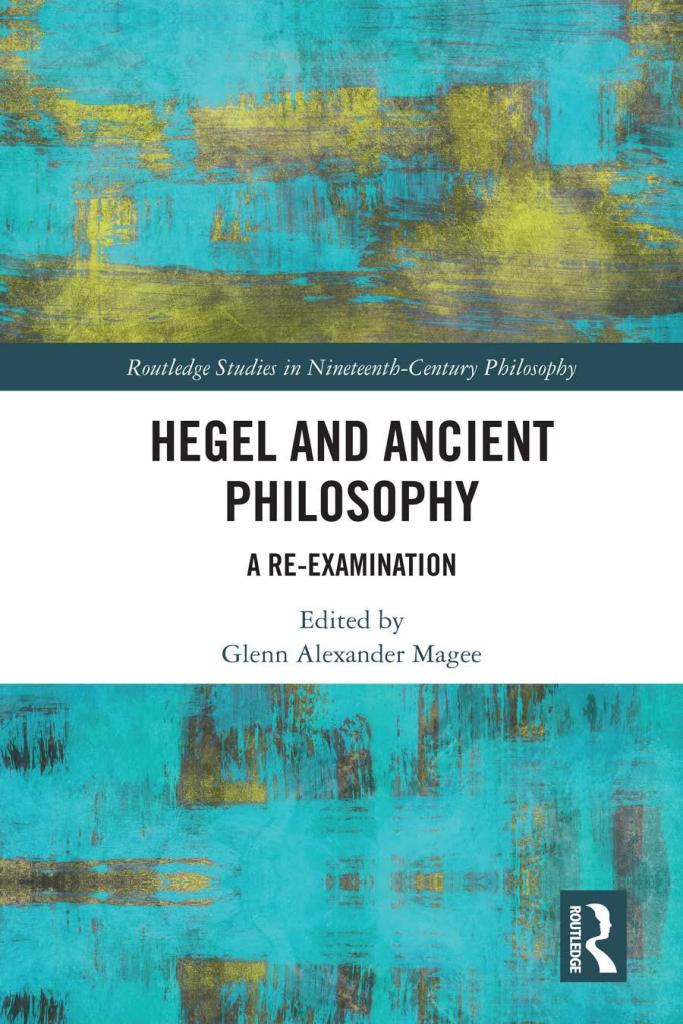
Glenn Alexander Magee’s Hegel and Ancient Philosophy: A Re-Examination is a scholarly endeavor that analyses the relationship between Hegel’s philosophy and ancient thought. This extensive volume gathers original essays from leading scholars who explore Hegel’s debts to ancient philosophers, as well as critically assess his interpretations, which are often as provocative as they are insightful. The book serves not only as a rigorous assessment of Hegel’s engagement with antiquity but also as a challenge to longstanding scholarly assumptions that have shaped our understanding of this relationship.
Hegel’s own acknowledgment of his indebtedness to ancient philosophy is well-documented. Approximately half of his Lectures on the History of Philosophy is devoted to ancient thinkers, and references to antiquity permeate his entire corpus. He viewed the Greeks and the German Idealists as the twin peaks of philosophical thought, with everything in between serving as necessary yet subordinate developments in the grand narrative of Spirit’s self-realization. This perspective is the backdrop against which Magee’s volume operates, offering a comprehensive re-examination that is both timely and necessary.
The book begins by situating Hegel within a broader historical context, urging readers to consider his philosophy not merely as a culmination of German Idealism but as a modern transformation of Aristotelian ideas. This approach echoes G.R.G. Mure’s earlier assertion that understanding Hegel requires a thorough grasp of Aristotle, a view that Magee and the contributing scholars take seriously. By framing Hegel’s positions in relation to ancient thinkers, the volume seeks to uncover the layers of interpretation that have often obscured the richness of both Hegel’s and the ancients’ philosophies.
One of the central themes explored is Hegel’s developmentalist approach to the history of philosophy—the notion that earlier philosophies are inherently “poorer” or more “abstract” compared to later, more “developed” ones. This perspective has led to the marginalization of certain ancient thinkers whose contributions do not neatly fit into Hegel’s dialectical progression. The volume critically examines this assumption by re-evaluating figures like Xenophanes, whose philosophical significance challenges the developmentalist schema. By doing so, it opens up new avenues for understanding the complexities and nuances of ancient thought and its influence on Hegel.
The essays collectively argue that Hegel’s relationship with ancient philosophy is more intricate than previously acknowledged. For instance, while Hegel is enormously indebted to Aristotle, an overemphasis on this relationship has sometimes overshadowed his engagements with other ancient thinkers. The volume addresses this imbalance by exploring Hegel’s interactions with a broader spectrum of philosophers, including the Presocratics, Plato, the Stoics, and the Skeptics. This broader focus illuminates the multifaceted nature of Hegel’s appropriations and critiques of ancient ideas.
Magee’s introduction underscores the importance of re-examining Hegel’s interpretations of ancient philosophy, noting that his readings were often influenced by the interpretive traditions preceding him, which themselves were products of their historical contexts. For example, Hegel’s understanding of Presocratic thought was shaped by Aristotle’s classifications, which may not accurately reflect the original intentions of those early thinkers. By critically engaging with these inherited interpretations, the volume aims to recover aspects of ancient philosophy that have been misrepresented or neglected.
A significant portion of the book is devoted to exploring Hegel’s readings of Plato and Aristotle, two figures who are central to his philosophical system. The contributors delve into Hegel’s conception of the “concrete universal” in relation to Plato’s dialogues, highlighting how Hegel saw his own dialectical method reflected in Platonic thought. Similarly, the volume examines Hegel’s appropriation of Aristotelian concepts in his discussions of the soul, the body, and their unity and distinction. These explorations reveal the depth of Hegel’s engagement with these thinkers and the ways in which he both drew from and transformed their ideas.
Another key theme is Hegel’s treatment of the notion of contradiction, particularly in relation to Aristotle’s principle of non-contradiction. The volume discusses how Hegel’s dialectical logic challenges this principle, liberating reason from traditional constraints and allowing it to become truly autonomous and self-determining. This examination not only sheds light on Hegel’s innovative approach to logic but also situates it within a historical dialogue with ancient philosophy.
The book also addresses Hegel’s relationship with Stoicism and Skepticism, philosophies that he saw as important stages in the development of self-consciousness and freedom. By re-evaluating Hegel’s interpretations of these schools of thought, the volume contributes to a more comprehensive understanding of his philosophy of Spirit and its historical underpinnings.
Throughout the essays, there is a concerted effort to balance appreciation for Hegel’s philosophical achievements with critical analysis of his historical interpretations. The contributors recognize that while Hegel’s readings were groundbreaking in their own right, they were also products of their time and subject to the limitations of contemporary scholarship. By bringing to bear the insights of modern philological and philosophical research, the volume seeks to refine our understanding of both Hegel and the ancient philosophers he engaged with.
In doing so, the book challenges the reader to reconsider not only Hegel’s place in the history of philosophy but also the very way we approach the study of philosophical traditions. It raises important questions about the nature of philosophical progress, the validity of developmentalist narratives, and the role of interpretation in shaping our understanding of philosophical texts. The volume thus serves as a catalyst for ongoing scholarly dialogue and a re-invigoration of interest in the intersections between ancient and modern thought.
Magee’s Hegel and Ancient Philosophy: A Re-Examination is, therefore, more than a collection of scholarly essays; it is a reflection on the enduring relevance of ancient philosophy in contemporary discourse. By bringing together scholarship and incisive analysis, the book offers a richly detailed and nuanced portrait of Hegel’s complex relationship with his philosophical forebears. It stands as an essential resource for anyone seeking to deepen their understanding of Hegel, ancient philosophy, or the dynamics between the two.
The volume exemplifies the kind of rigorous and reflective scholarship that is necessary for grappling with the questions at the heart of philosophy. It invites readers to engage critically with both Hegel and the ancients, to appreciate the historical depth of philosophical ideas, and to recognize the ways in which past thought continues to shape and inform the present. Magee and his contributors have provided a valuable contribution to Hegelian studies and to the broader philosophical community, one that will undoubtedly influence future research and discussion in the field.
 Simon Gros
Leave a comment