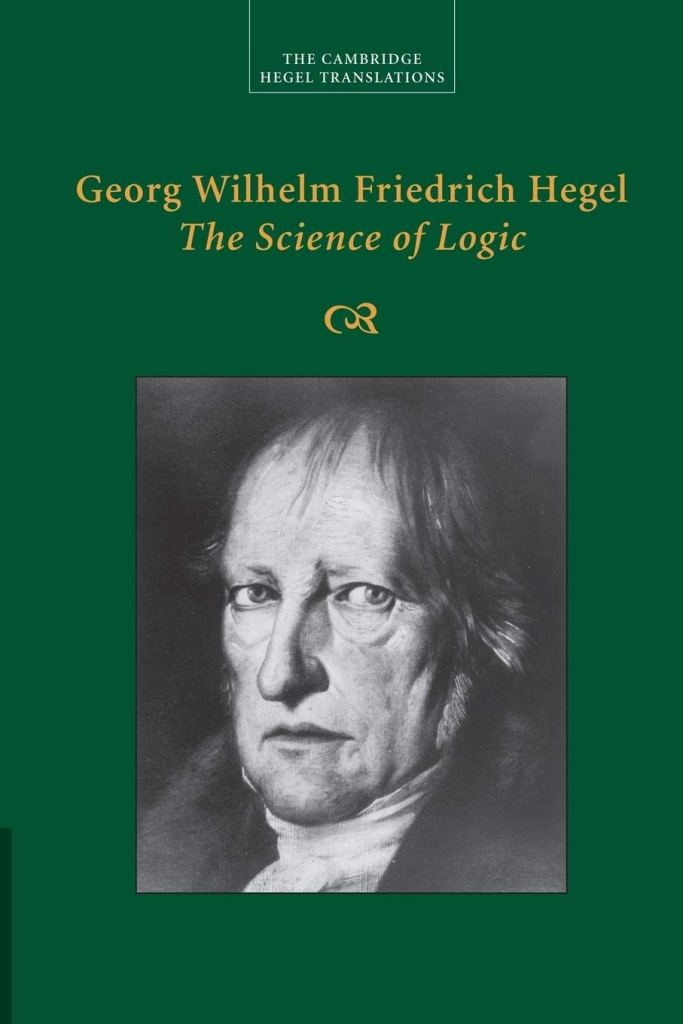
Georg Wilhelm Friedrich Hegel’s The Science of Logic, in this Cambridge translation by George Di Giovanni, is a monumental work in the annals of Western philosophy, representing both the culmination of classical metaphysics and a crucial reconfiguration of philosophical thought. This comprehensive edition brings together the revised Book I from 1832, along with Books II and III from 1813 and 1816 respectively, offering readers an unabridged access to Hegel’s system.
Hegel’s Logic is not just an abstract treatise but a rigorous exploration of the very foundations of thought and being. It goes into the dialectical processes that underlie all reality, positing that the evolution of concepts mirrors the evolution of existence itself. This work emerged from a period of intense intellectual development, where Hegel distanced himself from the influence of Schelling and re-engaged critically with the philosophies of Fichte and Kant. The break from Schelling was not a mere divergence but a radical rethinking that propelled Hegel to formulate his own system, one that sought to synthesize and transcend his predecessors.
The Science of Logic is an endeavor to map the structures of pure thought, independent of empirical content. Hegel begins with the most abstract concepts—being and nothingness—and demonstrates their inherent contradictions and the necessity of their synthesis in the concept of becoming. This dialectical method is the engine of the Logic, propelling the reader through increasingly complex categories and revealing the self-developing nature of thought.
Hegel challenges traditional metaphysics by asserting that the progression from abstract to concrete is not a linear accumulation of knowledge but a dynamic process where each stage contains the contradictions of the previous one and resolves them at a higher level of understanding. This movement is not confined to thought alone but reflects the unfolding of reality itself, suggesting a provocative identity of thought and being.
George Di Giovanni’s introduction provides invaluable context, reflecting upon recent scholarship that sheds light on the developmental trajectory of Hegel’s thought. He elucidates how Hegel’s Logic represents both a culmination and a departure—a culmination of the metaphysical tradition and a departure towards a new philosophical horizon. Di Giovanni highlights the “fault lines” within Hegel’s system that have led to divergent interpretations, acknowledging the complexity and the richness of Hegel’s philosophical enterprise.
The Logic is divided into three main parts: the Doctrine of Being, the Doctrine of Essence, and the Doctrine of the Concept. Each part corresponds to a different stage in the development of thought. In the Doctrine of Being, Hegel examines the most immediate and indeterminate categories of thought. The Doctrine of Essence delves into the structures underlying appearances, revealing the mediated nature of reality. Finally, the Doctrine of the Concept explores the self-reflective structures of thought, culminating in the Idea, which encapsulates the unity of subject and object.
Hegel’s analysis of categories such as quality, quantity, measure, essence, appearance, and actuality demonstrates his commitment to a system where each concept is both a product and a producer of the dialectical movement. He engages critically with previous philosophical systems, including those of Kant and Spinoza, and offers a reinterpretation that seeks to overcome their limitations while preserving their insights.
One of the remarkable aspects of Hegel’s Logic is its redefinition of traditional logical and metaphysical concepts. He transforms logic from a mere tool of analysis into a living, self-generating system that mirrors the dynamism of reality. This reconceptualization has significant implications for various domains, including epistemology, ontology, and even the philosophy of science.
The translation by George Di Giovanni is not only faithful to the original German but also renders Hegel’s complex ideas accessible to contemporary readers. Di Giovanni’s notes and commentary provide essential guidance through the complex structure of the Logic, clarifying Hegel’s arguments and situating them within the broader philosophical discourse.
The Science of Logic has been both influential and controversial. It has inspired thinkers to explore new directions in philosophy, while also provoking criticism and debate. George Lăzăroiu, in his review, describes the work as “very provocative and interesting,” noting its capacity to inspire novel lines of thought. This attests to the enduring relevance of Hegel’s Logic in stimulating philosophical inquiry.
Hegel’s work is not without its challenges. The density of his prose and the abstract nature of his subject matter require careful and sustained engagement. However, the rewards of such engagement are substantial. Readers are invited to participate in this exposition of the fundamental structures of thought, an endeavor that promises to reshape their understanding of reality.
The Science of Logic marks the end of classical metaphysics in the sense that it brings to closure a tradition of thought that sought to understand being through static categories. Hegel replaces this static conception with a dynamic process where contradictions are not merely obstacles but essential components that drive the evolution of thought and reality.
The historical context of the Logic’s development is crucial to appreciating its significance. Hegel wrote during a time of great intellectual ferment, engaging with and responding to the works of his contemporaries. His divergence from Schelling and his critical appropriation of Kant and Fichte’s ideas reflect a deep engagement with the philosophical currents of his time.
Hegel’s Logic is intrinsically linked to his overall philosophical system, which encompasses the Philosophy of Nature and the Philosophy of Spirit. The Logic serves as the foundational framework upon which these other parts are constructed, offering a comprehensive vision of reality that integrates logic, nature, and human spirit.
Georg Wilhelm Friedrich Hegel’s The Science of Logic is a foundational text that demands and rewards deep philosophical engagement. It challenges readers to rethink the nature of thought, reality, and their interrelation. George Di Giovanni’s translation and commentary make this monumental work accessible to a modern audience, ensuring that Hegel’s insights continue to inspire and provoke thoughtful discourse. This work speaks to the enduring power of philosophy and its capacity to illuminate the deepest aspects of existence.
 Simon Gros
Leave a comment