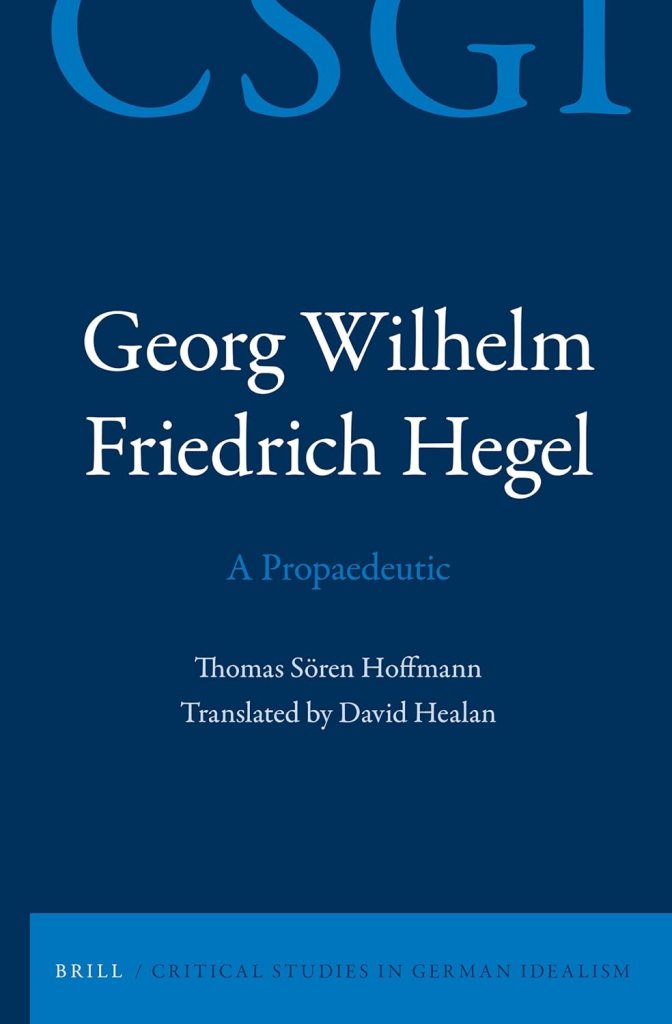
Thomas Sören Hoffmann’s Georg Wilhelm Friedrich Hegel: A Propaedeutic is a monumental intellectual biography that goes deeply into the dense philosophy of Hegel, the master philosopher of German idealism and the last great system builder of European philosophy. Hoffmann offers a comprehensive exploration of Hegel’s thought, working through all the major themes that define his philosophy—logic and metaphysics, history and spirit, art and language, thought and nature, right, religion, and science. These themes are not merely presented but are crafted as open invitations for readers to engage in a conversation with Hegel, to work alongside his ideas, and to think with the philosopher himself.
Hoffmann’s approach is characterized by the deployment of Hegel’s dialectical concept of life as a key to unlocking new insights and resolving the perennial enigmas and controversies surrounding Hegel’s work. This concept illuminates the dynamic, self-generating processes that underlie Hegel’s system, emphasizing the living, unfolding nature of his dialectic rather than static abstractions. By focusing on life as a dialectical process, Hoffmann reanimates Hegel’s philosophy, allowing readers to experience the vitality and relevance of his ideas in the contemporary context.
Hoffmann begins by situating Hegel’s philosophy as a philosophy of freedom. He underscores that Hegel did not write for scholars’ bookshelves or for academic exercises but was driven by a commitment to contribute to the liberation of human thought and practice. Hegel saw freedom as the fundamental principle that provides the key to a more humane, unalienated world. Hoffmann explores how Hegel believed that freedom of thought is inseparable from free practice and that both are intimately related. He goes into Hegel’s conviction that without freedom of thought, free practice succumbs to the rigor mortis of rigid structures, and without practical consequences, free thinking remains abstract and ineffective.
The propaedeutic then addresses the common prejudices and irritations that often hinder a proper understanding of Hegel’s philosophy. Hoffmann tackles these objections head-on, discussing concepts such as totality, system, dialectic, logocentrism, philosophy in its own time, and the absolute. He clarifies that Hegel’s concept of totality is not about imposing a rigid system that suppresses individuality but about recognizing that individuality and totality find their realization through each other. Hoffmann explains that for Hegel, the truth is the whole, and this whole is not a finished result but a dynamic process of development where the universal and the particular, the individual and the totality, are interdependent.
In discussing the system, Hoffmann emphasizes that for Hegel, systematic philosophy is not a corset imposed upon the life of the spirit but the knowledge that this life extends beyond any immediate concerns. Systematic thinking is the principle of actively generating philosophy anew, continually renewing the ur-continuity of the process of knowledge. Hoffmann elucidates that Hegel’s system is not about possessing a finished inventory of the world but about engaging in the continuous self-determination of thought, where each logical content contains within it the principle of its logical continuity.
The exploration of dialectic is central to Hoffmann’s exposition. He highlights that Hegel’s dialectic is not a subjective switching system of reasoning back and forth but the process of thinking that begins not with fixed starting points but in the middle of all polar oppositions, their genesis, overcoming, and mediation. Dialectic, for Hegel, is the method of revealing the potential for building relationships within differences, constantly updating knowledge within the logical continuum. Hoffmann makes it clear that dialectic is not about accepting contradictions as final but about understanding that contradictions point to deeper relations and that through dialectical movement, thought progresses toward higher levels of understanding.
Hoffmann also addresses the critique of logocentrism, explaining that Hegel’s use of the logos is not about suppressing difference but about recognizing that the logos is the gathering relation that unites the many into one. He points out that dialectical thinking begins with self-relating, which is simultaneously differentiating and uniting. This approach counters post-structuralist critiques by showing that Hegel’s philosophy allows for the transformation of the other and does not fix it in a state of perpetual otherness.
In discussing philosophy in its own time, Hoffmann explains Hegel’s assertion that philosophy is its own time grasped in thought. He clarifies that this means philosophy gives expression to the self-consciousness of an epoch, not by providing images of what is happening but by articulating the logical center that defines a particular period. Hoffmann emphasizes that for Hegel, truth is not about escaping time but about engaging with it, illuminating it from within, and recognizing that reason manifests itself in time.
The concept of the absolute is thoroughly examined, with Hoffmann explaining that for Hegel, the absolute is not an inaccessible entity separated from all relations but is identical with true knowing and self-mediating relations. The absolute is the medium of philosophy itself, present within the logical movement of thought. Hoffmann elucidates that the absolute, in Hegel’s philosophy, is not an object to be known but the process of knowing itself, the self-awareness that underlies all philosophical inquiry.
Throughout the propaedeutic, Hoffmann traces Hegel’s philosophical development, beginning with his early writings and Jena debut. He explores Hegel’s formative years, his zealous study habits, and his threefold interest in theology, classical literature, and philosophy. The rediscovery of Hegel’s apocryphal writings provides insights into his early thoughts on folk religion, Christianity, and religious life. Hoffmann delves into Hegel’s works such as the Life of Jesus, The Positivity of the Christian Religion, and The Spirit of Christianity and Its Destiny, revealing Hegel’s deep engagement with questions of faith, being, and the destiny of spirit.
Moving into Hegel’s Jena period, Hoffmann examines both the exoteric and esoteric writings, including the Difference Essay, the Critical Journal, and the Natural Law Essay. He discusses Hegel’s speculative concept of life, his engagement with skepticism, and his responses to contemporary philosophical challenges. The analysis of Hegel’s system drafts from 1803 to 1806 sheds light on the evolution of his thought leading up to the Phenomenology of Spirit.
Hoffmann provides an overview of the Phenomenology of Spirit, describing it as the anamnesis of the human spirit. He traces the phenomenological journey from sensibility to understanding, self-consciousness, reason, spirit, and finally to absolute knowing. Hoffmann emphasizes that the Phenomenology serves both as an introductory discipline and as a system component, illustrating the interdependence between consciousness and the unfolding of truth.
The examination of the Science of Logic reveals it as the realm of the concept and the center of Hegel’s system. Hoffmann explains how Hegel begins with pure being and progresses through determinate being, being-for-itself, number, measure, essence, reflection, relation, the concept, objectivity, and the idea. This logical progression demonstrates the dynamic structure of reality as a self-developing totality.
In the discussion of Hegel’s Berlin system, Hoffmann explores the philosophy of nature, subjective spirit, right, history, art, and religion. He explains how Hegel conceives nature as the idea in its otherness, leading to the system of nature as a dynamic, self-differentiating whole. The philosophy of subjective spirit delves into anthropology, the theory of consciousness, and psychology, examining the emergence of self-consciousness and the conditions of subjective freedom.
Hoffmann’s analysis of the philosophy of right and history elucidates Hegel’s notions of abstract right, morality, and the ethical life. He demonstrates how Hegel’s dialectical progression moves from individual rights to the ethical community and the state as the actuality of ethical life. The philosophy of history is presented as the unfolding of spirit in time, where world history becomes the rational process through which freedom realizes itself.
In the philosophy of art, Hoffmann addresses Hegel’s view of the ‘past character of art’ and the concept of art as a sensuous manifestation of the absolute. He explores the art ideal and the system of art forms, showing how art reflects the development of spirit and its self-understanding. The philosophy of religion is examined through the concordance thesis and the hermeneutics of religion, culminating in revealed religion as absolute religion, where the finite and the infinite are reconciled.
Finally, Hoffmann discusses philosophy in its concept and history, articulating the three syllogisms that structure Hegel’s logic and the history of philosophy as the developmental continuum of the idea. He emphasizes that for Hegel, philosophy is both its own time comprehended in thought and a living, self-developing process that continually renews itself through dialectical movement.
The propaedeutic is enriched by substantial excerpts from Hegel’s own writings, allowing readers to engage directly with his thought. Hoffmann includes selections from Hegel’s forewords, letters, and key passages, providing context and depth to his analysis. This approach ensures that Hegel’s voice remains central, enabling readers to experience the immediacy and power of his philosophy.
In the foreword to the second edition, Hoffmann reflects on the positive reception of the propaedeutic and the expressed need for an introduction that lets Hegel speak in his own words. He acknowledges the widespread prejudices and misunderstandings that continue to hinder a full appreciation of Hegel’s work. Hoffmann emphasizes the importance of approaching Hegel’s philosophy with an open mind, ready to engage with its complexities and to allow one’s own standpoints to be set in motion by the dialectical process.
Hoffmann critiques the tendency in contemporary scholarship to project Hegel down to the level of the philosophy of the understanding, addressing only small questions that are not his own. He calls for a renewal of engagement with Hegel’s philosophy, recognizing its potential to offer profound insights into the prevailing crisis of modernity. Hoffmann argues that Hegel is a key thinker whose ideas are ripe for rediscovery, capable of inspiring thought that seeks its own autonomy and desires to think for itself.
Throughout the propaedeutic, Hoffmann maintains that Hegel’s philosophy is not about constructing a rigid system or providing definitive answers but about participating in the logical life of reason. He presents Hegel’s thought as an open invitation to engage in the dialectical process, to explore the unfolding of concepts, and to recognize the dynamics between universality and individuality. Hoffmann emphasizes that Hegel’s philosophy requires active involvement, continuous effort, and a willingness to embrace the complexities and challenges of dialectical thinking.
Thomas Sören Hoffmann’s Georg Wilhelm Friedrich Hegel: A Propaedeutic is an indispensable work that offers a dense, detailed, and accurate exploration of Hegel’s philosophy. It bridges the gap between introductory overviews and specialist scholarship, providing readers with the tools and insights necessary to engage deeply with Hegel’s thought. Hoffmann’s emphasis on letting Hegel speak in his own words, his thorough analysis of the major themes, and his careful attention to resolving misunderstandings make this propaedeutic an essential resource for anyone seeking to understand and think with Hegel.
The propaedeutic invites readers to participate in the living inspiration behind Hegel’s thinking, to experience the transformative power of his dialectical method, and to recognize the relevance of his ideas for the present age. By engaging with Hoffmann’s work, readers are encouraged to bring their own standpoints into motion, to unfold new and broader perspectives, and to gain in content and intensity. This engagement is not merely an academic exercise but a philosophical journey that contributes to the liberation of thought and practice, fulfilling the ultimate aim of Hegel’s philosophy as a philosophy of freedom.
 Simon Gros
Leave a comment