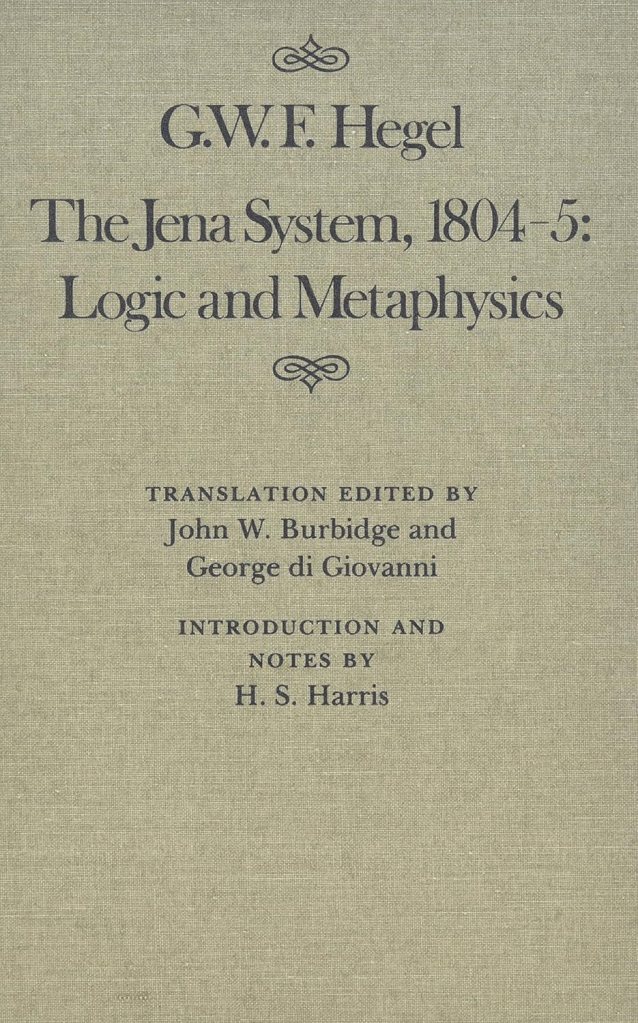
The Jena System, 1804-5: Logic and Metaphysics” by Georg Wilhelm Friedrich Hegel presents his early philosophical development during his tenure at the University of Jena. This work, edited and translated by John W. Burbidge and George di Giovanni, offers invaluable insight into the evolution of Hegel’s thought, particularly regarding the nature of logic and its intrinsic connection to metaphysics. The text serves as a critical bridge between Hegel’s formative ideas and the mature system he later articulated, illuminating the transformative changes that logic underwent in his philosophy.
The book goes into Hegel’s endeavor to construct a neutral theory of the categories of finite cognition—what he refers to as “logic”—which is essential for transitioning into the realm of infinite or philosophical cognition, termed “metaphysics.” This transition is not merely a shift in subject matter but represents a fundamental reconfiguration of philosophical method and content.
The text begins by situating Hegel within the intellectual milieu of Jena, highlighting his interactions with contemporaries such as Schelling and Fichte. It emphasizes how Hegel’s logic emerged as a response to, and a departure from, the prevailing philosophical currents of the time. While Schelling’s identity philosophy and Fichte’s Wissenschaftslehre provided significant impetus, Hegel sought to transcend their limitations by developing a system that integrated the finite categories of understanding into a comprehensive, self-developing whole.
In the initial sections, Hegel introduces the concept of “Simple Connection,” which serves as the groundwork for his logical exposition. This concept is a critical examination of the categories of quality, quantity, and measure as they pertain to finite cognition. Hegel critiques the notion of qualities as isolated entities, arguing instead for their interdependence and the necessity of their integration into a unified system. The dialectical movement from quality to quantity illustrates how concepts inherently contain their opposites and how this contradiction propels the development of thought.
As Hegel progresses into the exploration of “Quality,” he examines how the abstraction of pure being leads inevitably to the recognition of limit and negation. He posits that qualities, when considered in isolation, are devoid of determinacy and only acquire meaning through their relations and boundaries. Transitioning to “Quantity,” Hegel shows the notions of numerical one, multiplicity, and allness. He scrutinizes the inadequacies of understanding quantity merely as external aggregation or discrete units. Instead, he emphasizes the continuous and qualitative aspects of quantity, highlighting how the quantitative determination of things fails to capture their intrinsic nature. This critique extends to mathematical concepts, where Hegel challenges the application of quantitative measures to phenomena that are fundamentally qualitative and dynamic.
The section on “Quantum” further develops these ideas by addressing the interplay between the finite and the infinite. Hegel introduces the concept of the “bad infinite,” an endless progression that never reaches completion, as opposed to the “true infinite,” which is self-contained and self-determining. This distinction is pivotal in understanding how finite determinations are subsumed within an absolute totality, a process that is central to Hegel’s metaphysical system.
Throughout the text, Hegel engages with contemporary scientific and mathematical theories, such as dynamic physics and the infinitesimal calculus. He critically assesses the use of concepts like force, motion, and the infinitely small, arguing that they often rely on abstractions that obscure the true nature of reality. Hegel contends that mathematical representations, while precise in their own domain, cannot adequately capture the qualitative transformations and contradictions inherent in natural phenomena.
A significant portion of the work is dedicated to elucidating the concept of “Infinity.” Hegel presents infinity not as an external, unattainable beyond but as an immanent aspect of finite reality. The true infinite is a process of self-transcendence, where finite determinations negate themselves to reveal a higher unity. This dialectical movement is the engine of development in both thought and being, dissolving the static oppositions posited by the understanding.
The book also addresses the limitations of other philosophical systems. Hegel critiques the “logic of understanding,” which he associates with the static, formal logic of traditional metaphysics. He argues that such logic is insufficient for grasping the dynamic and self-differentiating nature of reality. Instead, he advocates for a speculative logic that embraces contradiction and change as fundamental features of thought.
The editors’ introduction and notes, particularly those by H. S. Harris, provide essential context and interpretation. Harris emphasizes how Hegel’s abstract categories are deeply rooted in his reflections on the structure and life of society. This connection underscores the relevance of Hegel’s logic and metaphysics to broader concerns in ethics, politics, and culture. The societal dimension of Hegel’s thought illustrates how individual consciousness and collective institutions are intertwined in a dialectical process of mutual development.
Furthermore, the text sheds light on Hegel’s method of “determinate negation,” where the negation of a concept leads to the emergence of a new, more comprehensive understanding. This method is central to the dialectical progression in the book, demonstrating how contradictions are not mere obstacles but necessary moments in the unfolding of truth. Hegel’s approach contrasts sharply with the methodologies of empiricism and formalism, which he views as inadequate for capturing the richness of philosophical inquiry.
The collaborative efforts of Burbidge and di Giovanni in translating and editing the manuscript bring clarity and accessibility to Hegel’s complex arguments. Their work ensures that readers can engage with the nuances of Hegel’s thought without losing sight of the broader philosophical implications. The inclusion of samples from the book and detailed explanations of key passages facilitate a deeper comprehension of the text’s intricate reasoning.
The Jena System, 1804-5: Logic and Metaphysics is a key contribution to the study of Hegel’s early philosophy. It reveals the formative stages of his dialectical method and his efforts to reconcile logic and metaphysics into a unified system. The work highlights Hegel’s departure from the abstract formalism of his predecessors and his movement towards a philosophy that recognizes the self-developing nature of reality.
The book also underscores the significance of the historical and intellectual context in which Hegel was writing. His engagement with the works of Kant, Schelling, and Fichte demonstrates his critical appropriation of their ideas and his desire to overcome their limitations. Hegel’s reflections on the nature of substance, causality, and the relationship between finite and infinite cognition reveal a profound grappling with the fundamental questions of philosophy. It provides valuable insight into Hegel’s conception of the role of logic in philosophical inquiry. Logic, for Hegel, is not merely a tool for analysis but is itself a living, dynamic process that mirrors the movement of reality. This perspective challenges conventional views of logic as static and unchanging, inviting readers to consider the transformative potential of logical thought.
The Jena System, 1804-5: Logic and Metaphysics is not only a reflection of Hegel’s intellectual journey but also invites scholars and students alike to engage with the complexities of dialectical reasoning and to explore the depths of metaphysical speculation. It is an important text for understanding the development of German idealism and its impact on subsequent philosophical traditions. It is an essential resource for anyone seeking to comprehend the evolution of Hegel’s thought and the foundational principles of his mature system. The translation and insightful commentary provided by Burbidge and di Giovanni enhance the accessibility of the work, making it a valuable addition to the study of Hegelian philosophy. Through its detailed exploration of logic and metaphysics, the book offers an examination of the dialectical process that underpins reality, thought, and the progression of philosophical understanding.
 Simon Gros
Leave a comment