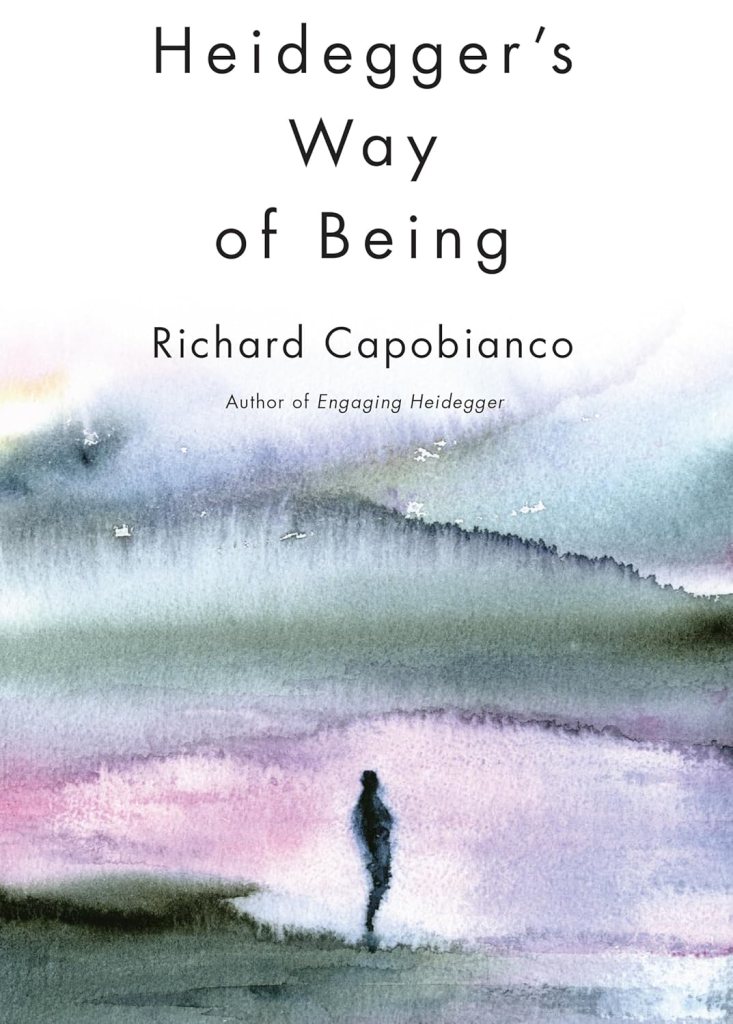
Richard Capobianco’s Heidegger’s Way of Being is an exposition of Martin Heidegger’s lifelong philosophical focus on the nature of Being. In this ambitious follow-up to Engaging Heidegger, Capobianco makes a compelling case for understanding Heidegger’s work as a unified endeavor to elucidate Being as the temporal and radiant emergence of all beings. By combining insights from a vast array of Heidegger’s writings, including previously untranslated texts, Capobianco rethinks the basis of Heidegger’s philosophy: the unveiling of Being as the primordial phenomenon of manifestation. This revelation, which Heidegger articulated through multiple names—physis (Nature), aletheia (unconcealment), the primordial Logos, Ereignis (event), Lichtung (clearing), and Es gibt (there is/it gives)—is not merely an abstract concept but concerns the heart of existence.
Capobianco’s work boldly reasserts the originality of Heidegger’s thought, countering modern readings that diminish the centrality of Being by reducing it to the domain of human meaning-making. Instead, he returns us to Heidegger’s primordial task: to bring into view Being’s self-showing, its radiant unveiling. Through detailed analysis, Capobianco demonstrates that Being for Heidegger is not merely a construct of human cognition but the underlying temporal-spatial dynamic that lets all things emerge, linger, and pass away. In this way, Capobianco provides a crucial corrective to interpretations that prioritize Dasein’s subjective experience over the ontological primacy of Being itself.
One of the most striking features of Heidegger’s Way of Being is its vivid invocation of Being’s radiant character. Capobianco does not merely analyse Heidegger’s terminology, he evokes the experience of Being as something that gleams, shines, and suffuses all that is. Drawing from Heidegger’s engagement with Hölderlin’s poetry and the Greek experience of physis, Capobianco reveals how Heidegger understood Being as a dynamic unfolding—a “gleaming” that encompasses both the self-showing of beings and the hidden ground from which they arise. This temporal interplay, richly described through references to the seasons and the cycles of nature, invites readers to grasp Being not as a static essence but as the ongoing event of presencing itself.
Capobianco also highlights the poetic and meditative dimension of Heidegger’s thought. In his exploration of Heidegger’s writings on Hölderlin, for instance, he emphasizes the unique way poetry opens a path to experiencing Being. Hölderlin’s imagery of “nature’s gleaming” and the “golden splendor” that suffuses all things mirrors Heidegger’s notion of aletheia as an unconcealing—a higher revealing that transcends ordinary perception. Through these reflections, Capobianco underscores Heidegger’s insistence that Being’s manifestation is not an intellectual abstraction but an event that calls forth wonder, reverence, and humility.
Central to Capobianco’s argument is the idea that Heidegger’s later philosophy, often summarized in the term Ereignis (event of appropriation), should not be understood as a departure from his earlier work but as a deepening of his original insights into Being. Heidegger’s emphasis on Ereignis as the “letting” of beings—the process by which beings are given their presence—reveals a continuity with his earlier focus on physis as the temporal-spatial emergence of all that is. Capobianco shows how this “letting” or “giving” of Being is not a causal act but a non-objective unfolding that grants beings their place in the world.
In addition to its rigorous textual analysis, Heidegger’s Way of Being invites readers into a meditative dialogue with Heidegger’s thought. Capobianco’s writing mirrors the contemplative quality of Heidegger’s philosophy, often adopting a lyrical tone that draws the reader into the very experience of Being. His reflections on the interplay of nature, time, and human existence evoke a sense of attunement to the “Being-way”—a mode of thinking and dwelling that aligns human existence with the broader rhythms of Being itself.
Capobianco’s engagement with Heidegger’s critiques of modernity further enriches the book’s philosophical scope. By returning to the Greek understanding of physis as the dynamic unfolding of nature, Capobianco highlights Heidegger’s challenge to the metaphysical tradition that reduces Being to mere presence or static essence. This critique is especially pertinent in an age dominated by technological thinking, which Heidegger saw as obscuring the radiant openness of Being. Capobianco’s interpretation restores the primordial depth of Heidegger’s thought, emphasizing the need to recover a sense of wonder and gratitude for the gift of Being.
The book is also a masterful rejoinder to reductive readings that equate Being with human-centered meaning-making. Capobianco dismantles such interpretations by showing that Heidegger’s emphasis on Dasein (human existence) was always subordinate to the broader ontological question of Being itself. While Dasein plays a crucial role in revealing Being, it is not the source of Being but a participant in its unfolding. This distinction, Capobianco argues, is essential for understanding Heidegger’s philosophy as a whole.
Through its rigorous scholarship, poetic sensibility, and deep philosophical insight, Heidegger’s Way of Being establishes itself as an indispensable contribution to Heidegger studies. Capobianco not only clarifies Heidegger’s central ideas but also invites readers to experience the wonder of Being directly. By returning us to the heart of Heidegger’s thought—Being as radiant manifestation—he challenges us to rethink our own relation to the world and to dwell more attentively within the unfolding mystery of existence. In doing so, Heidegger’s Way of Being not only illuminates Heidegger’s legacy but also reawakens the timeless question of Being for a new generation of thinkers.
 Simon Gros
Leave a comment