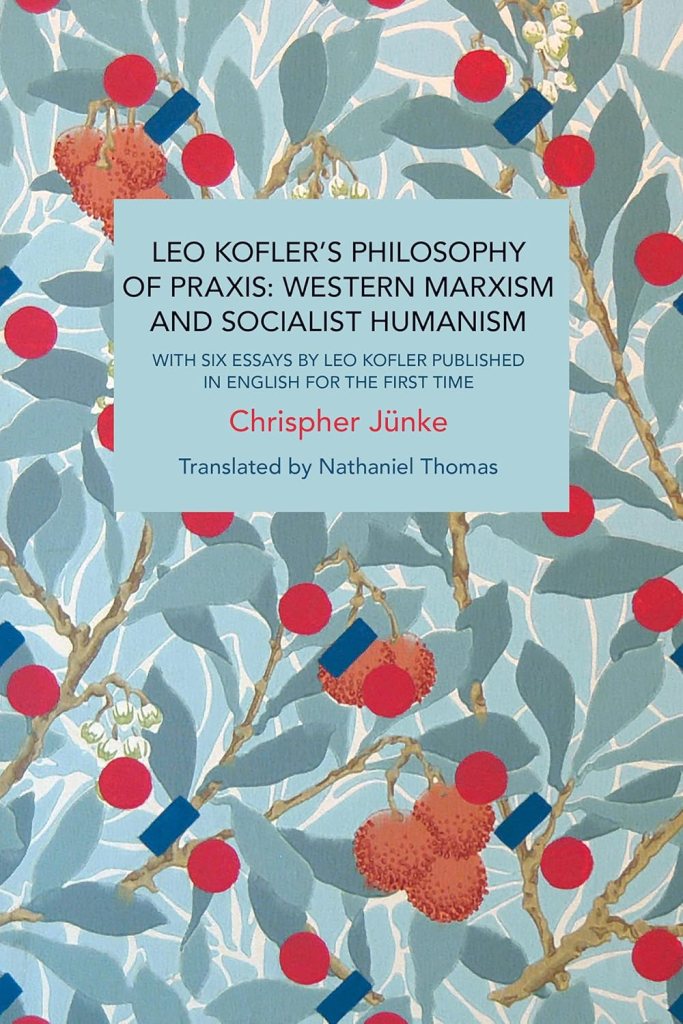
Leo Kofler’s Philosophy of Praxis, translated by Nathaniel Thomas, offers a monumental account of the life, philosophy, and critical thought of Leo Kofler (1907–1995), a figure dubbed an “unmutilated, living Marxist” by Oskar Negt. This book, rich in its philosophical excavation, explores the deep layers of Kofler’s work as it intersected with Western Marxist currents, socialist humanism, and the ideological landscape of the 20th century. Christoph Jünke, a historian and scholar dedicated to Kofler’s legacy, presents a compelling analysis that reveals the extraordinary nuance in Kofler’s dialectical philosophy—a “living Marxism” that defied Cold War binaries, ideological dogmas, and academic conventions. By linking Kofler’s intellectual journey to broader currents in Marxist thought, Jünke draws connections from Marxist classics to postmodern challenges, offering a vivid portrayal of Kofler as a “border crosser” in thought and life.
The text elucidates Kofler’s philosophical contributions, framed within a historical materialist praxis that recognized the crucial role of human agency, consciousness, and dialectical thinking in the evolution of society. As an innovator of Marxist thought, Kofler bridged the methodological rigor of Hegelian dialectics with the emancipatory spirit of Marx’s early humanist writings. Jünke traces how Kofler, a student of Austrian Marxist Max Adler, broke from deterministic and mechanistic Marxism, advancing a dialectical approach that emphasized the subjective agency of human consciousness within material conditions. This led to Kofler’s groundbreaking critique of ideology, asserting that, far from mere economic determinism, human society and its history are deeply dynamic and shaped by the conscious intentions of individuals acting within the social whole.
The book goes into Kofler’s pivotal contributions to the history of ideas, where he interrogated the contradictions inherent in bourgeois humanism and its failure to resolve the gulf between private property and true human freedom. Kofler’s work, as Jünke demonstrates, was deeply critical of capitalism’s reliance on liberal individualism, which, while heralding freedom, bound the ideal of personal liberty to property and capital, relegating the propertyless to a position of existential inferiority. Through a genealogical analysis of critical thought, Kofler charts the transformations within bourgeois humanism, from early Enlightenment ideals to 20th-century neoliberal individualism. His incisive critique sheds light on the inherent limitations of bourgeois ideology, arguing that its vision of freedom and democracy could never transcend the boundaries imposed by capitalist class structures.
Jünke places Kofler’s philosophy within the larger tradition of Western Marxism, positioning him alongside intellectual giants such as Lukács, Bloch, and Marcuse. Yet, Kofler’s philosophy retained a distinct stance, particularly in its rejection of Frankfurt School’s critical theory and its emphasis on a socialist humanism deeply invested in the ideals of human solidarity and collective emancipation. Kofler was wary of the Frankfurt School’s perceived nihilism, finding in their critical theory a pessimistic rejection of praxis and human agency. His own conception of Marxist theory sought to ground itself not in abstract critiques but in a “science of society” oriented toward the practical concerns and material needs of humanity. Jünke contends that Kofler’s approach offers a more accessible and socially engaged path within Marxist humanism, resonating with contemporary concerns over the erosion of democratic values and collective social responsibility.
The volume is enriched with six essays by Kofler himself, translated into English for the first time, each providing crucial insights into his thoughts on political theory, revolutionary praxis, and the nature of human consciousness. These essays reflect Kofler’s engagement with pressing philosophical debates, from Marxist anthropology and humanist critique to the ideological underpinnings of neo-capitalism. Kofler’s own writing reveals a thinker constantly at odds with established structures, a “border crosser” who traversed regions, ideologies, and intellectual traditions in pursuit of an uncompromised vision of socialist humanism. His nuanced critiques of Stalinism, bourgeois ideology, and aesthetic modernism challenge readers to reconsider the contours of Western Marxist thought and its potential relevance to 21st-century struggles for social justice.
In Leo Kofler’s Philosophy of Praxis, Jünke introduces readers to a forgotten pioneer of radical thought, whose intellectual contributions remain startlingly relevant today. His analysis serves as both an introduction to Kofler’s work and an invitation to a deeper understanding of the possibilities and limitations of Marxist humanism. Kofler emerges as a philosopher of praxis who envisioned a radical, human-centered socialism that embraces freedom, consciousness, and human potential as the bedrock of a genuinely emancipatory society.
 Simon Gros
Leave a comment