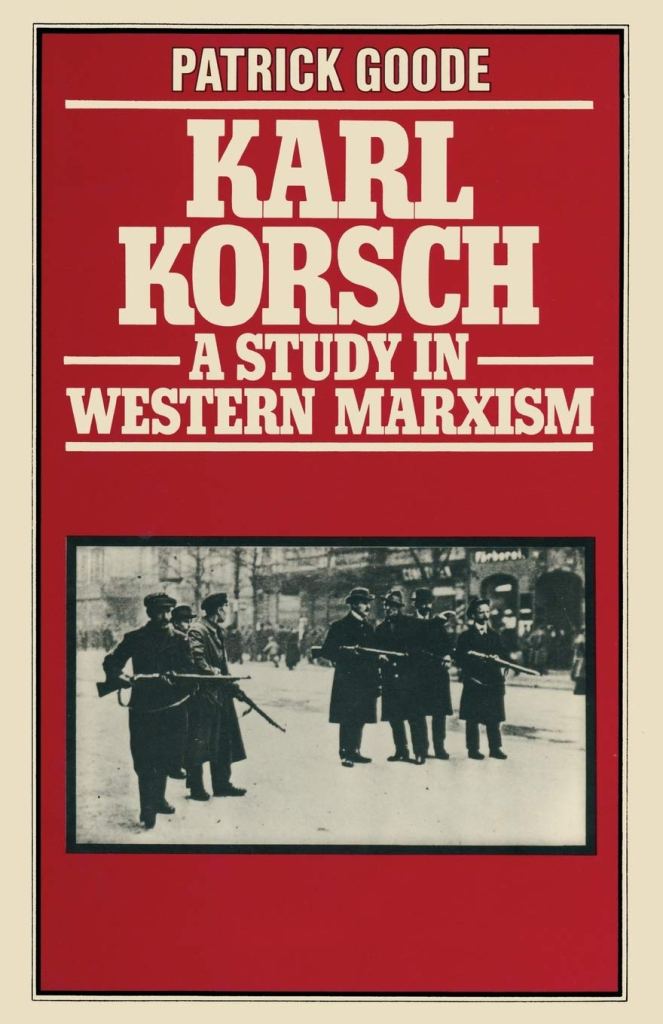
Karl Korsch: A Study in Western Marxism by Patrick Goode provides an analysis of Karl Korsch’s intellectual journey, his engagement with revolutionary Marxism, and his unique contribution to Marxist theory within the context of 20th-century European politics. This study explores Korsch’s revolutionary praxis, particularly his belief that Marxism is not merely an interpretative framework for history but a transformative force intended to actively change society. Goode puts Korsch’s thought and its evolution against the shifting fortunes of the working-class movement and the ideological landscape of Western Europe. He carefully positions Korsch in contrast to and in dialogue with other Western Marxists, such as Lukács and Althusser, highlighting Korsch’s insistence on the need for direct political engagement as the core validation of Marxist ideas—a viewpoint that diverged from the philosophical focus that defined much of Western Marxist thought.
Through detailed analyses of Korsch’s key works, including Marxism and Philosophy and Karl Marx, Goode illustrates how Korsch’s interpretations of Marxist theory reflected the turbulence of his time, including the early revolutionary optimism that eventually gave way to the rise of Stalinism and fascism. Korsch’s focus on Lenin’s theories and his attempts to adapt them to the challenges of Western Europe further differentiated him from contemporaries who viewed Marxism as largely theoretical or idealistic, rather than an immediately practical tool for class struggle. Goode also navigates the complexity of Korsch’s eventual ideological conflicts with the Communist Party, noting that Korsch’s allegiance to revolutionary praxis over ideological orthodoxy led to his marginalization within the movement and his designation as a dissident by official Marxist factions.
In tracing Korsch’s intellectual path from his early philosophical inclinations through his exposure to the German Social Democratic Party and Fabian Society, Goode provides essential context for understanding Korsch’s turn to Marxism as a framework not only for social critique but also for practical reform. Particularly compelling is Goode’s examination of Korsch’s critique of the SPD’s gradualist approach to socialization and his calls for a radical, council-based form of socialism that would transfer industrial control directly to the working class. Korsch’s conception of “socialization,” as explored in Goode’s work, was far from the bureaucratic state socialism of his time. Instead, it emphasized a vision of “industrial autonomy” that allowed for worker self-management, a notion influenced by but ultimately transcending his engagements with Fabianism and syndicalism.
Goode also brings to light Korsch’s critique of “state socialism,” emphasizing his disdain for bureaucratic, top-down models of socialism that he believed merely replicated capitalist exploitation under a new guise. Through Korsch’s writings, Goode elucidates how his two-stage model of socialization aimed to dismantle capitalist structures at both material and ideological levels. By comparing Korsch’s views to those of Lenin and Marx, Goode goes into the philosophical and practical underpinnings of Korsch’s critique of both reformist and syndicalist socialization models. Korsch’s skepticism towards these models, stemming from his belief in the necessity of a radical “leap” in class consciousness and organization, is thoroughly examined within the broader trajectory of his political thought.
Karl Korsch: A Study in Western Marxism is not simply an intellectual biography; it is an incisive reflection on the intersections of theory, practice, and ideology in revolutionary Marxism. Through Goode’s comprehensive analysis, Korsch emerges as both a tragic and heroic figure—a thinker whose insistence on the active, revolutionary dimensions of Marxism set him at odds with the dominant currents of his time but whose work continues to resonate with contemporary debates on the nature of socialist transformation. Goode’s study of Korsch is an indispensable resource for understanding the complexities of Marxist theory, the dynamics of Western Marxism, and the enduring questions around the practical application of revolutionary ideas.
 Simon Gros
Leave a comment