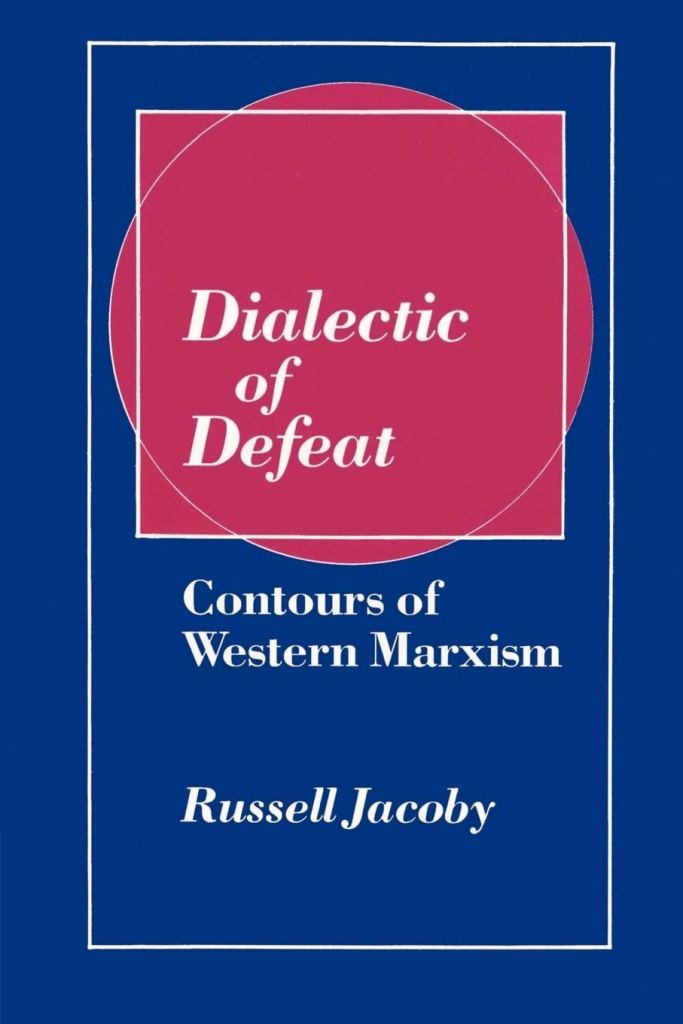
In Dialectic of Defeat: Contours of Western Marxism, Russell Jacoby undertakes a rigorous critique of mainstream, “conformist” Marxism, a tradition he views as deeply compromised by its adherence to the “cult of success” and the fetishization of scientific methodology. Jacoby’s work engages with an essential but sidelined trajectory within Marxist thought, a Western alternative that, unlike the mainstream, did not bow to triumphalist tendencies or erase individualism in its attempts at rigor. In contrast to the more orthodox forms of Marxism that embraced rigid structural interpretations and ideological discipline, Western Marxism, Jacoby argues, retained a space for humanistic engagement, creative dissent, and a critique of both capitalist and socialist orthodoxies. He situates this alternative as historically distinct, tracing its roots back to different readings of Hegel and critical debates over Engels’s vision of Marxism, a discourse where critical engagement held more sway than state-building strategies or ideological conformity.
In the opening salvo of his work, Jacoby delivers a pointed denunciation of orthodox Marxism, which he argues has betrayed its emancipatory impulse by clinging to a framework that elevates science and industrial rationality over critical, philosophical engagement. He contends that this framework, particularly as evidenced in the Russian and Chinese revolutions, fostered a breed of Marxism enamored with order, technology, and the bureaucracy of production rather than with the unsettling potential of Marx’s revolutionary critique. Jacoby illustrates how this Marxism was absorbed into the structures of power it once sought to overthrow, succumbing to the values of bourgeois society, such as productivity, scientific progress, and stability. Orthodox Marxism, in his view, mirrored capitalism’s instrumental logic and rationalized the social world in ways that abandoned the critique of everyday life, reducing revolution to a mere recalibration of economic structures rather than a deeper transformation of human relations, culture, and consciousness.
Dialectic of Defeat charts the contours of Western Marxism as it diverged from the Russian orthodoxy, refusing the imperatives of industrial and scientific “progress” and taking a more skeptical approach to the technological determinism that underscored Lenin’s and Stalin’s visions. Jacoby argues that Lenin’s valorization of technology as a means to achieve socialism and Stalin’s formulation of “Leninism” as a combination of Russian revolutionary zeal with “American efficiency” illustrate how orthodox Marxism sought not to critique but to inherit capitalism’s industrial mechanisms. In opposition to this, Western Marxists like Karl Korsch, György Lukács, the Frankfurt School theorists, and others preserved a Marxism that saw beyond the capitalist ideal of scientific rationality. Jacoby emphasizes that these thinkers—though diverse—share a commitment to exposing the inner workings of capitalism’s “secondary” processes: the media, culture, urban life, and the formation of subjective life under capitalism. Unlike orthodox Marxists, who dismissed such topics as mere ephemera of the superstructure, Western Marxists analyzed them as essential sites of capitalist reproduction and ideological entrapment.
This Western trajectory did not ignore the failings of capitalism in industrial and economic terms; rather, it expanded critique to consider the subtler ways in which capitalism transforms life, experience, and imagination. Jacoby’s analysis foregrounds thinkers like Max Weber and later figures from the Frankfurt School who penetrated deeply into capitalism’s rationalizing tendencies, recognizing a complicity between capitalist rationality and orthodox Marxism’s scientific posturing. For these thinkers, Marxism’s potential for critique extended beyond wages or production techniques to encompass critiques of alienation, reification, and the dehumanizing effects of technological society.
Jacoby positions this Western Marxism not as a utopian fantasy but as a rigorous, dialectical alternative to an orthodox Marxism which had abandoned such concerns in favor of technocratic determinism. Through the works of figures like Ernst Bloch and Andre Breton, Jacoby explores how Western Marxists retained elements of romanticism, subjectivity, and imagination as essential to Marxist critique. These thinkers saw socialism not simply as an improved industrial regime but as a fundamentally different way of life, one that transcended the narrow instrumentalism of capitalist and state socialist projects. Jacoby emphasizes how Bloch’s “warm current” of Marxism—a current animated by utopian vision and a belief in the transformative power of human creativity—stood in contrast to the “cold current” of a Marxism fixated on industrial expansion and scientific methodology.
Throughout, Dialectic of Defeat meditates on the question of failure, examining how Western Marxism retained its critical edge by refusing the coercive optimism of scientific socialism. Jacoby makes clear that this was not a Marxism of resignation but a radicalism steeped in skepticism toward all forms of domination, including those dressed in the guise of Marxist science. The critique offered by this alternative Marxism—a critique alive to the contradictions, ambivalences, and inner tensions of capitalist modernity—provides a counterpoint to the orthodoxies that claimed success while transforming Marxism into a rigid, quasi-scientific doctrine. For Jacoby, this marginalized current serves as a reminder that true Marxist thought must resist the comforts of closure and certainty, remaining open to critique, contradiction, and the messiness of human experience.
In examining the “loser” of Marxism, Jacoby does not aim to redeem a failed tradition but to bring its unique insights into focus, suggesting that the legacy of Western Marxism lies in its refusal to conform to ideological, economic, or structural dictates. By bringing attention to the ongoing relevance of this marginalized strain, Jacoby argues for a Marxism that does not surrender its critical capacities to either the seductions of power or the fetishes of science.
 Simon Gros
Leave a comment