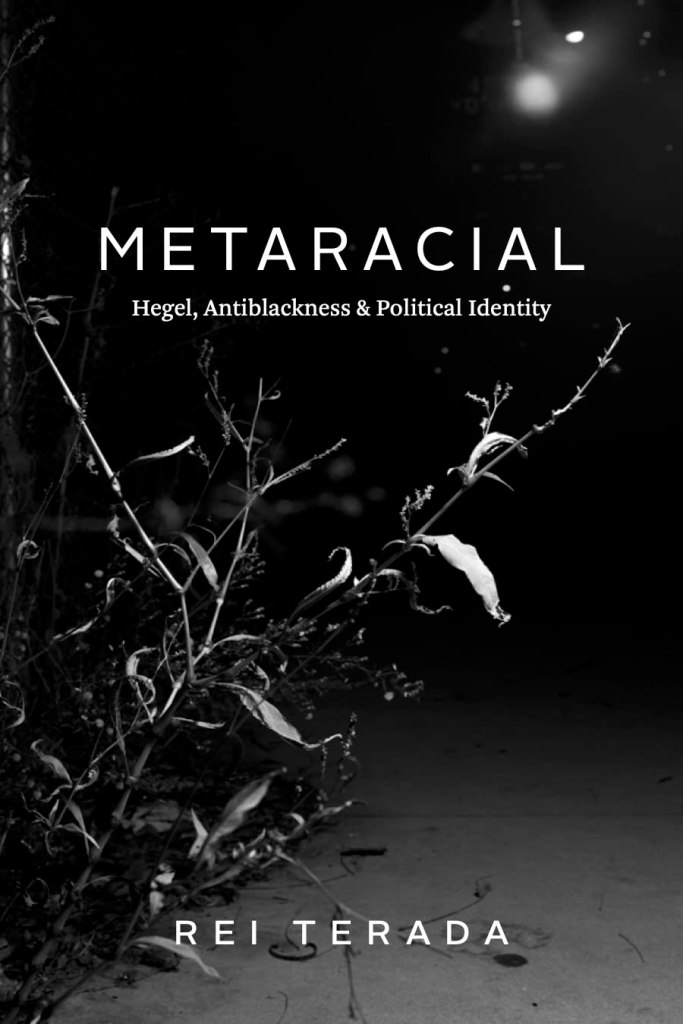
In Metaracial: Hegel, Antiblackness, and Political Identity, Rei Terada initiates an ambitious critical inquiry into the contours and limitations of antiracist philosophy, dissecting the intersection of Hegel’s thought, antiblackness, and the evolution of political identity in modernity. Terada’s project delves into Hegel’s adaptation of racial hierarchy into an ontological framework of differing stances toward reality, uncovering an ideological transposition that both sustains and reframes racialized hierarchies.
Through close reading and re-evaluation of Hegel alongside the legacies of Rousseau, Kant, Mary Shelley, and Marx, Terada interrogates how figures of blackness and the Atlantic slave emerge in radical Enlightenment thought—not as individuals per se, but as formative disruptions within a discourse preoccupied with the political unfreedom of Europeans. This work interrogates how Hegelian dialectics facilitates an ideological shift from racialization to “metaracial” subordination, wherein blackness and the figure of the slave are reconfigured to accommodate a seemingly antiracist yet intrinsically antiblack political subjectivity.
As Terada explains, the Enlightenment’s anxieties surrounding Atlantic slavery introduced a volatile figure within its vision of human progress. In this milieu, racial distinctions were obscured through abstractions, yet retained as underlying structures within the fabric of political and philosophical thought. Hegel’s master-slave dialectic, in Terada’s analysis, exemplifies this shift: while rejecting overt racial determinism, it reassigns racial hierarchy onto epistemological and existential hierarchies of self-awareness and consciousness, producing a new genre of the human subject. In tracing this evolution, Terada engages with Sylvia Wynter’s concepts of “Man1” and “Man2,” theoretical constructs representing shifts in the definition of humanity from theological to political domains, and Denise Ferreira da Silva’s critique of Hegel’s “engulfment,” which views non-European existence as derivative of European norms. Through this framework, Terada situates Hegel as central to a “metaracial” lineage in which blackness persists as an unassimilable “difference” within the Enlightenment’s universalist claims.
Metaracial does not merely examine how blackness is sidelined in these structures but interrogates the fundamental inability of Hegelian and post-Hegelian radical thought to account for black subjectivity without residual racialism. Terada considers the persistence of racialized figures like the “slave” within leftist political theory, where they serve as stand-ins for abstract negation, self-transcendence, or historical consciousness, rather than being fully acknowledged as agents with discrete histories and existential conditions. This dynamic reveals how radical thought seeks to appropriate blackness as a figure of political identity, but one whose existence and historical suffering are perpetually reframed to serve a relational ontology that is still ultimately Eurocentric. This strategy is, in Terada’s critique, antiblack because it redefines political freedom and subjectivity in ways that systematically overlook or erase the specificities of black life and oppression.
Terada’s philosophical archaeology reveals that Hegel’s dialectical method—while structured around notions of negation, contradiction, and eventual sublation—encodes a racialized understanding of political identity. For Hegel, the movement from bondage to freedom is a universal process, yet Terada contends that this universality is compromised by the assumptions embedded within it about who can genuinely participate in political identity and at what cost. Hegel’s “radical” dialectics, she suggests, fails to transcend racial hierarchies; instead, it recasts them in terms of conceptual and existential “maturity,” thus implying that those historically racialized must adopt a stance of political assimilation to fit within the new universal subjectivity. Terada’s examination of Hegel’s master-slave dialectic shows that Hegel’s “negation” fails to extend genuinely to the black or colonized figure, who remains constrained within an antiblack philosophical structure. This figure is present as a conceptual necessity but is denied the recognition required to emerge fully into political subjectivity. Thus, the dialectic’s logic of identity formation, founded on negation, becomes a philosophical mechanism that contains, rather than dismantles, racial hierarchies.
Terada’s critical lens extends to radical thinkers influenced by Hegel, exposing how even ostensibly liberatory philosophies retain latent structures of antiblackness. Through the examples of thinkers like C. L. R. James, Frantz Fanon, and contemporary Black studies scholars, Terada explores how Hegelian frameworks, when adopted uncritically, position blackness and the legacy of Atlantic slavery as instrumental figures within broader revolutionary narratives. Her work demonstrates that the dialectical transformation demanded by Hegelian subjectivity is one-sided when applied to black lives: it demands a “sacrifice” of black specificity for the sake of universal political identity.
Metaracial thus problematizes the philosophical and political use of blackness within Hegelian and radical thought. Terada’s rigorous critique argues that, for these frameworks to support genuine liberation, they must reckon with the historical and material conditions of blackness that have been systematically overlooked or marginalized. The radical subjectivity proposed in these traditions, she argues, will remain inherently limited without a reconfiguration that centers black experience and epistemology. Terada’s work challenges readers to confront the philosophical erasure at the heart of radical European thought, inviting a rethinking of how liberation and subjectivity might be understood outside these traditionally exclusionary models.
Metaracial provides a thorough philosophical exegesis of Hegel’s enduring influence on modern conceptions of political identity and antiracism, laying bare the unresolved tensions and exclusions that continue to define radical philosophy’s engagement with race. Terada’s analysis positions Hegel’s dialectic not as a path to liberation for black subjects but as a metaracial construct that effectively reiterates antiblack structures within ostensibly progressive, anti-essentialist frameworks. This provocative work invites scholars to reconsider the assumptions underlying antiracist thought and to envision more inclusive foundations for future political identities.
 Simon Gros
Leave a comment