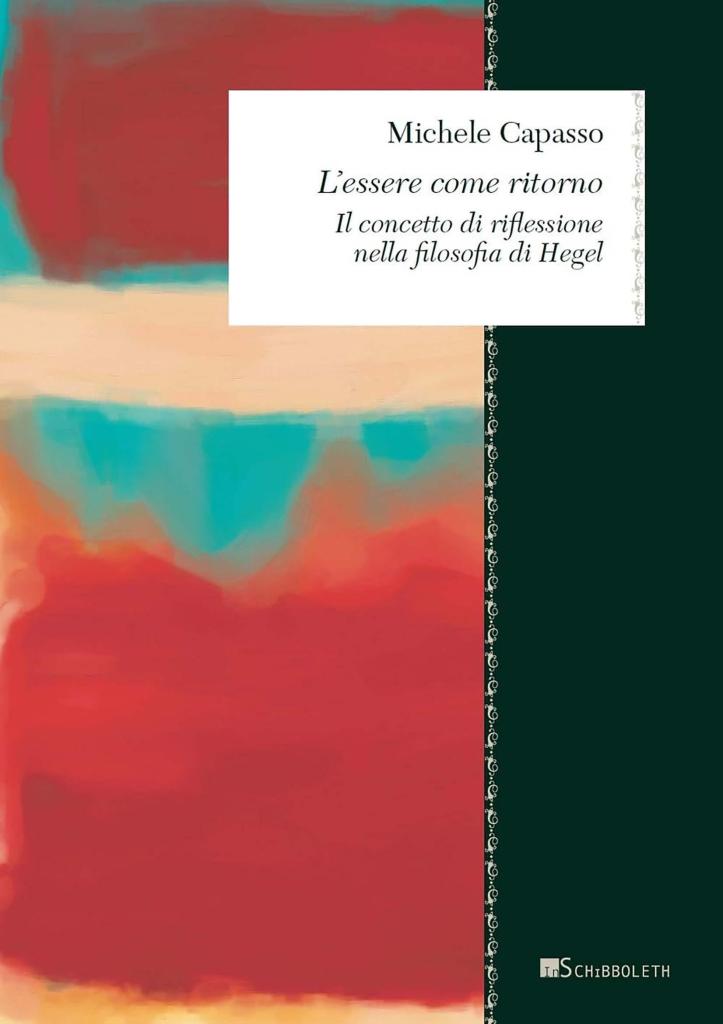
Being as Return: The Concept of Reflection in Hegel’s Philosophy by Michele Capasso is an exhaustive and incisive exploration of one of the most pivotal concepts in Hegelian philosophy—the concept of reflection. Capasso illuminates the significance of reflection in the unfolding of the Idea and its essential role in the dialectical movement that characterizes Hegel’s system. The book traces the genesis and development of the concept of reflection from Hegel’s early writings through to the mature exposition in the Science of Logic, in comprehensive analysis.
At the basis of Hegelian philosophy lies the question of the beginning—how thought can commence without presuppositions, and how the dialectical process originates. This question has been the subject of extensive debate and interpretation, particularly concerning the initial dialectical triad of Being, Nothing, and Becoming in the Science of Logic. Capasso contends that a true understanding of the beginning emerges when one examines the concepts of essence and reflection, as elaborated in the Doctrine of Essence. Here, Hegel demonstrates that the beginning is not an arbitrary starting point but arises from an intrinsic necessity within the unfolding of the Idea. Being, initially appearing as a mere presupposition, reveals its truth only through the reflective movement that posits it as a return into itself. The beginning, therefore, is an internal operation of reflection that suspends itself and negates its own positing, embodying a dynamic process that is fundamental to the comprehension of dialectics.
Capasso’s study is structured in two main sections: the genesis of the concept of reflection and the logic of reflection. In the first section, he reconstructs the context in which the concept of reflection matures, starting from Hegel’s early writings during the Frankfurt period, such as The Positivity of the Christian Religion and the System Fragment, and proceeding through the critical writings like The Difference Between Fichte’s and Schelling’s Systems of Philosophy and Faith and Knowledge, up to the Jena Logic and Metaphysics of 1804-05. This thorough historical analysis allows Capasso to highlight how Hegel’s need to reconstitute the broken harmony of the modern world—the “Entzweiung” or scission—finds its greatest obstacle in the philosophies of reflection that culminate in the Enlightenment’s emphasis on the understanding (Verstand) at the expense of reason (Vernunft).
Hegel critiques these philosophies of reflection, which he terms “Reflexionsphilosophien,” for their tendency to isolate manifestations of the absolute and set them up as autonomous elements, thereby weakening the representation of reason. These philosophies, influenced by Kant’s critical philosophy, impose insurmountable limits on thought, relegating any relation with the absolute to the domain of faith and subjugating reason to the separating power of the understanding. Capasso emphasizes that Hegel’s judgment on critical philosophy and its Fichtean continuation is ambivalent. While recognizing that both Kant and Fichte introduce the possibility of overcoming this self-limiting interpretation of thought, Hegel critiques Fichte’s inability to realize the principle of intellectual intuition—the I = I—in the deduction of the system without falling into the pitfalls of reflection.
Capasso explores how Hegel seeks to recover an original reflective movement that includes scission within itself rather than ignoring it. This movement is characterized by an immanent reflection that goes beyond the external reflection criticized in the philosophies of reflection. Hegel’s notion of reflection as reason or absolute reflection is central to this endeavor. Capasso elucidates how this concept is already adumbrated in the reflective structure of life, which, in its infinite positing as other than itself, remains with itself. However, the categories fixed by the understanding resist attempts to think this “pure life,” necessitating a rupture at the theoretical level. Reflection must annihilate itself and, by passing through the “night of consciousness,” re-comprehend itself as absolute negativity in reason.
In his analysis, Capasso pays particular attention to Hegel’s early works, where the concept of reflection begins to take shape. In the System Fragment, for instance, Hegel grapples with the challenge of thinking pure life without making it a mere thought or concept—an aporia that underscores the limitations of reflection when it becomes entangled in the abstractions of the understanding. Capasso highlights how Hegel anticipates objections that later become central to anti-Hegelian critiques, such as the charge of privileging identity over difference. Hegel’s insistence that “life is union of union and non-union” reflects his attempt to articulate a dynamic and productive identity that encompasses opposition within itself.
Transitioning to the second section, Capasso goes into the logic of reflection as developed in the Science of Logic, particularly in the Doctrine of Essence. He underscores the pivotal role of reflection in Hegel’s logic, noting that it acts as a “hinge” in the entire structure. Reflection is treated thematically, and Hegel distinguishes between three forms: positing reflection, external reflection, and determining reflection. Capasso analyzes each of these forms, revealing how they correspond to various strategies employed by German Idealism. Positing reflection involves the immediate positing of determinations; external reflection supervenes upon the given and considers determinations as independent; determining reflection synthesizes the prior forms, revealing the immanent movement of reflection within the determinations themselves.
Capasso emphasizes that for Hegel, reflection is not merely a subjective operation of consciousness (Nachdenken) but an ontological process inherent in the very structure of reality. External reflection, which is characteristic of the understanding, must be comprehended as a suspension of absolute reflection. This perspective allows Hegel to critique philosophies that make the I their starting point, such as Fichte’s, for failing to recognize the process that constitutes them. Absolute reflection, as Capasso elucidates, is a movement without substrates and does not require an underlying subject, distinguishing it from traditional metaphysics and transcendental philosophy.
In his critical examination of Fichte, Capasso illustrates how Hegel identifies the limitations imposed by reflection on Fichte’s system. Fichte’s attempt to deduce the world from the I = I encounters difficulties because the abstraction from multiplicity leaves the multiplicity itself in the background, and the transcendental I remains in opposition to the empirical I. This opposition undermines the absolute identity that Fichte aims to establish, resulting in a reflection that cannot posit itself as absolute. Consequently, freedom in Fichte’s system becomes a negative freedom, defined by opposition rather than the removal of opposites, and fails to produce itself within the system.
Capasso shows how Hegel’s concept of reflection seeks to overcome these limitations by positing a self-mediation that is intrinsic to the process of thought itself. Reflection, in Hegel’s logic, is both the movement of thought and the movement of being; it is the dynamic process through which essence reveals itself as appearance and through which the dialectical progression unfolds. Determining reflection, in particular, prefigures the movement of the concept (Begriff), where the unity of subject and object is fully realized.
Throughout the book, Capasso engages with contemporary scholarship on Hegel’s concept of reflection, referencing the work of scholars such as Dieter Henrich, who described the Doctrine of Essence as a “logic of logic,” and Gwendoline Jarczyk, who dedicated significant study to speculative reflection. Capasso situates his own analysis within this scholarly context, contributing original insights and clarifications that deepen our understanding of Hegel’s philosophy.
Capasso also addresses the broader implications of Hegel’s concept of reflection for the history of philosophy and for contemporary thought. He argues that Hegel’s critique of reflection philosophies is not merely a historical concern but speaks to ongoing philosophical challenges related to subjectivity, objectivity, and the possibility of absolute knowledge. By recovering the original movement of reflection as an immanent process that includes scission within itself, Hegel offers a way to think beyond the limitations imposed by the understanding and to reconceive the relationship between thought and reality.
Being as Return is, therefore, not only a detailed exegesis of Hegel’s concept of reflection but also a reflection on the nature of philosophy itself. Capasso demonstrates how reflection, when properly understood, reveals the essence of dialectics and the dynamic unfolding of the Idea. The book invites readers to reconsider the foundational aspects of Hegel’s system and to appreciate the intricate connections between logic, metaphysics, and epistemology in his thought.
Michele Capasso’s L’essere come ritorno is an indispensable contribution to Hegelian scholarship. It offers a comprehensive account of reflection as the central motif in Hegel’s philosophy, illuminating the complex interplay between being, essence, and concept. Capasso’s analysis not only clarifies the technical aspects of Hegel’s logic but also underscores the enduring significance of Hegel’s insights for contemporary philosophical discourse. The book speaks to the depth and richness of Hegel’s thought and serves as a vital resource for anyone seeking to engage deeply with the challenges and possibilities of dialectical philosophy.
 Simon Gros
Leave a comment