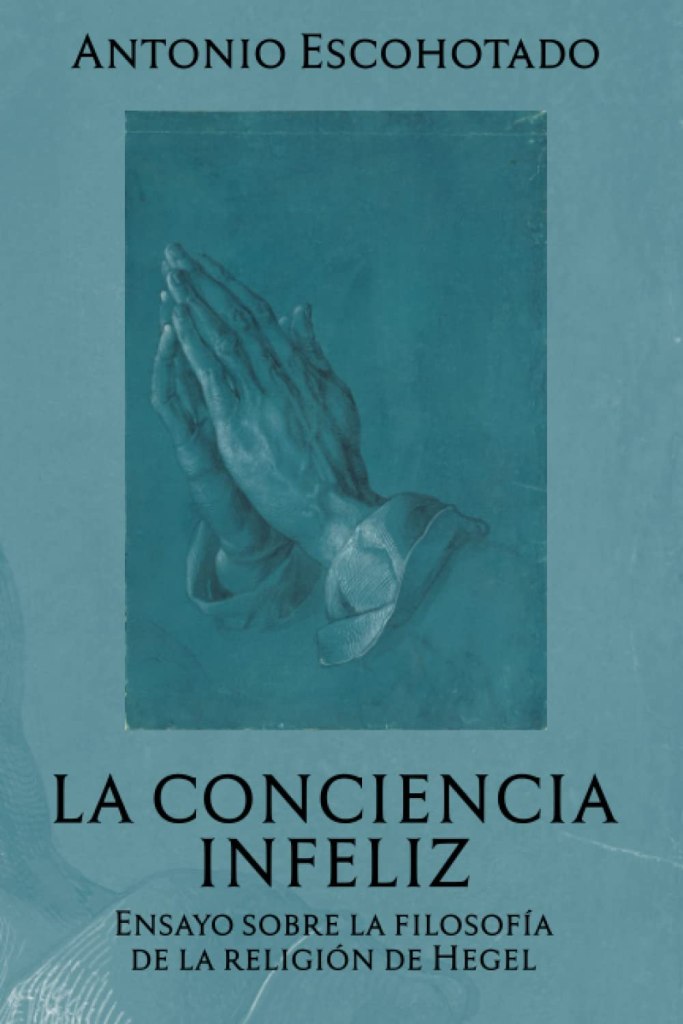
In La conciencia infeliz: Ensayo sobre la filosofía de la religión de Hegel, Antonio Escohotado explores Hegel’s complex philosophy of religion, situating the religious consciousness within the broader dialectic of philosophical and historical consciousness. Escohotado confronts Hegel’s idea of “unhappy consciousness” as a distinctively human existential state—a paradoxical blend of longing and estrangement in which religious faith confronts the unattainable nature of the divine. This tension between concept (philosophy) and representation (religion) becomes the foundation for understanding the evolution of religious thought in the Western tradition, especially through Judeo-Christian frameworks.
Hegel’s philosophy diverges from both conventional religiosity and atheistic skepticism, as he views religion as not merely a collection of dogmas or narratives but as an essential medium of the spirit’s development. Escohotado amplifies Hegel’s thesis that philosophy and religion, while seemingly opposing each other, form a dialectical unity. Religion embodies an incomplete form of consciousness: it is tethered to representation, unable to grasp the conceptual clarity philosophy achieves. Thus, Escohotado articulates how philosophy attains absolute knowledge by resolving the duality of subject and object, whereas religion remains bound to the historically contingent realm of symbols and representations, which only dimly illuminate the divine. The divergence between representation and concept, for Escohotado, is the crux of Hegel’s critique of dogmatic theology’s limitations in conveying the full truth of divine revelation.
The book approaches the Judeo-Christian phenomenon by tracing the evolution of religious consciousness from ancient Hebrew theology to Protestant Reformation, analyzing the unfolding of the Trinity as the philosophical pivot of Western spirituality. This analysis of the Trinity unfolds through three interpretive frames: the Father, the Son, and the Spirit, which embody the dialectical movement of the divine as it undergoes historical transformation. Escohotado examines how each stage corresponds to the self-development of religious consciousness—beginning with a monotheistic God that is remote and transcendent, moving through the incarnation in Christ as a divine self-sacrifice, and culminating in the Spirit, which represents the immanent self-reflection of God within the community of believers.
Escohotado masterfully shows that Hegel’s account of religion as “unhappy consciousness” is not a cynical dismissal but a testament to the existential depth of religious life. He underscores that Hegel views religion as a necessary but incomplete articulation of humanity’s striving for absolute truth—a striving that, for the religious individual, often entails an irresolvable experience of alienation. This consciousness of alienation reaches its apex in the symbol of Christ’s crucifixion, where the divine appears in mortal form and, paradoxically, experiences abandonment. The incarnation is, in Hegelian terms, the kenotic act—God’s self-emptying into the finite—demonstrating that the divine’s ultimate truth emerges not by transcending the human but by fully inhabiting it. Here, Escohotado highlights Hegel’s rejection of otherworldly dualism: the divine and the human are inseperable, with the supernatural grounded in the finite world as both its fulfillment and self-manifestation.
This work is also a reflection on the inherent mystery of the Trinity, which stands as the central, if enigmatic, dogma of Christian faith. Escohotado elaborates on Hegel’s interpretation of the Trinity as a dialectical expression of the divine life. In Hegel’s logic, the Father represents God as undivided unity; the Son represents the self-alienation or otherness of God; and the Spirit represents the reconciliation of this division through the communal consciousness of the faithful. This triadic structure is, for Escohotado, emblematic of the broader dialectical movement Hegel sees in history itself, where contradictions are not erased but synthesized into higher levels of understanding.
Escohotado takes this analysis further by situating Hegel’s philosophy within the ethical and historical context of post-Enlightenment Europe, in which humanity increasingly perceives itself as both the creator and subject of its world. In an age increasingly divorced from traditional theologies, Hegel’s concept of “spirit” presents a way to see history and religion as two sides of the same existential and cultural development. The dialectic of the Trinity, with its internal ruptures and reconciliations, parallels the evolution of ethical life (Sittlichkeit) in the modern world. This ethical life, for Hegel and Escohotado, emerges as the human community’s striving for unity and purpose, ultimately aspiring to achieve in collective self-consciousness the harmonious realization of freedom.
In La conciencia infeliz, Escohotado does not merely analyze Hegel’s text but reconstructs the underlying logic of Hegel’s dialectic, showing that the so-called “unhappy consciousness” is not a flaw or an impediment but an essential stage in humanity’s journey toward self-realization. The tragic irony of religious life, as Escohotado emphasizes, is that the individual is perpetually caught between faith and doubt, divine ideal and earthly reality, desire for unity and experience of separation. In this, he argues, lies both the power and the limitation of religion: it is a human attempt to represent the infinite within the finite, which ultimately reveals the inadequacy of such representations. Religion, in its truest form, gestures toward the infinite but is bound by finite symbols and doctrines that inevitably fail to capture it fully.
Finally, Escohotado’s treatment of Hegel’s philosophy of religion stands out for its engagement with Hegelian ideas on an existential and deeply personal level. Drawing on his own intellectual journey, marked by an unwavering commitment to intellectual freedom and a deep suspicion of dogmatism, Escohotado’s analysis embodies the libertarian spirit that permeates his larger body of work. Just as Hegel posits that true freedom is achieved through self-consciousness and reconciliation, Escohotado’s philosophical project affirms the idea that freedom lies not in escaping the contradictions of life but in confronting and understanding them.
La conciencia infeliz is not only an erudite study of Hegelian philosophy but also a work of great existential insight, one that invites readers to reflect on the nature of faith, knowledge, and freedom. Escohotado illuminates Hegel’s philosophy of religion as a dialectic of freedom in which humanity’s pursuit of truth and meaning is an ongoing, self-reflective process. For Escohotado, the philosophical understanding of religion is itself a spiritual act—one that strives not to overcome religion but to realize it more fully in a world where the infinite is inseparable from the finite and the divine is forever embedded in the human experience.
 Simon Gros
Leave a comment