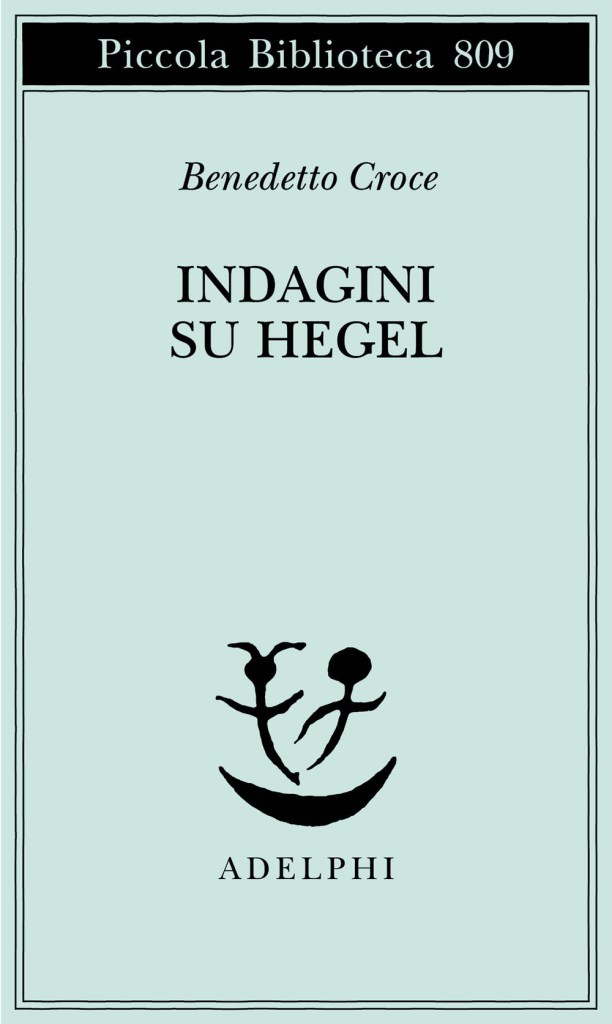
In Indagini su Hegel (Investigations on Hegel), Benedetto Croce crafts a philosophical dialogue that transcends mere critique to explore the tensions and affinities between his own intellectual journey and that of Hegel. Centered on a fictional encounter between Hegel and a Neapolitan admirer, Francesco Sanseverino, Croce’s novella is a masterful blend of historical reflection and intimate self-examination. Written in 1948, in Croce’s final years, the work represents both a homage to Hegel’s philosophical grandeur and an unraveling of the ideological threads binding Croce’s intellectual legacy to his German forebear. This fictional Sanseverino becomes a ‘double’ for Croce, an interlocutor who, with youthful intensity, critiques Hegel’s system while probing questions that resonate with Croce’s lifelong inquiry into the relationship between philosophy, history, and the individual.
Sanseverino confronts Hegel on points where the unity of philosophy and history, central to Croce’s conception of ‘storicismo,’ seems compromised in Hegel’s doctrine. Hegel’s Philosophy of History, for example, is presented as over-reliant on a teleological schema that, to Sanseverino (and Croce), imposes theological scaffolding onto the vitality of historical processes, reducing the organic dialectic of thought and existence into a doctrinal narrative. Croce sees in Hegel’s systematic approach both an enlightening framework and a binding structure that restrains historical understanding from the openness that Croce believes genuine philosophy should achieve. Sanseverino’s objections mirror Croce’s disillusionment with interpretations of Hegel that see history as an immutable progression rather than a space of infinite creative potential.
The fictive encounter is both a theatrical performance and a serious meditation, framed as an ‘invective’—a lively discourse not merely between minds but between personalities embodying two distinct philosophical worlds. In choosing the form of the novella, Croce departs from the rigidity of academic critique, opting instead for a form that captures the paradoxes of philosophy as both a creative and destructive force. Here, Croce examines his early and late life side by side, invoking the vitality and self-doubt that define his existential reflection. Croce’s self-reflective engagement with Hegel underscores his belief that philosophy must perpetually grapple with its origins, a necessity sharpened by the ‘crises’ he felt deepened by his study of Hegel.
Croce’s novella is thus a double-layered self-portrait, both an exploration of his youth and a testament to his older self. At its basis is the revelation of an enduring tension between Croce’s view of progress, which emphasizes the role of practical reason in human affairs, and Hegel’s absolute idealism. Sanseverino’s speech to Hegel illuminates Croce’s deep respect for his mentor’s intellectual contributions, yet he warns against the dangers of a philosophy that risks elevating its dialectical structure over the fluid, lived experience of history. It is, for Croce, a cautionary tale of the vulnerability of reason and philosophy to institutionalization—a warning against letting philosophy itself become ‘static,’ crystallized by rigid categorizations or metaphysical finalities.
This duality of reverence and critique reveals Croce’s philosophical project as a self-proclaimed ‘storicismo assoluto,’ where philosophy is indistinguishable from history—a ‘logic of history’ that serves as an ongoing clarificatory process rather than a closed system. For Croce, philosophy cannot exist as an isolated domain but must engage with the concrete realities of human experience, making it a continuous act of interpretation and re-interpretation. Hegel’s systematic structures are thus challenged by Croce’s commitment to an organic, open-ended process of understanding, one that acknowledges both human finitude and the limitless horizons of historical inquiry.
Croce’s text reflects his own philosophical evolution and the crises that marked his thought in the years following World War II. He rejects existentialism, viewing it as a form of irrationalism, even as he acknowledges the ‘malattia’—the sickness or crisis—that drives philosophy. He positions Hegel as both a companion and a challenge, one who must be engaged in a dialogue that stretches across generations and ideologies, addressing the ‘real time of philosophy.’ As Croce draws upon Hegel’s insights, he also liberates himself from Hegel’s limitations, seeking a more flexible and historically sensitive interpretation of dialectics.
In Indagini su Hegel, Croce establishes a legacy of ‘philosophy as autobiography,’ reflecting a life spent in service to ideas that are simultaneously personal and universal. This complex, layered work thus serves as both Croce’s tribute and his philosophical testament, a final reckoning with the master who helped him ‘find himself’ in thought, even as he fought to free himself from the confines of Hegel’s legacy.
 Simon Gros
Leave a comment