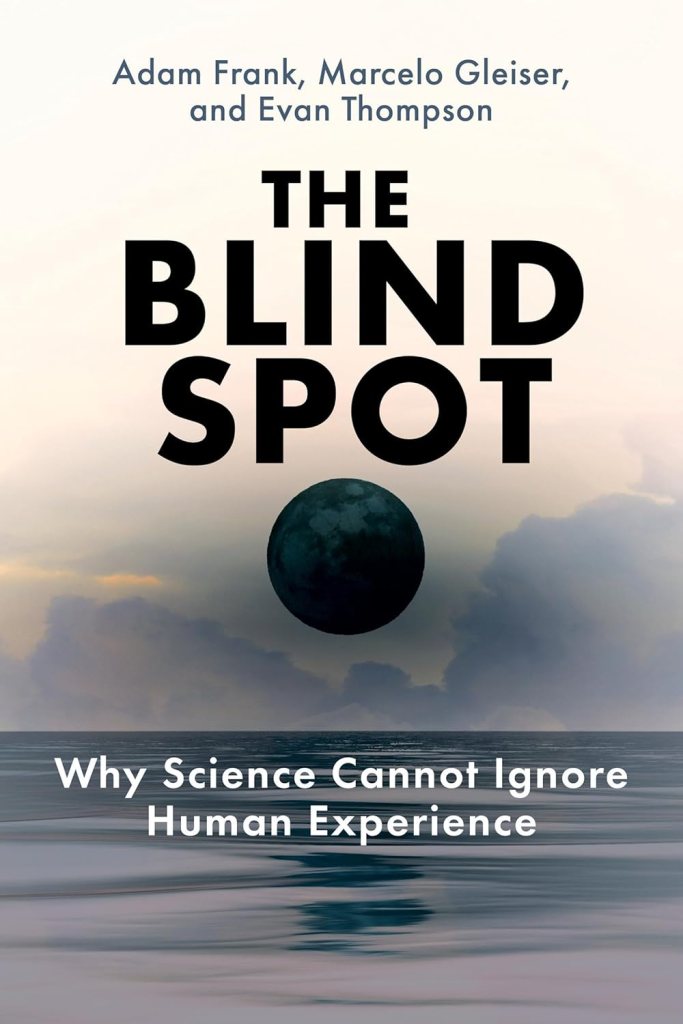
The Blind Spot: Why Science Cannot Ignore Human Experience is an exploration of the intrinsic relationship between human experience and the scientific endeavor. Authored by astrophysicist Adam Frank, theoretical physicist Marcelo Gleiser, and philosopher Evan Thompson, this work presents a compelling argument for the integration of the human perspective within science, asserting that human experience is not merely an adjunct but a fundamental component that makes science possible.
At the heart of the book lies the assertion that modern science, in its pursuit of objective truth, has developed a “Blind Spot”—a critical oversight where the role of direct human experience is neglected or actively excluded. The authors contend that since the Enlightenment, science has increasingly aspired to provide a God’s-eye view of reality, one that assumes an external position outside the universe it seeks to understand. This aspiration has led to a worldview where nature is perceived solely through external physical entities, imagined from an impossible outside perspective, thereby losing sight of the necessity and centrality of human experience.
The authors unravel how this Blind Spot manifests across various domains of scientific inquiry. In cosmology, it surfaces in the conundrums surrounding time and the origin of the universe, where the human observer is paradoxically both central and peripheral. Quantum physics grapples with the measurement problem and the role of the observer, highlighting the inseparability of the observer from the observed. In the biological sciences, the mysteries of life and sentience remain elusive, as attempts to understand life solely through reductionist approaches fail to capture the richness of lived experience. Cognitive neuroscience faces the “hard problem” of consciousness, struggling to explain subjective experience in purely objective terms.
Throughout the book, Frank, Gleiser, and Thompson advocate for a revolutionary scientific worldview that embraces human experience as an inescapable part of the quest for knowledge. They argue that scientific knowledge is not a collection of absolute truths but a self-correcting narrative, evolving through the interplay between the world and our experience of it. This perspective challenges the notion of science as a detached observer of an external reality, proposing instead that we are both an expression of nature and a source of nature’s self-understanding.
The authors trace the philosophical origins of the Blind Spot to the bifurcation of nature, a concept introduced by Alfred North Whitehead, which distinguishes between the objective reality of external physical entities and the subjective appearances perceived by the observer. This bifurcation leads to the fallacy of misplaced concreteness, where abstractions and mathematical models are mistakenly treated as the ultimate reality, while direct human experience is relegated to mere illusion or epiphenomenon.
Drawing on the works of philosophers such as Edmund Husserl and Maurice Merleau-Ponty, the authors emphasize the primacy of direct experience. Husserl’s critique of the “surreptitious substitution” highlights how mathematical abstractions have been covertly elevated above the concrete realities they aim to describe, leading to a disconnection between scientific models and the lived world. Merleau-Ponty’s concept of the body as the “vehicle of being in the world” underscores the inseparability of perception and bodily experience, reinforcing the idea that awareness and subjectivity are fundamental to any understanding of reality.
The book goes into historical examples to illustrate how scientific concepts are rooted in human experience. The development of the concept of temperature serves as a parable for the Blind Spot. Initially grounded in the bodily sensations of hot and cold, the concept evolved through abstraction and mathematical formalization. Over time, the abstract notion of thermodynamic temperature, defined as the average kinetic energy of particles, was erroneously considered more fundamental than the direct experience of warmth or coldness. This shift exemplifies how the ascent into abstraction can lead to the neglect of the experiential foundations upon which scientific knowledge is built.
Frank, Gleiser, and Thompson argue that this neglect has deep implications, particularly in the context of the planetary climate crisis and the rise of science denialism. The disconnection between scientific knowledge and human experience contributes to a crisis of meaning, where science appears to render human life insignificant in the vast, indifferent cosmos, yet simultaneously shows that our human perspective is inescapable in the pursuit of knowledge. This paradox undermines our ability to address existential challenges, as it fosters a worldview where nature is seen merely as a resource to be controlled, rather than a dynamic system with which we are intimately connected.
The authors critique three prevalent but inadequate responses to this crisis of meaning. Scientific triumphalism doubles down on the supremacy of science, often dismissing the value of philosophy and overlooking the limitations inherent in scientific methodologies. Science denial and certain strands of postmodernism reject science’s capacity to establish truths about the world, leading to skepticism and the spread of disinformation. The new age movement, with its uncritical embrace of fringe science and pseudoscience, fails to offer a viable alternative, as it often misrepresents other cultural worldviews and lacks rigorous foundations.
Instead, the authors propose an alternative vision that calls for a new scientific culture—one that recognizes the interdependence of science and human experience. They advocate for a balanced perspective that acknowledges both the successes of science and the problems it has helped create. This perspective involves re-envisioning science not as a detached observer seeking absolute knowledge, but as a human endeavor intrinsically linked to the lived world.
The book emphasizes the importance of phenomenology, the philosophical study of structures of consciousness as experienced from the first-person point of view. By plumbing the depths of direct experience, the authors seek to bridge the gap between science and the life-world—the immediately given world of concrete things, situations, and human communities with their values and projects. They argue that scientific theories and experiments do not take us outside experience but rather enlarge and enrich it. For instance, while we cannot directly observe subatomic particles, we can infer their existence through indicative signs within controlled experimental settings, expanding our experiential understanding of the world.
The authors contend that acknowledging the Blind Spot and integrating human experience into scientific inquiry can lead to a more comprehensive understanding of reality. This approach has practical implications for how science is conducted and communicated. It challenges the reductionist and objectivist tendencies that dominate contemporary scientific thought, urging a reevaluation of the metaphysical assumptions that underpin scientific models and theories.
The Blind Spot urges the creation of a new scientific worldview that is responsive to the existential challenges of the twenty-first century. By recognizing ourselves as both observers and participants in the natural world, we can foster a scientific culture that is more attuned to the complexities of human experience and the interconnectedness of all phenomena.
The book has garnered significant acclaim, with Michael Pollan describing it as “by far the best book I’ve read this year,” highlighting its profound impact. Reviews from publications such as the Wall Street Journal and the Los Angeles Review of Books commend its stimulating and accessible approach to complex philosophical arguments. “Nature Physics” emphasizes the book’s potential to become a classic text, noting its power to challenge authority and orthodoxy in science.
In their collective expertise, Frank, Gleiser, and Thompson bring together perspectives from astrophysics, theoretical physics, and philosophy. Their interdisciplinary approach exemplifies the very integration of human experience and scientific inquiry that they advocate. By situating science within the broader context of human existence, they offer a vision of science that is not only more inclusive but also more capable of addressing the urgent challenges facing humanity.
The Blind Spot: Why Science Cannot Ignore Human Experience is a seminal work that critically examines the foundational assumptions of modern science. It exposes the limitations of a worldview that seeks to understand reality solely through abstraction and mathematical formalization, at the expense of direct human experience. By advocating for a science that recognizes the inseparability of observer and observed, the authors provide a transformative perspective that holds promise for the future of scientific inquiry and the flourishing of humanity in the new millennium.
 Simon Gros
Leave a comment