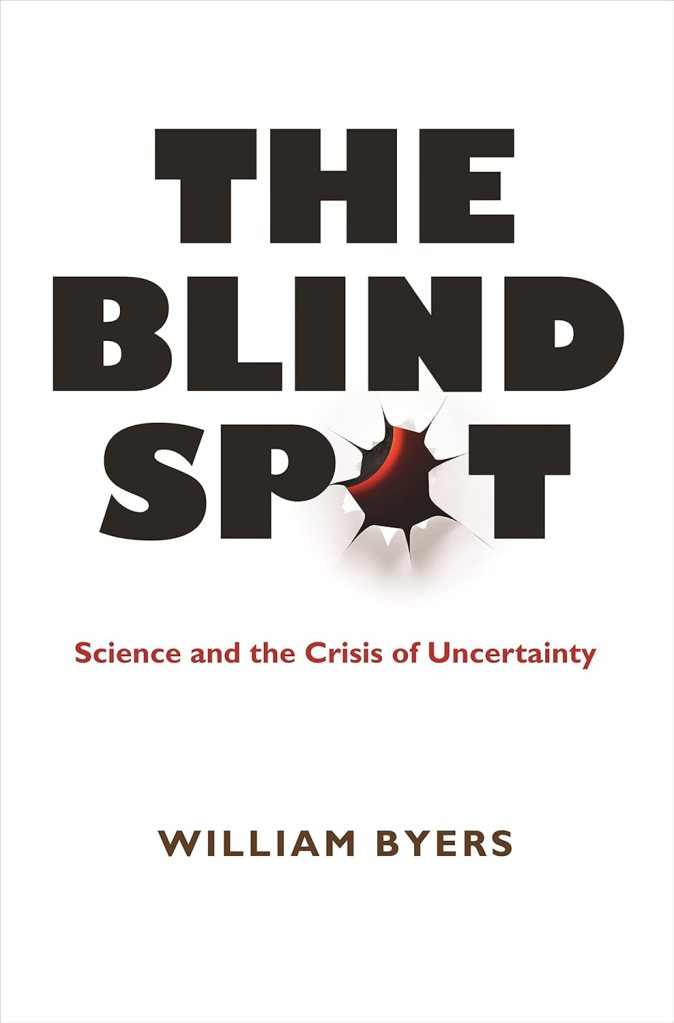
The Blind Spot: Science and the Crisis of Uncertainty by William Byers is an exposition of the inherent limitations within the scientific endeavor and the epistemological crises that arise from them. Byers goes into the paradoxes and uncertainties that have emerged in modern science and mathematics, challenging the long-held belief that science offers an objective, infallible account of reality. He posits that all human endeavors, including science, are embedded within contexts that supply meaning, and that the content of scientific theories often has great implications for our understanding of the nature of science itself and its role in society and culture.
Central to Byers’ thesis is the concept of the “blind spot” in science—the aspects of reality that elude the grasp of analytic intelligence and reason. This blind spot is not merely a gap in knowledge that can eventually be filled but represents fundamental limits to what can be known through scientific inquiry. Byers illustrates this through the work of mathematician Gregory Chaitin and his introduction of the Omega number (Ω), a real number that epitomizes irreducible complexity. Omega is defined as the probability that a randomly constructed, self-contained computer program will halt rather than run indefinitely. Remarkably, the precise value of Omega is incompressible; it cannot be simplified or predicted, and its decimal expansion lacks any discernible pattern.
Chaitin’s Omega serves as a metaphor for the mysteries that lie at the heart of mathematics and science. It embodies the tension between two interpretations: the optimistic view that celebrates the creativity and open-endedness of scientific exploration, and the pessimistic view that emphasizes the inherent limits of reason and the unattainability of complete knowledge. Byers uses this dichotomy to illustrate the two possible reactions to encountering the blind spot—either as a gateway to new realms of creativity or as a source of frustration due to the limitations it imposes on analytic thought.
Byers acknowledges that the recognition of such limits is deeply unsettling to the analytic mind, which prides itself on the ability to understand, predict, and control. The idea that there are aspects of reality that are fundamentally unknowable challenges the very foundations of a culture that venerates reason and scientific progress. This discomfort stems from the realization that the tools we rely on—logic, language, mathematical symbols—are inherently incomplete and incapable of capturing the totality of existence. The dream of reason, which aspires to map out a rational universe comprehensible in its entirety, is revealed to be an illusion that overlooks the richness and complexity of reality.
The author explores the limitations of language and abstraction in conveying the fullness of experience. He argues that while words and symbols are essential for communication and the development of scientific theories, they inevitably miss something vital—the immediate, unmediated encounter with reality that cannot be fully articulated. This is akin to the difference between reading a musical score and experiencing the music itself; the notation is not the music, just as scientific descriptions are not the phenomena they describe.
Byers draws on insights from neuroscience to discuss the roles of the brain’s hemispheres in shaping our understanding. The left hemisphere, associated with language and analytic thought, dominates scientific discourse, while the right hemisphere, which processes information in a holistic and non-verbal manner, remains underrepresented. This imbalance leads to an overemphasis on objective analysis at the expense of subjective experience. Byers suggests that acknowledging and integrating the contributions of both hemispheres can lead to a more comprehensive understanding of reality.
The author emphasizes the importance of introspection and contemplation as means of accessing the dimensions of reality that lie beyond analytic reasoning. He references physicist Arthur Zajonc’s notion that careful and sustained attention to phenomena can transform the observer, opening up new capacities for perception and understanding. This contemplative approach values the subjective participation of the scientist in the act of discovery, recognizing that personal experience and consciousness are integral to the process of knowing.
Byers provides a historical perspective on how uncertainty has infiltrated mathematics, the traditional stronghold of certainty and exactness. He discusses the advent of non-Euclidean geometries, which undermined the long-held belief in the absolute truth of Euclidean geometry. The discovery that alternative geometrical systems were logically consistent and equally valid challenged the notion that mathematical truths were universal and immutable. Geometry shifted from being seen as a direct reflection of physical reality to being understood as a collection of models, each with its own set of axioms and applicable contexts.
The goes into the efforts of mathematicians like David Hilbert to restore certainty through the development of formal logical systems and axiomatic methods. While these initiatives sought to provide a secure foundation for mathematics by grounding it in pure logic, they ultimately exposed deeper uncertainties. The emergence of paradoxes and the realization that certain truths could not be proven within the system—most notably demonstrated by Kurt Gödel’s incompleteness theorems—highlighted the intrinsic limitations of formal reasoning.
Byers also discusses the arithmetization of calculus and the introduction of the real number system as significant milestones that, while advancing mathematical rigor, unveiled new complexities and uncertainties. The work of Georg Cantor on the properties of real numbers and the concept of different infinities revealed paradoxes that challenged the completeness and consistency of mathematical systems. These developments illustrated that even in mathematics, there are truths that transcend formal proof and that certainty is elusive.
Throughout the book, Byers advocates for a paradigm shift in how we approach science and knowledge. He argues that embracing uncertainty and recognizing the blind spot can lead to a more nuanced and authentic engagement with reality. By letting go of the quest for absolute certainty and control, we open ourselves to creativity, wonder, and the possibility of new insights that emerge from the interplay between the known and the unknowable.
Byers’ exploration extends beyond the realm of science and mathematics, touching on philosophical and cultural implications. He critiques the dominant narrative that equates progress with the accumulation of knowledge and the expansion of control over nature. This narrative, he suggests, has led to a disconnection from the deeper aspects of existence and a failure to appreciate the limits of our understanding. By acknowledging the blind spot, we can cultivate humility and openness, fostering a more balanced relationship with the world.
In The Blind Spot: Science and the Crisis of Uncertainty, William Byers offers a compelling examination of the limitations inherent in scientific and mathematical endeavors. His insightful analysis challenges readers to reconsider the role of reason and to appreciate the profound mysteries that lie beyond the reach of analytic thought. By integrating perspectives from mathematics, physics, philosophy, and neuroscience, Byers presents a rich and nuanced account of the crisis of uncertainty. His work invites us to embrace the complexity of reality and to recognize that uncertainty is not a deficit to be overcome but an essential aspect of the human experience that can lead to deeper understanding and creativity.
 Simon Gros
Leave a comment