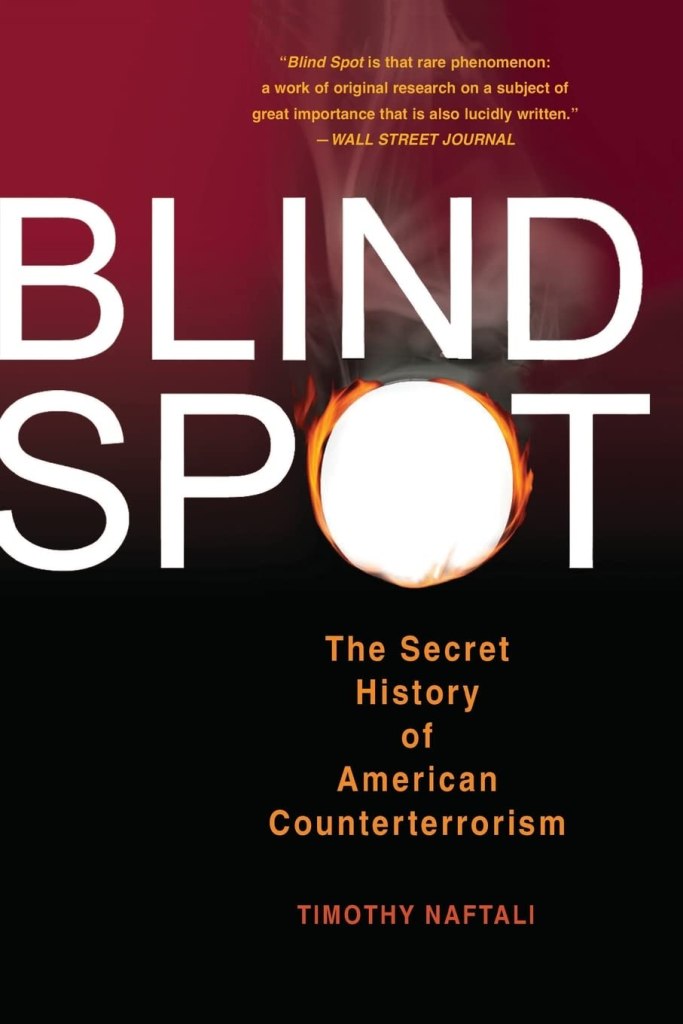
Blind Spot: The Secret History of American Counterterrorism by Timothy Naftali is a presentation of the often tumultuous history of the United States’ efforts to combat terrorism from the aftermath of World War II up to the harrowing events of September 11, 2001. Naftali, a distinguished national security historian, goes deep into the clandestine world of intelligence and counterintelligence, unearthing a narrative that is as revelatory as it is unsettling.
At the core of Naftali’s thesis is the paradox of an open, liberal democracy grappling with the shadowy and ruthless nature of terrorism. He posits that the very principles that define the United States—freedom, transparency, and adherence to the rule of law—also render it inherently vulnerable to asymmetric threats posed by non-state actors and clandestine organizations. This vulnerability is not merely a product of policy failures or administrative oversights but is rooted in the philosophical and structural fabric of democratic governance.
Naftali begins by revisiting the immediate post-World War II era, highlighting the sophisticated counterintelligence capabilities of the Office of Strategic Services’ “X-2” department. This unit had effectively countered threats from die-hard Nazi elements, establishing a seamless system that could have been a robust foundation for future counterterrorism efforts. However, with the dissolution of the OSS and the transition to peacetime priorities, these capabilities were neglected and eventually forgotten. This oversight created a vacuum that left the nation ill-prepared for the emerging threats of the latter half of the 20th century.
The narrative then shifts to the late 1960s, a period marked by the rise of Palestinian militant groups and a series of highly publicized airplane hijackings. These events served as a rude awakening for the United States, signaling the advent of international terrorism as a persistent and escalating threat. Naftali chronicles how successive administrations, from Nixon to Reagan, engaged in a perpetual game of “catch-up,” often responding to crises with ad hoc measures rather than developing a cohesive and proactive counterterrorism strategy.
One of the pivotal moments explored in the book is the 1972 Munich Olympic massacre, where Palestinian terrorists took Israeli athletes hostage, leading to a tragic and violent outcome. Naftali goes into the U.S. government’s response to this event, revealing a complex interplay of political calculations, intelligence assessments, and diplomatic constraints. The incident not only exposed the limitations of existing counterterrorism measures but also underscored the challenges of coordinating international responses to such crises.
Throughout the book, Naftali provides a detailed examination of internal government deliberations, drawing upon a wealth of primary sources, including presidential tapes, CIA communications, and National Security Council minutes. This approach lends authenticity and depth to his analysis, allowing readers to gain insight into the thought processes of key decision-makers. For instance, he explores President Nixon’s conflicted reactions to terrorist incidents, torn between public outrage, diplomatic considerations, and concerns about domestic political fallout.
Naftali also addresses the systemic issues that have plagued U.S. counterterrorism efforts. He highlights the bureaucratic rivalries between agencies like the CIA, FBI, and State Department, which often resulted in fragmented and inefficient responses to emerging threats. The lack of a centralized coordinating body and the absence of a unified strategy meant that valuable intelligence was not always shared effectively, and opportunities to prevent attacks were missed.
A significant portion of the book is dedicated to the examination of policy decisions and their long-term implications. Naftali critiques the reactive nature of U.S. counterterrorism policies, which frequently prioritized immediate tactical responses over the development of a strategic framework. He discusses the establishment of the Cabinet Committee to Combat Terrorism under Nixon, noting how it was initially conceived as a symbolic gesture rather than a substantive initiative, reflecting the administration’s ambivalence toward the issue.
The author does not shy away from controversial assertions, such as his critique of the “no concessions” policy adopted by the U.S. government following high-profile terrorist incidents. Naftali argues that while this stance was morally unambiguous and politically expedient, it often failed to consider the complex realities on the ground and, in some cases, may have exacerbated situations, leading to tragic outcomes.
One of the most compelling aspects of Naftali’s work is his exploration of the inherent tension between civil liberties and national security. He goes into the philosophical dilemmas faced by democratic societies when confronting threats that operate outside the bounds of conventional warfare and legal frameworks. The book raises critical questions about the sacrifices that societies are willing to make in the name of security and the potential erosion of the very freedoms that are being defended.
Naftali extends his analysis into the late 20th century, examining incidents such as the 1993 World Trade Center bombing and the persistent vulnerabilities that these events revealed. He underscores the continuity of certain security lapses, noting that issues identified during the Reagan administration remained unaddressed into the presidency of George W. Bush. This persistence of blind spots suggests a deeper systemic failure rather than isolated oversights.
The book has garnered significant praise from scholars and policymakers alike. Critics have lauded Naftali for his unbiased scholarship and research, noting that his work transcends partisan perspectives and provides a comprehensive understanding of the challenges faced by the United States. His ability to combine detailed archival material with broader analytical insights makes the book both informative and thought-provoking.
In Blind Spot, Naftali offers more than a historical account; he presents a cautionary tale about the consequences of neglecting the lessons of the past. He challenges readers to consider how a nation can effectively defend itself against threats that exploit its own values and principles. The book serves as a reminder that counterterrorism is not merely a tactical endeavor but a complex interplay of strategy, policy, philosophy, and ethics.
Naftali’s work compels readers to reflect on the fundamental question of whether an open society can reconcile the demands of security with the preservation of its core values. Blind Spot is a seminal contribution to the discourse on national security, offering valuable insights for policymakers, scholars, and citizens concerned about the future of American democracy and its ability to confront the evolving challenges of terrorism.
 Simon Gros
Leave a comment