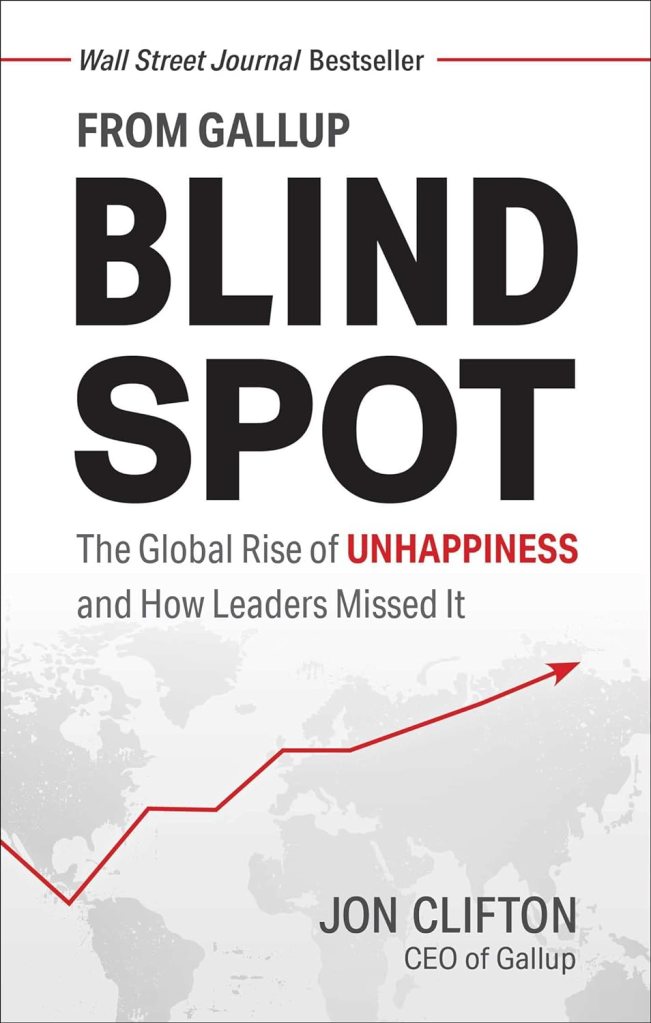
Blind Spot: The Global Rise of Unhappiness and How Leaders Missed It by Jon Clifton is an analysis of a critical yet overlooked phenomenon shaping the contemporary world: the escalating unhappiness among global citizens and the consequential blind spot that has afflicted world leaders. Clifton, the CEO of Gallup and a visionary dedicated to amplifying the voices of seven billion people through the Gallup World Poll, goes into a decade-long surge in global unhappiness that has eluded the attention of policymakers and leaders alike.
At the heart of Clifton’s thesis is the assertion that while traditional economic indicators like GDP and unemployment rates have been the focal point of governmental assessment, they fail to capture the true state of citizens’ wellbeing. This myopic focus on quantitative economic metrics has led leaders to overlook the qualitative aspects of life that define happiness and life satisfaction. The implications of this oversight are not merely academic but have manifested in tangible political and social upheavals across the globe.
Clifton examines pivotal events such as the Arab uprisings, Brexit, and the election of Donald Trump, positing that these were not sudden anomalies but the culmination of festering discontent and declining wellbeing among populations. He suggests that these events caught leaders off guard precisely because they were not attuned to the undercurrents of unhappiness brewing beneath the surface of seemingly stable economic indicators.
Drawing on Gallup’s extensive global research, Clifton makes an urgent case for the necessity of measuring and quantifying wellbeing and happiness as essential components of governance. He argues that understanding how citizens perceive their lives is crucial for effective leadership and policy-making. By neglecting these measures, leaders risk being blindsided by the very populations they aim to serve, leading to destabilization and loss of trust in institutions.
In a compelling analysis of the 1980 U.S. presidential election, Clifton revisits Ronald Reagan’s poignant question to the American electorate: “Are you better off than you were four years ago?” This question, he argues, transcends mere economic status and taps into the wider assessment of individual wellbeing. Reagan’s landslide victory, Clifton suggests, was a reflection of the electorate’s dissatisfaction with their quality of life, despite economic indicators that might have suggested stability.
The book goes deeply into the Brexit referendum as a case study of this phenomenon. Despite the United Kingdom experiencing economic growth, low unemployment rates, and high rankings on the Human Development Index, the majority voted to leave the European Union. Clifton reveals that in the years leading up to the referendum, Gallup recorded a significant decline in the percentage of Britons who were “thriving.” This decline in subjective wellbeing, he argues, was a critical factor that traditional economic metrics failed to capture.
Clifton challenges the assumption that economic prosperity equates to public contentment. He highlights that although the UK economy was expanding, the benefits were not uniformly felt across the population. Issues such as immigration, loss of sovereignty, and cultural changes contributed to a sense of unease and declining quality of life for many Britons. This dissonance between economic indicators and personal wellbeing underscores the central thesis of the book: leaders are missing the fundamental human elements that drive societal satisfaction and political behavior.
The analysis extends to the 2016 U.S. presidential election, where Clifton observes that national wellbeing trends upwardly masked localized declines in life satisfaction. Counties that swung heavily toward Donald Trump were often those where residents reported lower levels of wellbeing. This pattern suggests that aggregated national data can conceal significant regional disparities, leading to misinterpretations of the public mood.
Clifton emphasizes that politics itself can exacerbate feelings of unhappiness. He cites research indicating that merely prompting individuals to think about politics can lower their assessments of their own lives. This insight adds a layer of complexity to the relationship between wellbeing and political outcomes, suggesting that the political climate can both reflect and influence public happiness.
The book also references the work of behavioral scientist George Ward, who found that happiness measures are strong predictors of the electoral fortunes of governing parties in Europe. Clifton uses this to bolster his argument that subjective wellbeing is a vital metric for understanding and anticipating political shifts. He contends that while economic indicators remain important, they are insufficient on their own to capture the nuances of public sentiment.
Throughout Blind Spot, Clifton advocates for the inclusion of five key elements of a great life in policy considerations: career wellbeing, social wellbeing, financial wellbeing, physical wellbeing, and community wellbeing. He argues that improvements in these areas are essential for enhancing the lives of people everywhere. By focusing on these elements, leaders can develop a more comprehensive understanding of their citizens’ needs and craft policies that address the root causes of unhappiness.
Clifton’s own mission, as outlined in his professional endeavors, aligns with the book’s message. His leadership at Gallup and his commitment to the Gallup World Poll reflect a dedication to capturing the voices of individuals worldwide. His background, including his education at the University of Michigan and the University of Nebraska, and his honorary doctorate from Midland University, contribute to his credibility and depth of understanding on these issues.
Blind Spot serves as a clarion call for leaders to recalibrate their metrics of success. Clifton compellingly argues that without incorporating measures of wellbeing and happiness, leaders will continue to be blindsided by events that, in hindsight, seem inevitable. The book challenges conventional wisdom, urging a shift from an exclusive focus on economic indicators to a wider approach that values the lived experiences of individuals. It is a timely and essential read for policymakers, scholars, and anyone interested in understanding the underpinnings of global unrest and the path toward a more contented and stable society.
 Simon Gros
Leave a comment