


The Artificial Intelligence and Symbolic Computation series represents a look through the evolving landscape of computational intelligence and symbolic reasoning over the course of several decades. This collection of nine volumes encapsulates the proceedings of nine international conferences, each serving as a milestone in the convergence of artificial intelligence (AI) and symbolic mathematical computation. The series shows the interdisciplinary synergy that has progressively unified these once distinct fields, highlighting the rich interplay between algorithmic logic and symbolic reasoning.
The initial volumes emerged at a time when AI and mathematics seemed to have charted separate courses, yet these conferences rekindled the dialogue between them. The second conference, held in Cambridge, UK, in August 1994, marked a pivotal moment where revised and thoroughly vetted papers showcased how the two disciplines were beginning to interweave once more. Nineteen papers from this conference illuminated the burgeoning interactions between mathematical computation and AI, setting the stage for future explorations that would further unify the field.
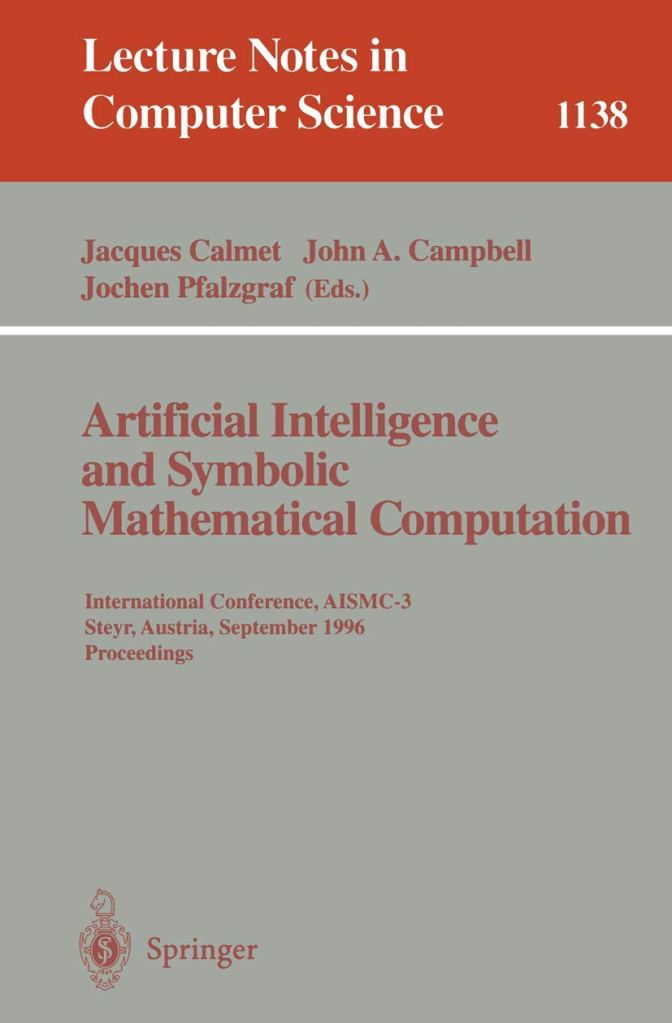
As the series progressed, the third conference in Steyr, Austria, in September 1996, continued to build on this foundation. The proceedings featured nineteen carefully selected papers alongside invited contributions from notable scholars. The topics addressed ranged from theorem proving and rewriting systems to spatial reasoning and automated deduction. This diversity underscored the expanding horizons of AI and symbolic computation, revealing the depth and breadth of research that was bridging gaps between theoretical and applied aspects of the disciplines.
The 1998 conference in Plattsburgh, New York, marked another significant expansion of the series. Twenty-four revised papers delved into various aspects of symbolic computation and formal reasoning, including inductive logic programming, context reasoning, and knowledge discovery. This volume emphasized the growing importance of integrating AI with formal methods and computational logic, reflecting a broader trend in the field towards embracing complexity and interdisciplinarity.
By the time of the fifth conference in Madrid, Spain, in July 2000, the series had firmly established itself as a central forum for scholars interested in the convergence of AI and symbolic computation. The Madrid conference was notable not only for its academic contributions but also for fostering a vibrant community through its organization. The choice to centralize activities in one location facilitated continuous interaction among attendees, promoting both formal and informal exchanges of ideas. This approach reinforced the conference’s reputation for creating a congenial atmosphere conducive to collaborative exploration.
The sixth conference, held jointly with Calculemus 2002 in Marseille, France, in July 2002, reflected a strategic alignment with related fields. The collaboration with Calculemus, a symposium focused on the integration of symbolic computation and mechanized reasoning, highlighted the interconnectedness of AI with other domains such as automated deduction. This joint event underscored the importance of looking at symbolic computation from multiple perspectives, enriching the discourse and fostering cross-pollination of ideas.
Continuing this trajectory, the seventh conference in Linz, Austria, in September 2004, demonstrated the health and vitality of the field. Despite a noticeable mathematical inclination in the distribution of papers, the conference maintained its commitment to the full spectrum of AI and symbolic computation. The organizers’ openness to diverse topics ensured that the conference remained relevant and forward-looking, encouraging researchers from all areas to contribute to the evolving dialogue.
The eighth conference in Beijing, China, in September 2006, further cemented the global reach of the series. The proceedings included a mix of invited and contributed papers, organized into themes such as artificial intelligence and theorem proving, symbolic computation, and mathematical knowledge management. The inclusion of applications in both industry and academia highlighted the practical implications of the research, demonstrating how theoretical advancements were translating into real-world solutions.
A significant leap occurred by the twelfth conference in Seville, Spain, in December 2014. The proceedings reflected a maturation of the field, with papers binding mathematical domains like algebraic topology and algebraic geometry to AI. There was also a conscious effort to link AI to domains beyond pure algorithmic computing. The topics covered spanned computability, non-classical logics, reasoning, learning, decision support systems, and the philosophy of symbolic mathematical computing. This breadth indicated a inclusive approach to understanding intelligence, both artificial and symbolic, in a broader epistemological context.
The thirteenth conference in Suzhou, China, in September 2018, continued to serve as an essential forum for showcasing ideas at the intersection of traditional AI and emerging areas like probabilistic reasoning and deep learning. The proceedings included full papers, short papers, and invited talks, reflecting a vibrant and dynamic field. The conference underscored the importance of ensuring that insights from traditional AI were not lost amid the rapid advancements in new subfields. Instead, it promoted the idea that foundational theories and methods could inform and enhance cutting-edge research.
Throughout the series, several recurring themes and developments can be discerned. There has been a persistent emphasis on theorem proving, rewriting systems, and formal verification, indicating a sustained interest in the logical underpinnings of AI and symbolic computation. Concurrently, there has been an expansion into areas like constraint solving, knowledge discovery, and machine intelligence, reflecting the field’s responsiveness to new challenges and technologies.
The conferences have also played a crucial role in fostering communities of scholars and practitioners. By facilitating continuous interactions among attendees, often in immersive environments, the organizers have promoted a culture of collaboration and openness. This approach has not only advanced academic discourse but has also led to practical applications in industry and academia, demonstrating the tangible impact of the research presented.
Moreover, the series has been instrumental in bridging gaps between different areas of AI. By integrating symbolic computation with areas like probabilistic reasoning and deep learning, the conferences have helped to create a more unified understanding of artificial intelligence. This integration is particularly important in an era where AI is becoming increasingly ubiquitous, and where interdisciplinary approaches are essential for tackling complex problems.
In reflecting on the Artificial Intelligence and Symbolic Computation series, it becomes evident that the conferences have significantly contributed to the evolution of computational intelligence. They have provided platforms for introducing new ideas, debating theoretical foundations, and showcasing practical applications. The series has also highlighted the importance of revisiting and reinvigorating connections between AI and mathematics, demonstrating that their integration can lead to fruitful interdisciplinary activities.
Looking forward, the legacy of these conferences suggests a continued trajectory of growth and integration. As AI continues to evolve, the foundational work captured in these volumes will remain relevant, offering insights into how symbolic reasoning and computational logic can inform and enhance emerging technologies. The series stands not only as a historical record but also as a source of inspiration for future research, emphasizing the enduring importance of collaboration across disciplines in the pursuit of knowledge and innovation.
 Simon Gros
Leave a comment