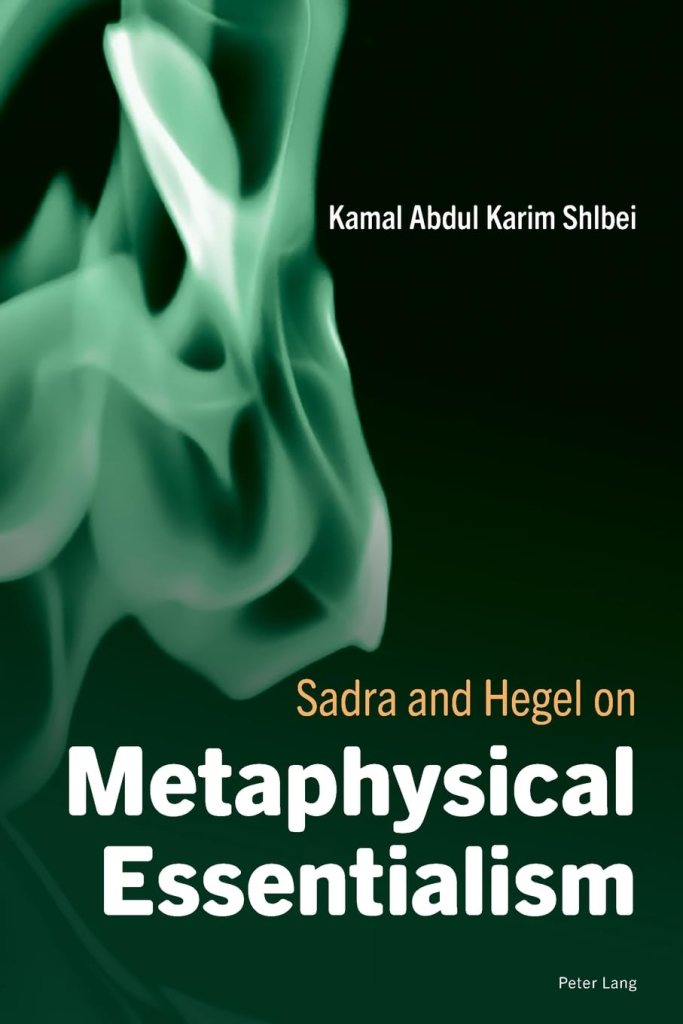
Sadra and Hegel on Metaphysical Essentialism by Kamal Abdul Karim Shlbei is a comparative study that examines and compares the philosophies of Mulla Sadra, a pivotal figure in Islamic philosophy, and Georg Wilhelm Friedrich Hegel, a cornerstone of Western philosophical thought. The book presents the accounts of the relationship between essence and existence as represented by both thinkers, revealing a rich dialogue between Eastern and Western metaphysical traditions.
Shlbei situates Mulla Sadra’s philosophy within the broader context of Hegel’s Lectures on the History of Philosophy. This positioning raises two interrelated challenges: the historical period of Sadra’s work and the philosophical themes he addresses. Sadra, whose philosophical activity peaked in the seventeenth century, does not neatly fit into Hegel’s historical divisions, particularly since Hegel’s classification places significant emphasis on the transition to modern philosophy through figures like Francis Bacon and Jacob Boehme. Moreover, Sadra’s philosophical concerns, especially the relationship between essence and existence in relation to God, align more closely with medieval philosophical problems, creating a temporal dissonance within Hegel’s framework.
Complicating matters further is Sadra’s ethnic and linguistic identity. Although ethnically Persian, Sadra wrote predominantly in Arabic, and Hegel’s lectures engage with Arabic philosophy only tangentially, treating it as an external component within the Christian-centric narrative of medieval philosophy. This peripheral treatment leaves Sadra without a clear philosophical locus in Hegel’s historiography, prompting Shlbei to seek a more nuanced approximation of Sadra’s thought within Hegel’s logical principles.
Shlbei’s analyses Hegel’s assertion that the evolution of philosophy involves the sublation of previous determinate principles—a process where earlier philosophical positions are both negated and preserved as ideal moments within a more comprehensive system. Hegel posits that while philosophies are refuted in their restrictive boundaries, they are simultaneously affirmed in their contributions to the unfolding of absolute truth. In this light, Sadra’s metaphysical existentialism, which emphasizes the primacy of existence over essence, can be viewed as a moment within Hegel’s dialectical progression, representing a sublation of prior metaphysical essentialism prevalent in both Western and Eastern traditions.
Shlbei examines Sadra’s critique of metaphysical essentialism, particularly his departure from the Platonic and Aristotelian traditions that privilege essence as the foundational correspondence to truth. In Sadra’s view, essence, when considered in itself, is tantamount to nothingness—an absence devoid of real existence. Existence, conversely, is the qualitative differential principle of truth, the concrete actuality that imparts reality to beings. Sadra’s philosophy thus represents a significant shift from the abstract universals of essence to the concrete particulars of existence, challenging the established metaphysical paradigms.
Parallel to Sadra’s critique, Hegel’s engagement with metaphysical essentialism involves a reconfiguration of the Platonic and Aristotelian notions of essence. Hegel interprets essence not as a static, abstract universal but as a dynamic, self-negating process that unfolds through dialectical movement. Essence, for Hegel, is a negative dynamicity containing mediation within itself—a conception that aligns with his broader logical framework where being and nothingness are reconciled through becoming.
Shlbei highlights that while both Sadra and Hegel reject the static abstraction of essence as the ultimate truth, they diverge in their resolutions. Sadra’s metaphysics culminates in the notion of the Spreading Existence—a manifestation of the Absolute that embodies both unity and multiplicity. This Spreading Existence serves as a bridge between the unknowable Absolute and the relative existents, allowing for a mystical intellectual intuition wherein unity and multiplicity coexist without contradiction. For Sadra, true knowledge transcends the limitations of sensory perception and rational understanding, requiring an intellectual-mystical intuition that grasitates the unity-in-multiplicity and multiplicity-in-unity of existence.
Hegel, on the other hand, situates essence within the realm of dialectical logic, emphasizing its role in the self-determination of the Absolute. He critiques the one-sidedness of views that prioritize either essence or existence without recognizing their interdependence and mutual sublation within the movement of the Concept (Begriff). In Hegel’s system, the Absolute is not an unknowable beyond but the result of a process wherein essence actualizes itself through self-negation and returns to itself enriched. This dialectical unfolding is absent in Sadra’s framework, where the Absolute remains ultimately unknowable, accessible only through mystical intuition rather than rational comprehension.
Shlbei’s exploration extends to the relationship between knowledge and existence in both philosophies. Sadra posits that the cognizing soul actively creates cognitive forms, with knowledge unfolding in tandem with the unfolding of existence. This process involves a substantial motion (al-harakat al-jawhariyya) wherein the soul ascends through stages of sensation, understanding, and intellectual-mystical intuition, each corresponding to higher degrees of existential realization. Knowledge, in this sense, is not a passive reception but an active, existential transformation of the soul.
Hegel similarly acknowledges the progression of consciousness through stages of sense-certainty, perception, understanding, and reason, as outlined in his Phenomenology of Spirit. However, Hegel’s emphasis is on the dialectical development of self-consciousness and the role of negation in propelling this movement. The ultimate aim is the attainment of Absolute Knowing, where subject and object are reconciled, and the self recognizes itself in the other—a culmination that contrasts with Sadra’s emphasis on the ineffable nature of the Absolute.
Throughout the book, Shlbei carefully navigates the complexities of comparing two philosophers from vastly different cultural and historical contexts. He acknowledges the challenges posed by linguistic nuances, particularly the Arabic term “wujud,” which carries connotations of both existence and finding, implicating consciousness and perception. This linguistic dimension enriches the analysis, highlighting the subtle differences in how existence and essence are conceptualized in Islamic and Western philosophies.
Shlbei also addresses potential criticisms of both philosophers. He notes that Sadra’s synthesis of unity and multiplicity, while innovative, faces internal contradictions. The Spreading Existence, meant to mediate between the Absolute and the relative, simultaneously preserves and complicates the distinction between unity and multiplicity. Similarly, Hegel’s system, while offering a comprehensive dialectical framework, may be critiqued for subsuming all particularities under the totalizing movement of the Absolute, potentially overlooking the irreducible aspects of individual existents.
Sadra and Hegel on Metaphysical Essentialism offers a rigorous examination of two monumental figures in philosophy, uncovering deep connections and fundamental divergences in their approaches to essence and existence. Shlbei’s work not only illuminates the different metaphysical landscapes of Sadra and Hegel but also contributes to the broader discourse on comparative philosophy, inviting readers to reconsider the boundaries between Eastern and Western thought. The book is a valuable resource for scholars of Hegel, Islamic philosophy, and those engaged in the quest to understand the universal questions that transcend cultural and historical divides.
 Simon Gros
Leave a comment